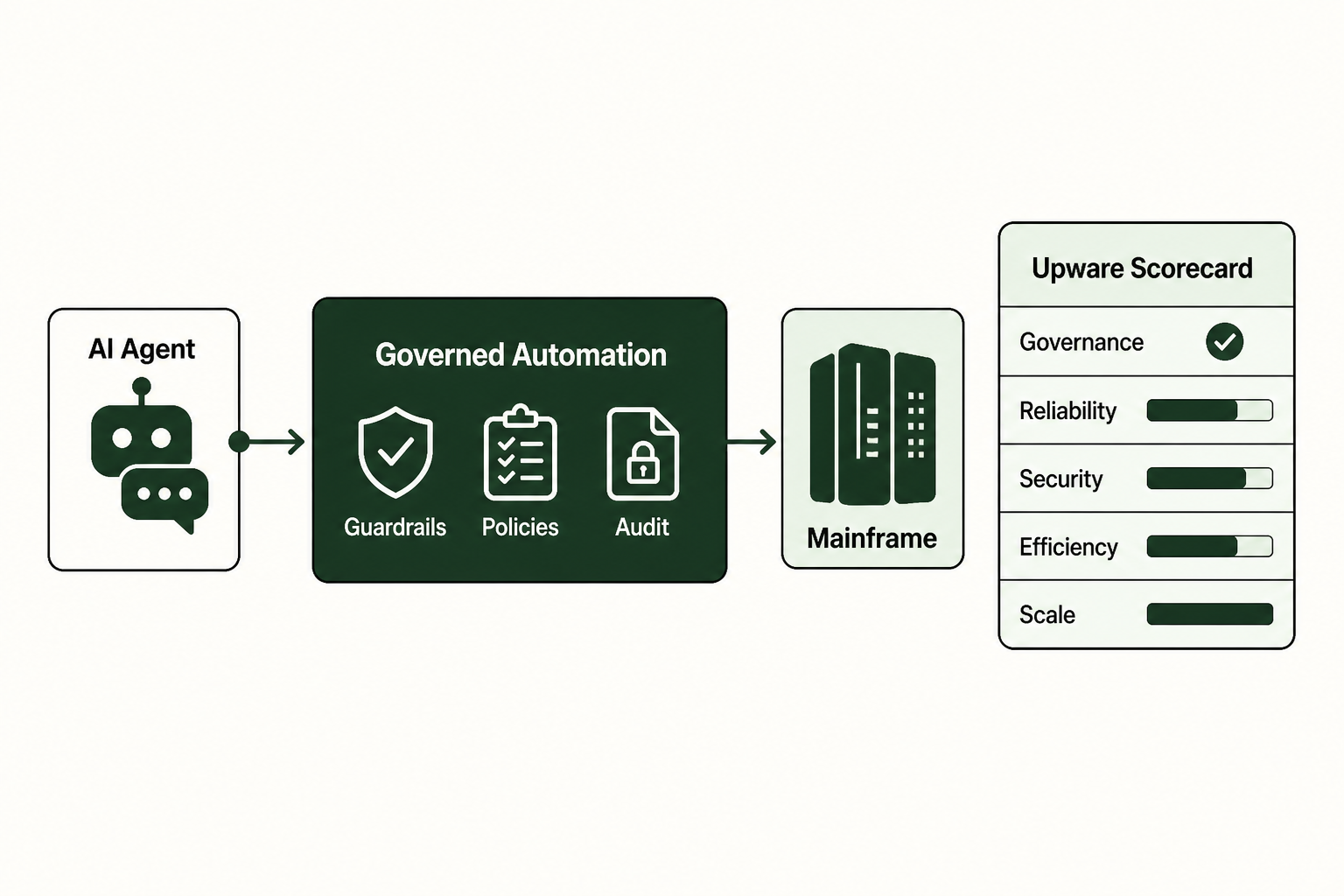
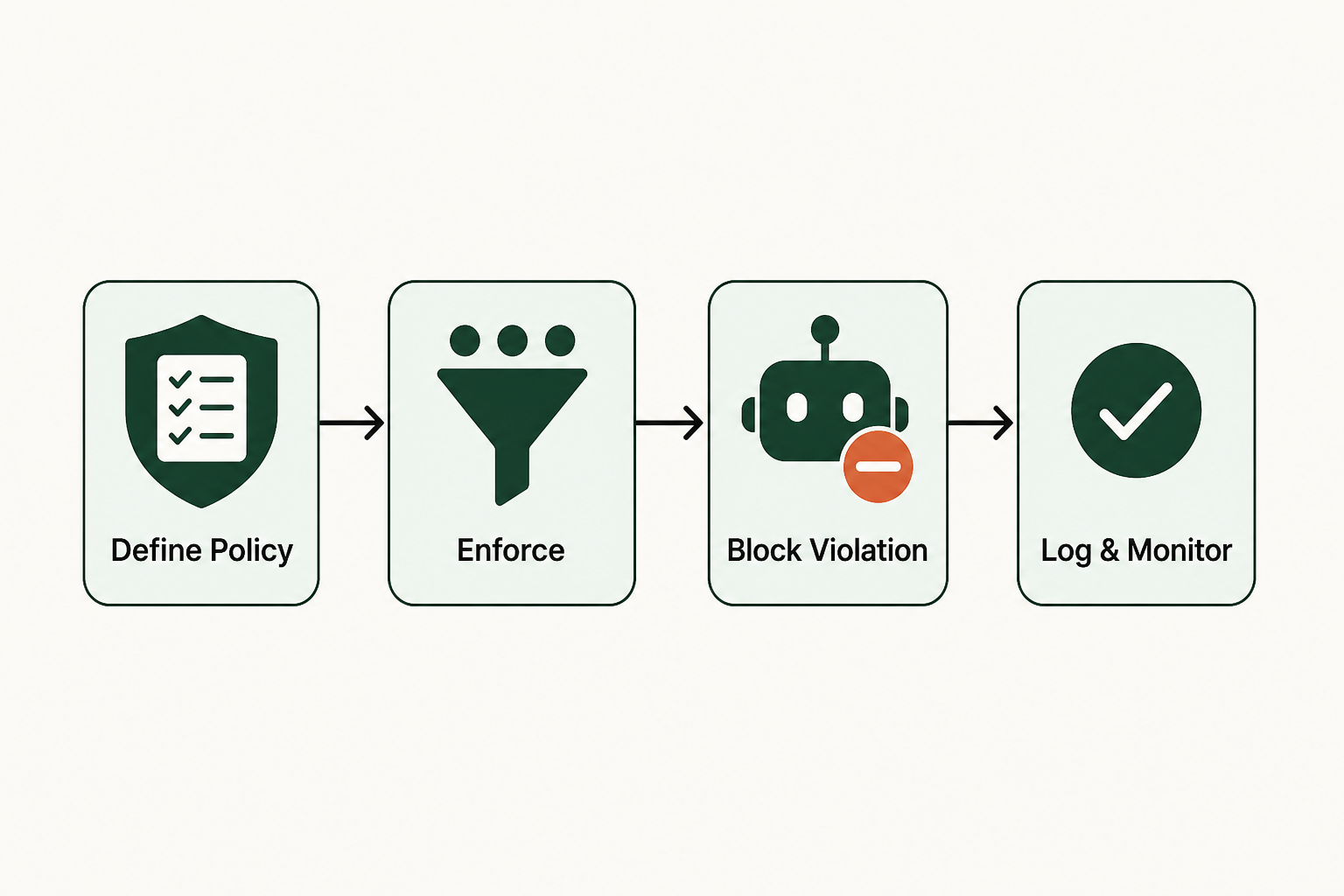
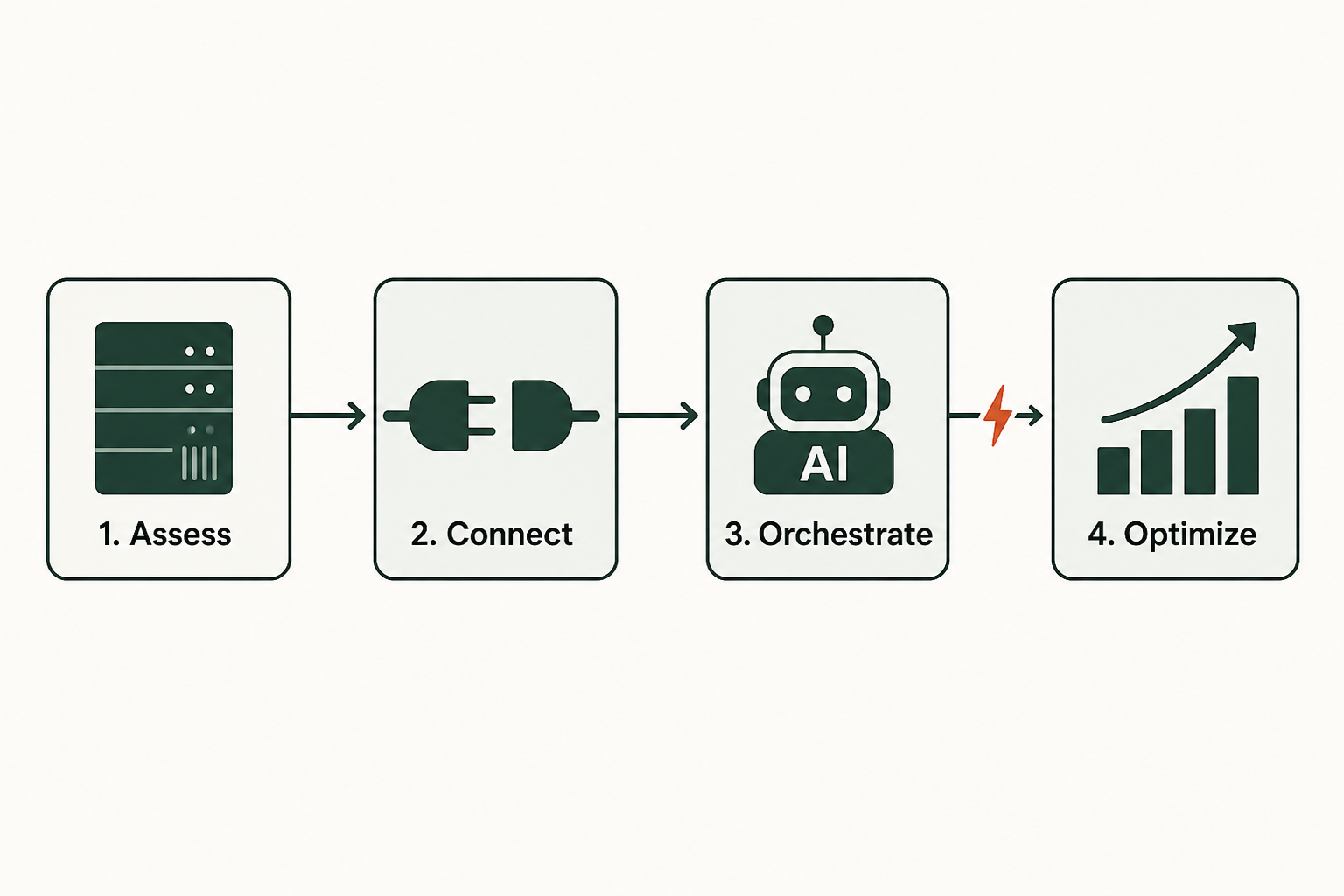
A useful agent becomes a governance problem the moment it can change a customer record, approve a refund, update an ERP field, or trigger a downstream workflow. Securely authorizing AI agents means putting a controlled execution layer between model intent and system change, with policies, verifiable checkpoints, state management, and an auditable record for every action.
This ranked list is for CIOs, CAIOs, security leaders, and enterprise architects choosing among three practical approaches to AI agent authorization: an Agentic Harness, agent engineering frameworks, and custom IAM or OAuth extensions. The ranking favors the approaches that control consequential work, not the ones that merely describe what an agent should do.
Why AI agent authorization is now a critical enterprise control
The enterprise blocker is no longer whether an agent can reason through a task. The harder question is whether the business can prove what the agent was allowed to do, what it saw, which system it called, what changed, and who approved the action when the stakes were high.
That gap is measurable. A [report on AI agent governance gaps](https://labs.cloudsecurityalliance.A report on AI agent governance gaps found that 92% of organizations lack full visibility into their AI identities, and the same report indicated that, as of 2026, 86% of large-enterprise security leaders do not enforce access policies for AI identities. Those figures explain why many pilots stall when they move from recommendations into live system actions. A model can suggest a workflow, but the enterprise still needs a governed execution path before it lets that workflow touch production systems.
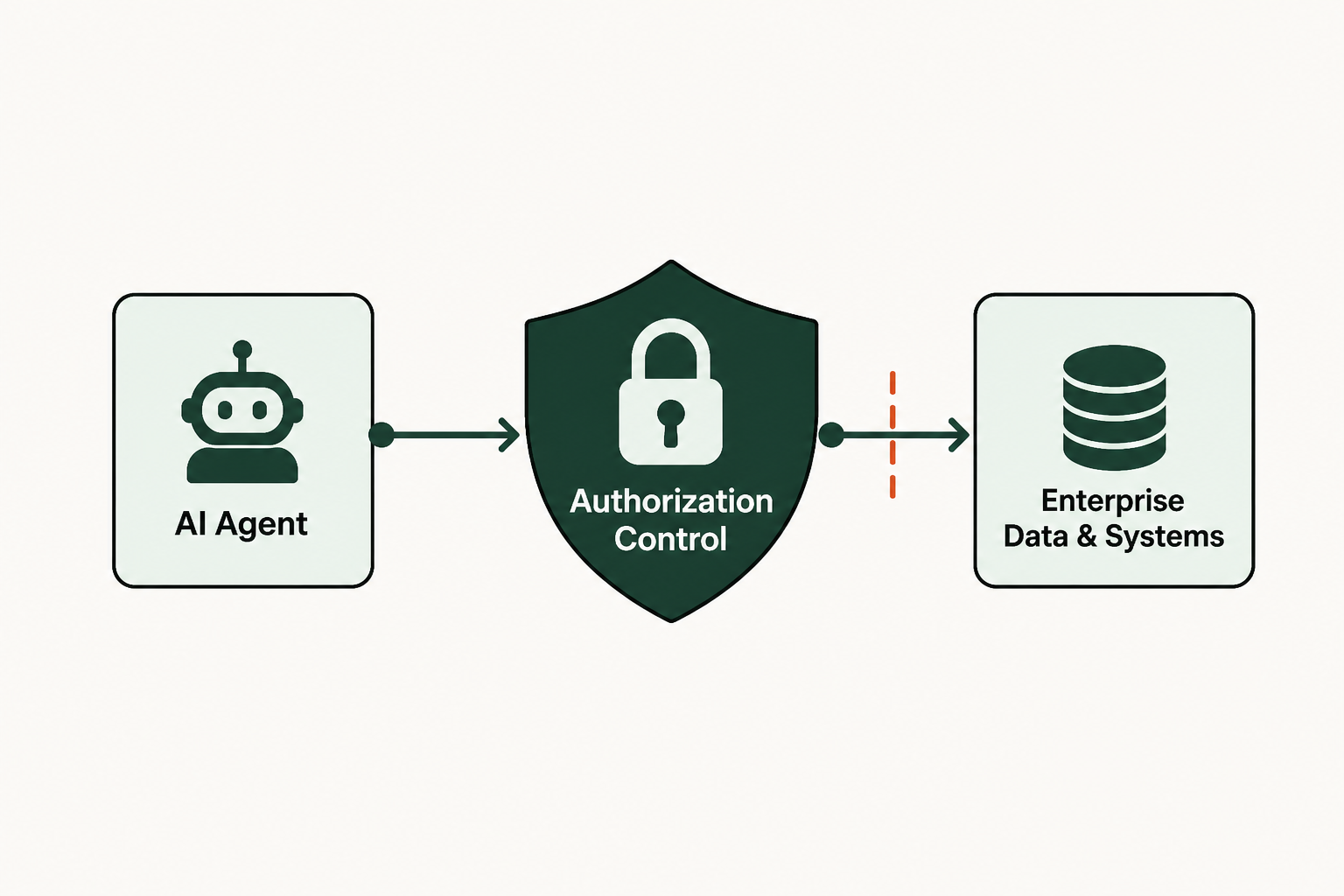
For a CIO or CAIO, AI agent authorization sits between AI ambition and operational permission. It is narrower than an AI agent governance guide, because the concern here is specific agent action: can the agent execute this step, in this system, under this policy, with this evidence trail?
 Why AI agent authorization is now a critical enterprise control
The operating model is simple enough to state, but difficult to enforce without the right architecture. Agents are the brain, but governed execution is the hands. The brain can interpret context and propose action; the hands must follow deterministic workflows, apply policy, record state, verify checkpoints, and stop or escalate when reality differs from the plan. Without that split, authorization can depend on prompt instructions and role assumptions, with log review happening only after the fact, which is too thin for regulated or mission-critical work.
How we evaluated agent authorization solutions
Once authorization is treated as an execution control, the evaluation changes. The strongest option is not the tool that builds the most capable agent, or the one that fits most neatly into an existing identity diagram. It is the approach that makes consequential agent actions predictable and auditable while keeping them within compliance expectations inside enterprise systems.
The evaluation used three dimensions that matter when agents move from lab work to production work:
Policy enforcement and granularity
A credible authorization layer must decide at the action level, not merely at the application level. The practical questions are specific:
- Action scope: Can the system allow a read, block a write, require approval for a refund, or limit a change to a certain data range?
- Context awareness: Can the control point consider the current task, state, source system, user intent, and business rule before allowing execution?
- Escalation handling: Can it send a high-consequence action to a human reviewer without stopping all automation?
Auditability and verifiability
Operational logs are useful, but they do not automatically answer an auditor's questions. The better test is whether the organization can reconstruct the agent's path from request to result.
- Decision trail: The record should show the agent's input, the workflow step, the system touched, the policy applied, and the result.
- Checkpoint evidence: Approvals, verifications, failures, and retries should be preserved as part of the record.
- Runtime predictability: The execution path should be constrained enough that security and compliance teams can review it before deployment.
Integration with enterprise systems
Authorization matters most where systems are messy. Enterprises still run legacy systems, no-API systems, internal admin portals, ERP screens, CRM environments, and industry-specific platforms. A strong approach must govern agent action across that estate without making every workflow a custom engineering project.
Integration breadth on its own is not enough. The decisive factor is whether the system can connect to systems and carry out work through deterministic workflows, then verify and record what happened while keeping the agent bounded by policy.
The 3 best approaches to AI agent authorization, ranked
With those criteria in place, the ranking becomes a production-control decision rather than a feature checklist.
| Rank | Approach | Headline strength | Main trade-off |
|---|---|---|---|
| 1 | Agentic Harness | Best fit for governed execution across enterprise systems | Requires adopting a distinct execution layer between agents and systems |
| 2 | Agent engineering frameworks | Best for rapid prototyping and agent logic design | Leaves production authorization, verification, and audit controls to surrounding systems |
| 3 | Custom IAM and OAuth extensions | Best for standards alignment | Demands significant internal design, build, and maintenance work |
The ranking is intentionally biased toward controlled execution. If your agent only summarizes documents or drafts internal notes, the top option may be more structure than you need. If the agent updates records, triggers processes, or acts across systems, the order changes quickly because execution evidence becomes as important as model quality.
1. Agentic Harness: best for governed execution
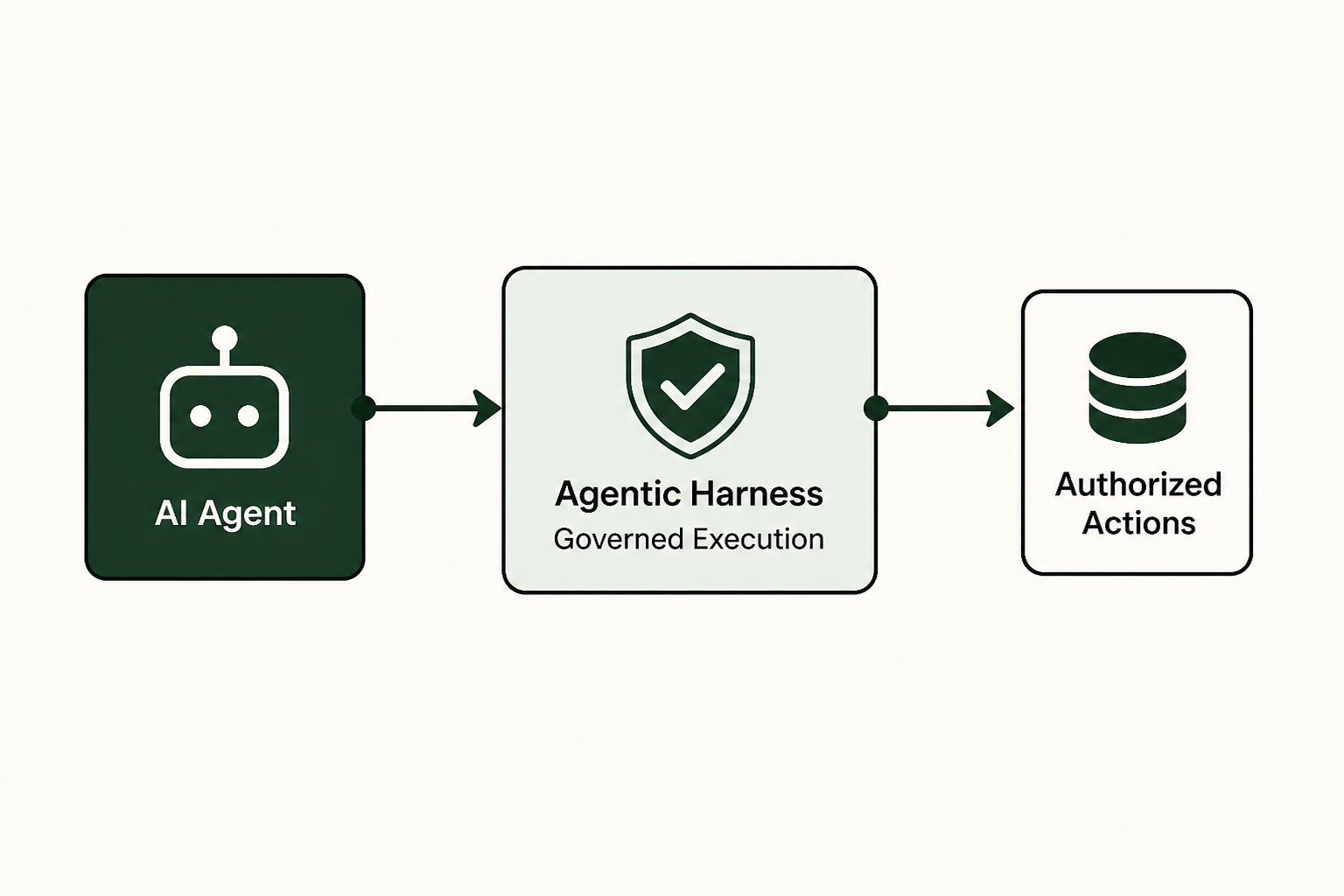
The strongest fit for consequential work is an Agentic Harness, a controlled execution layer that sits between an AI agent and the enterprise systems it needs to affect. In plain English, it lets the agent decide what should happen, while the platform controls how the work is carried out, checked against system state, recorded for review, and recovered if the system state does not match the plan.
This approach fits CIOs and CAIOs moving agents into regulated or mission-critical operational workflows where a bad action has a real business cost. Its main strength is governed execution through deterministic workflows. Instead of giving the model broad operational reach, the Agentic Harness turns permitted work into bounded process execution with policy enforcement, verification checkpoints, state management, and failure recovery.
 1. Agentic Harness: best for governed execution
The practical advantages are clearest where enterprise systems are uneven. A governed execution layer can mediate work across modern applications, legacy systems, and no-API systems, which is where many prototypes fail. The platform's evidence posture also matters: an AI agent audit trail is not an accessory when the agent performs write actions. It is the basis for compliance evidence as well as approval and incident review.
For teams evaluating [Agentic Harness infrastructure](https://upware.For teams evaluating Agentic Harness infrastructure, Upware states four specific operating claims: deployment in days, up to 80% lower token costs, 100% predictability in runtime, and '0 engineering resources'. The 100% predictability claim applies to runtime execution paths, not to eliminating every AI risk. That distinction matters. The agent can still be probabilistic in reasoning, while the action pathway remains controlled.
The main trade-off is architectural discipline. An Agentic Harness asks the enterprise to treat agent action as governed process execution, which means defining approved workflows, controls, and checkpoints before scaling. For consequential work, that discipline is useful. For loose experimentation, it may feel heavy.
2. Agent engineering frameworks: best for rapid prototyping
Where an execution layer governs the action path, agent engineering frameworks focus on building the agent itself. They help AI teams design reasoning loops, tool calls, memory patterns, and task decomposition, and they are often the fastest route from an idea to a working prototype.
They fit experimentation and internal research during early workflow discovery. Their main strength is speed in shaping the agent's brain: how it interprets requests and breaks work into steps before choosing which tool to call. For CAIO teams proving that an agent can perform a task in principle, that speed has real value.
The trade-off appears when the prototype touches production systems. Frameworks can help define what the agent wants to do, but they usually leave enterprise authorization, policy enforcement, audit evidence, state recovery, and operational controls to other layers. That creates a gap between "the agent can do it" and "the enterprise can approve it."
Conversational agent platforms, RPA-era automation suites, integration and orchestration platforms, and agent engineering frameworks all do useful work: they help teams create agents, coordinate steps, and connect applications; they can also automate familiar tasks. What they leave unresolved is the governed execution layer between agents and enterprise systems, especially when actions require policy checks, verification, recovery, and audit evidence. Upware centers on that layer instead, so the enterprise controls how systems are changed after the agent has reasoned through the task.
For that reason, agent engineering frameworks rank second. They are strong at creating agent capability, but AI agent authorization in production depends on the system that constrains and records execution.
3. Custom IAM and OAuth extensions: best for standards alignment
For organizations prioritizing existing standards, another path is to extend identity and authorization patterns for agent interactions. The [IETF proposed model](https://datatracker.ietf.The IETF proposed model describes authentication and authorization of AI agent interactions using existing standards such as the Workload Identity in Multi-System Environments architecture and the OAuth 2.0 family of specifications.0 family of specifications.
This approach fits enterprises with deep identity engineering capacity and strict standards alignment requirements, plus enough time to design their own operating model. Its main strength is compatibility with familiar security concepts. Teams can reason about agents as identifiable workloads, define scopes and issue tokens, then align controls with established patterns rather than inventing a separate authorization vocabulary.
The trade-off is build and maintenance burden. Standards can define how identities and authorizations are represented, but the enterprise still needs to decide how agent intent maps to business action, how policy is enforced at each step, how state is preserved, how approvals are captured, and how a complete audit record is created. That work is especially hard across legacy systems and no-API systems, where the clean identity model meets operational reality.
This path ranks third because it can be correct in principle and slow in practice. For a regulated enterprise with a mature platform engineering team, it may be the right foundation. For a CIO trying to move approved agent workflows into production without turning every use case into a custom program, it can become a long-running internal project.
Who should skip these solutions?
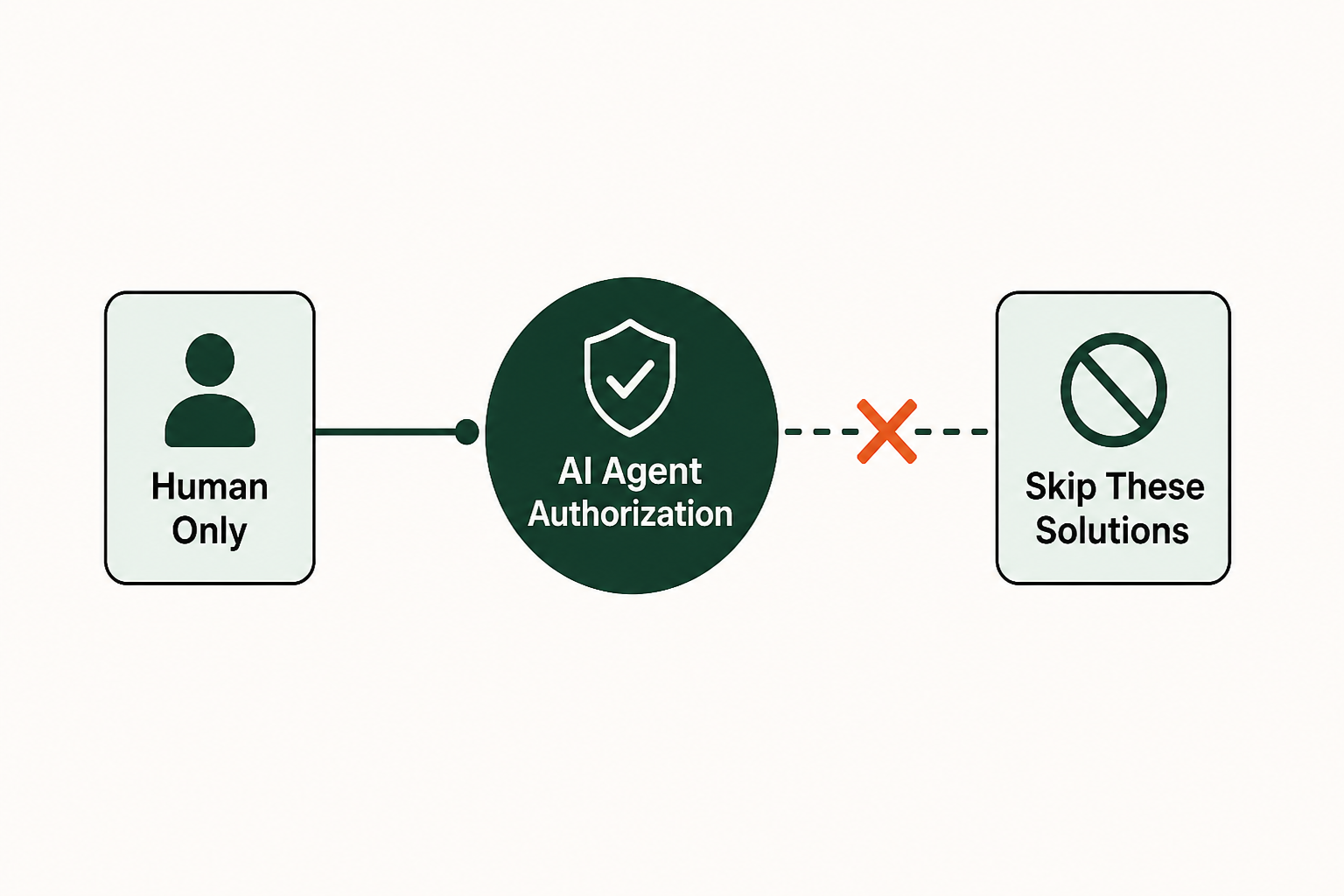
Formal authorization tools do not belong in every AI project. The category makes the most sense when agents perform consequential actions, meaning actions that change systems of record, affect customers, move money, alter operational status, or create compliance exposure. If the agent only drafts text and summarizes knowledge, or classifies documents for human review, or runs in a sandbox, a full AI agent authorization layer may be unnecessary.
Teams should also pause if they have not identified the production workflow. Authorization works best when the enterprise can name the systems involved, the actions allowed, the policies that apply, and the evidence required after execution. Without that, the project may drift into abstract governance rather than operational control.
Skip or delay these approaches when:
- The agent has no write path: Read-only assistance usually needs monitoring and data controls, not a governed execution layer.
- The workflow is still speculative: Authorization design should follow a real operating process, not a vague agent roadmap.
- The organization cannot assign ownership: Security, AI, operations, and compliance must agree on permitted actions and failure handling.
- The environment is non-production: Lab experiments do not need the same checkpoints as live enterprise systems.
 Who should skip these solutions?
The honest line is simple: if nothing meaningful can change, the authorization burden should stay light. If the agent can act, the burden becomes part of production readiness.
The verdict: why governed execution wins
The right choice depends on the consequence of the action. For low-risk exploration, agent engineering frameworks are a reasonable starting point. For teams committed to standards-first architecture, custom IAM and OAuth extensions can fit, provided the organization accepts the engineering work.
For production agents that change enterprise systems, the top pick is the Agentic Harness because it centers the missing control plane: governed execution. It keeps the agent's reasoning separate from the deterministic workflows that execute operational work, verify it, record it, and recover when needed. That separation is the practical difference between an impressive pilot and an approved production system.
The strategic trade-off is discipline. You gain predictability and audit evidence by forcing consequential action through a controlled execution layer. You give up the illusion that an open-ended agent should directly operate the business. For CIOs and CAIOs, that is a reasonable exchange.
Master your AI agent authorization strategy.
Discover our solutions in action or connect with an expert to tailor your approach.
Frequently asked questions
What is the main benefit of using a dedicated AI agent authorization tool?
The main benefit is control over consequential action. A dedicated tool gives the enterprise a place to enforce policy and verify checkpoints while it manages execution state and preserves an audit record before and after an agent changes a system. That matters because prompt instructions and generic application access do not provide enough evidence when security, legal, or compliance teams ask what the agent was allowed to do and what actually happened.
How do I know how long it takes to implement an Agentic Harness and see results?
Implementation time depends on the workflow, the systems involved, and the approvals required, but the platform proof point for an Agentic Harness is deployment in days. That should not be read as deployment with no setup or no governance work. It means the execution layer is designed to avoid a long custom engineering cycle once the target workflow, policy rules, and system access pattern are defined.
What are the most common mistakes to avoid when authorizing AI agents?
The common mistake is treating model permission as system permission. An agent may be instructed to follow a policy, but the enterprise still needs policy enforcement at execution time. Other mistakes include relying on operational logs that do not show the decision trail, giving agents broad access because narrow scopes are inconvenient, skipping human approval for high-consequence actions, and failing to define recovery behavior when the system state differs from the agent's plan.
Can I adapt my existing enterprise IAM solution for AI agents?
Yes, but it is usually only part of the answer. Existing IAM patterns can help identify workloads and issue credentials while aligning agent access with standards. The IETF model shows how existing standards such as WIMSE architecture and OAuth 2.0 can be applied or extended for AI agent interactions. The remaining work is operational: mapping agent intent to specific business actions, enforcing policy at each step, preserving state, and creating audit evidence across enterprise systems. Secure your AI agents. Explore our top authorization tools.