What Is AI Agent Governance and Why Is It Important?
AI agent governance is the framework of policies, procedures, and technologies used to manage, monitor, and control the behavior of AI agents, ensuring they operate within approved enterprise boundaries. For a CIO, CAIO, or security leader, that plain definition matters because an agent that can reason, call tools, and change systems has crossed from content generation into operations.
Agents also break some of the assumptions that made traditional software governance manageable. Research on runtime governance describes AI agents as systems that plan, reason, and act using large language models, exhibiting non-deterministic, path-dependent behavior that cannot be fully governed at design time.org/html/2603.16586v1) that cannot be fully governed only at design time. A conventional application follows a known route through code. An agent may choose a route based on context, available tools, prior memory, retrieved content, and intermediate results.
That is why ai agent governance has become a board-level operating concern rather than a narrow model-management task. A task-specific agent embedded in a business application may look harmless while it recommends next steps, but the risk profile changes once it can update a record, trigger a refund, approve an exception, send customer data to another system, or coordinate with another agent.
The demand is moving faster than many control environments. Gartner projects that 40% of enterprise applications will embed task-specific AI agents by the end of 2026, compared with fewer than 5% in 2025. At the same time, a 2026 KPMG survey of large-enterprise leaders found that 75% cite security, compliance, and auditability as the most critical requirements for agent deployment. Those two facts define the operating tension: enterprises want agentic work, but consequential work cannot be approved without governed execution.
Foundations: Key Risks of Ungoverned AI Agents
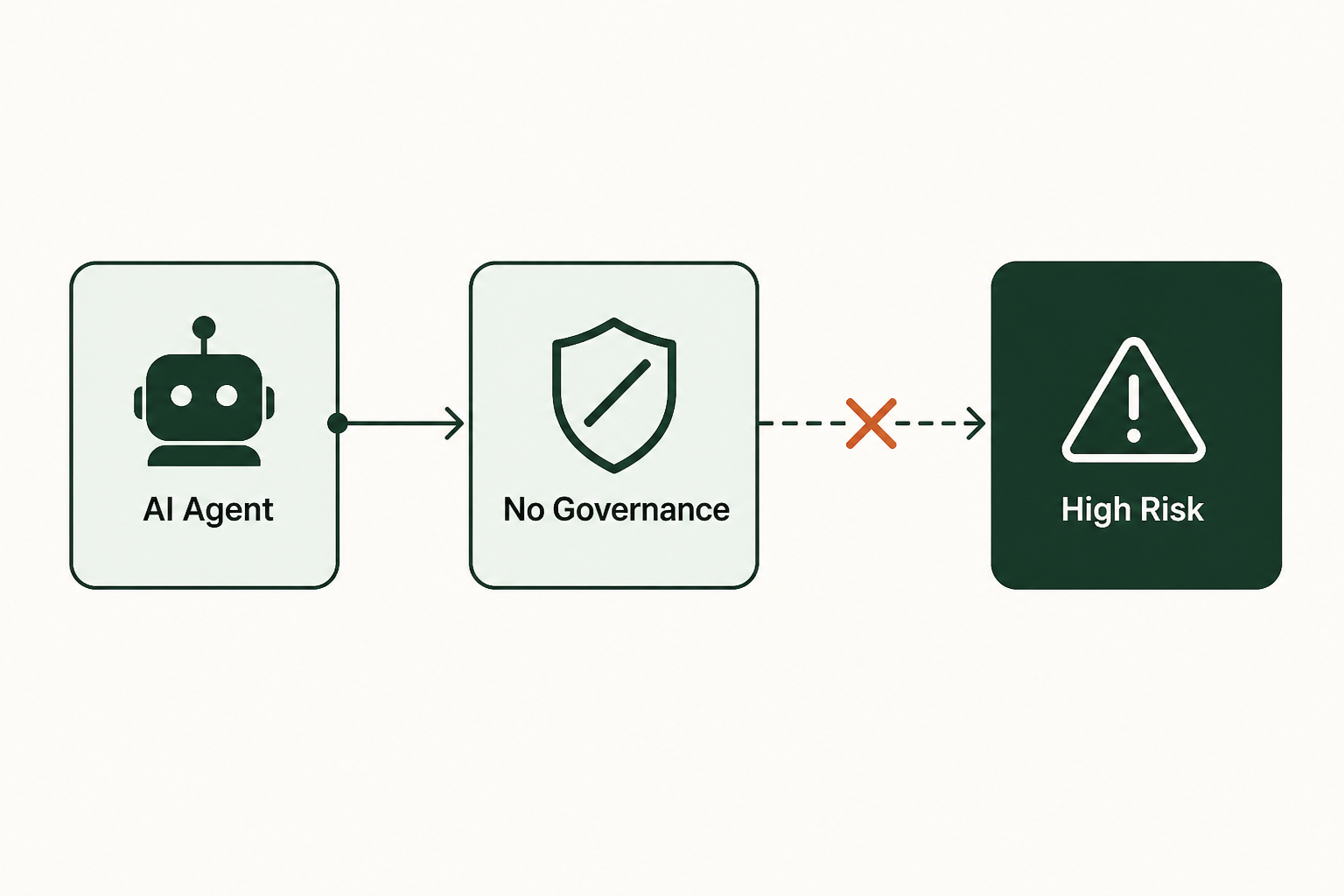
The risk is not that agents are unsafe by default. The problem is fit. Enterprise systems were built around identity, process, logging, and change control, while agents introduce decision paths that are harder to predict before runtime. That mismatch creates security gaps, compliance gaps, and operational ambiguity.
Security and Compliance Gaps
The most visible risk is authorization. A human employee usually has an identity, role, approval path, and record of action. An agent may inherit access through a service account, plug into tools through a prototype connector, or operate behind a workflow that never expected autonomous decisions. If that agent is compromised, misdirected, or simply wrong, the enterprise may struggle to know what it touched.
The Cloud Security Alliance reported that a 2026 survey of 235 large-enterprise CISOs and CIOs found that 92% lack full visibility into their AI agent identities and 95% doubt they could detect or contain a compromised agent.cloudsecurityalliance.org/research/csa-research-note-ai-agent-governance-framework-gap-20260403), and 95% doubt they could detect or contain a compromised agent. That is a serious operational finding because identity visibility is the first layer of control. Without it, policy enforcement becomes guesswork.
The access problem extends into business systems. A 2026 CISO AI Risk Report found that only 16% of organizations effectively govern AI access to core business systems. That leaves many enterprises with agents that can recommend work but cannot safely perform it, or agents that perform work through brittle permissions that security teams cannot defend in an audit.
Prompt injection adds another route into the same problem. Prompt injection has ranked first on the OWASP Top 10 for Large Language Model Applications since 2025. OWASP also published an Agentic Top 10 on December 10, 2025, covering primary attack surfaces specific to autonomous agent systems. These are operational concerns when an agent can call tools and alter enterprise records.
Lack of Operational Control and Auditability
Security controls only address part of the failure mode. Operations leaders also need to reconstruct what happened when a workflow fails, which means seeing the prompt, context, tools available, tools selected, approvals requested, systems touched, outputs returned, retries attempted, and final state. Basic logs that show latency and token usage do not provide enough evidence.
One survey cited by the Cloud Security Alliance, conducted in March 2026 by the EY/AIUC-1 Consortium, found that only 38% of organizations monitor AI traffic end-to-end across prompts, tool calls, and outputs, and only 17% continuously monitor agent-to-agent interactions. That gap matters because agent failures often live in the path, rather than in a single output. If the path is invisible, incident review turns into speculation.
Research on runtime governance makes this point directly: the execution path is the central object for effective governance. In plain English, the enterprise needs to govern the route the agent takes through tools, data, policies, approvals, and system changes. Without that route, the business cannot prove what the agent saw, called, decided, or changed.
 Foundations: Key Risks of Ungoverned AI Agents
Key Terms in AI Agent Governance
The vocabulary around agent governance can sound more complicated than the operating problem, so the practical definitions matter. These are the terms leaders need before choosing controls, assigning ownership, or approving agents in production.
AI agent
An AI system that can interpret a goal, reason through steps, use tools, and act across one or more systems. The important difference from a chatbot is action. Once the system can change something, governance has to cover execution.
Agent governance
The policy, monitoring, approval, access, verification, audit, and recovery structure that controls what agents may do and proves what they did.
Execution path
The full sequence of events an agent follows, including inputs, reasoning context, tool calls, approvals, system responses, retries, and final outcomes. For governance, this path is often more important than the final answer.
Execution layer
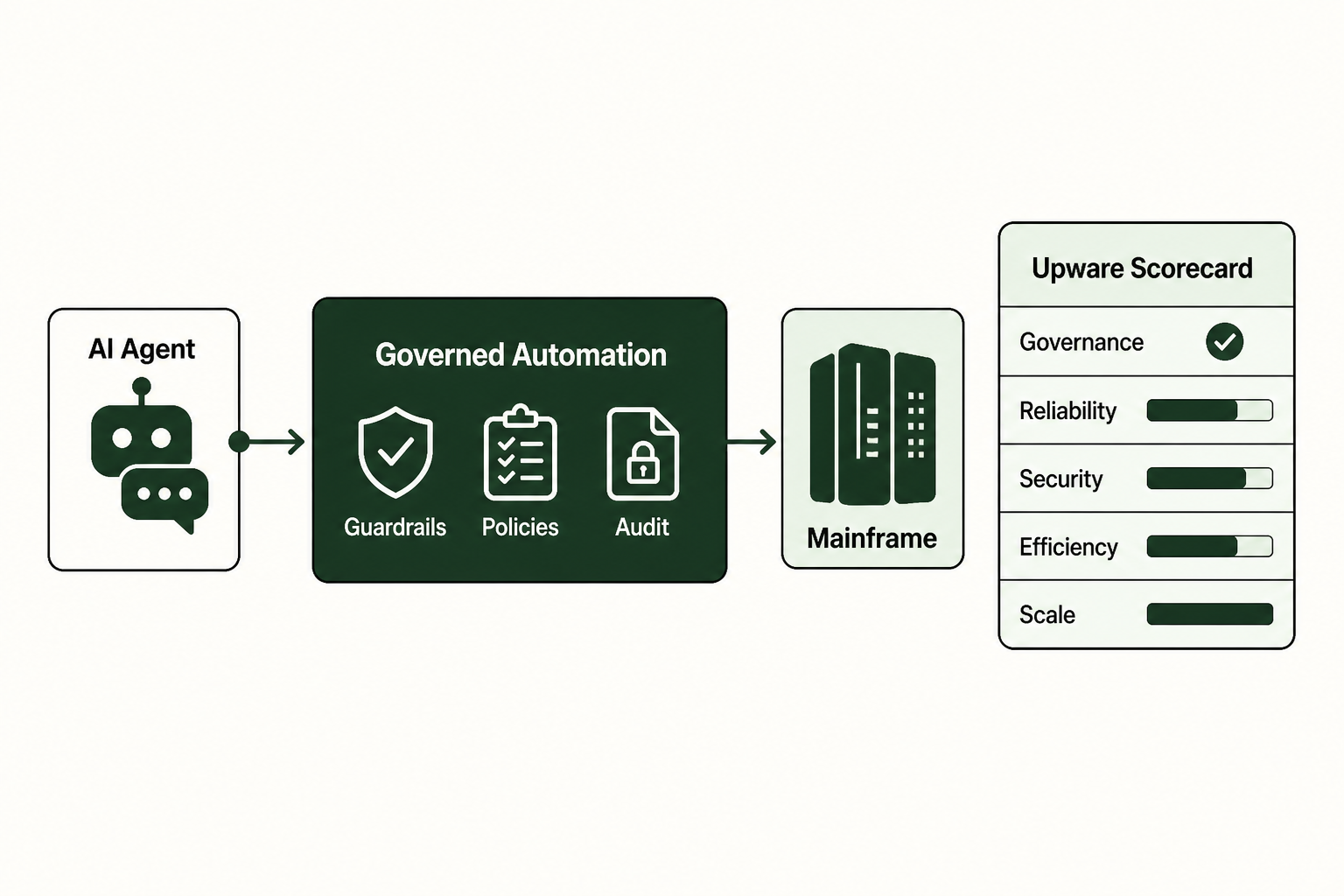
The controlled layer between the agent and enterprise systems. It receives the agent’s intended action, applies rules, verifies context, manages state, and executes only approved work.
Agentic Harness
An Agentic Harness is the operational control layer that turns an agent’s intent into governed execution. The agent is the brain. The Agentic Harness is the hands, applying policy, process, and system control before anything consequential changes.
Deterministic workflows
Predefined, auditable workflows that produce predictable runtime behavior for approved actions. Deterministic workflows do not make the model itself deterministic; they make the action path bounded and reviewable.
Human escalation
A required approval, review, or intervention point when an agent reaches a high-consequence decision, policy exception, missing context, or failed verification.
Core Components of an Effective Governance Framework
Once the risk is framed around execution, the required controls become clearer. A governance framework cannot live only in a policy document, and it cannot be reduced to a dashboard. It has to sit close enough to execution to stop, alter, approve, retry, or record agent actions before they affect enterprise systems.
Policy Enforcement and Access Control
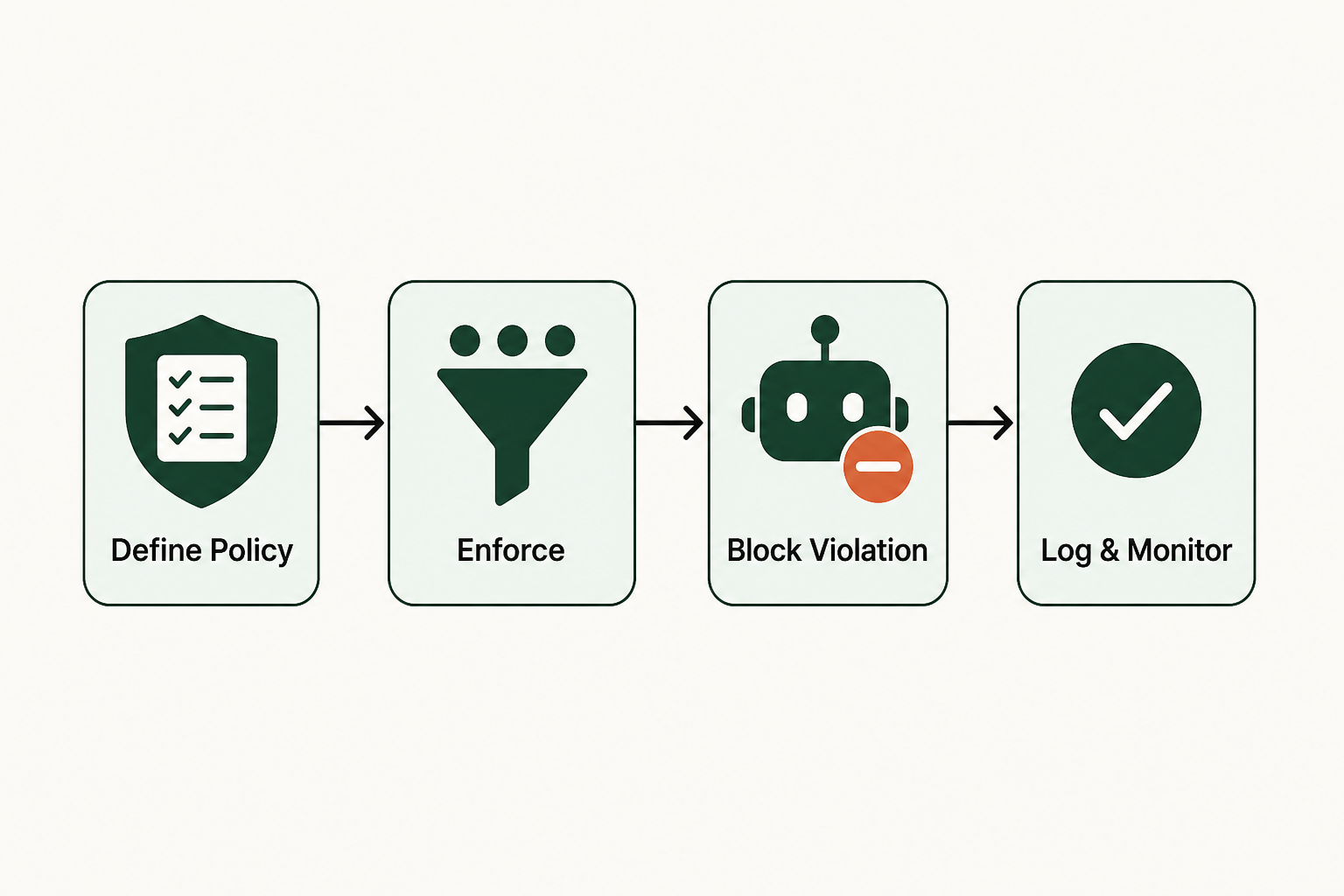
The first component is a policy layer that defines what an agent may do, under which conditions, and with which approvals. This includes role-based permissions, system-specific limits, data-access rules, escalation thresholds, and forbidden actions. The point is to turn broad instructions into enforceable controls.
A useful framework answers practical questions before the agent acts:
- Allowed systems: Which enterprise systems, legacy systems, or no-API systems can this agent touch?
- Allowed actions: Can it read, write, approve, delete, send, refund, amend, or only recommend?
- Allowed context: Which records, documents, customer attributes, or operational data may inform the action?
- Approval thresholds: Which actions require a human reviewer, a second system check, or a hard stop?
- Fallback behavior: What happens when the agent lacks evidence, policy conflicts, or the target system returns an unexpected state?
This is where many pilots stall. The prototype shows that an agent can complete a task in a test setting, but the production environment asks harder questions about authority, liability, and evidence. A prompt instruction such as "do not approve high-risk cases" is weaker than a governed control that blocks the approval, records the reason, and routes the case to a human.
Real-Time Monitoring and Verification
Monitoring has to cover more than outputs. It must track the agent’s operating context, tool selection, calls made, system responses, and any changes in state. That creates an active control environment rather than a passive log.
Verification is the companion function. Before an agent updates a system, the governance layer should be able to check whether the proposed action matches policy, whether the required context is present, whether the target record is in the expected state, and whether a human approval is needed. In regulated or mission-critical workflows, this is where governed execution earns its place.
A common enterprise mistake is treating monitoring as something that happens after the fact. Post-event review is necessary, but it does not prevent a bad write, unauthorized access, or a policy breach. Runtime checks are different because they can stop the action before it becomes a production incident.
Comprehensive Audit and State Management
Auditability depends on state. If an agent starts with one set of assumptions, calls a tool, receives a conflicting result, retries the action, and then escalates, the governance record must preserve that chain. Otherwise, a compliance review sees a final output without the decision trail that produced it.
Research pointing to the execution path as the central object for effective runtime governance of AI agents supports this shift. The audit record should say more than the fact that an agent acted. It should show the path, including what the agent was allowed to do, what it attempted, what was blocked, what was approved, and what changed in the target system.
State management also matters for recovery. Enterprise workflows rarely fail cleanly. A system may accept part of a transaction, reject a downstream update, time out after a tool call, or return a result that no longer matches the agent’s plan. Governance must track that state so the process can pause, retry, roll forward, escalate, or restore without relying on a human to reverse-engineer what happened.
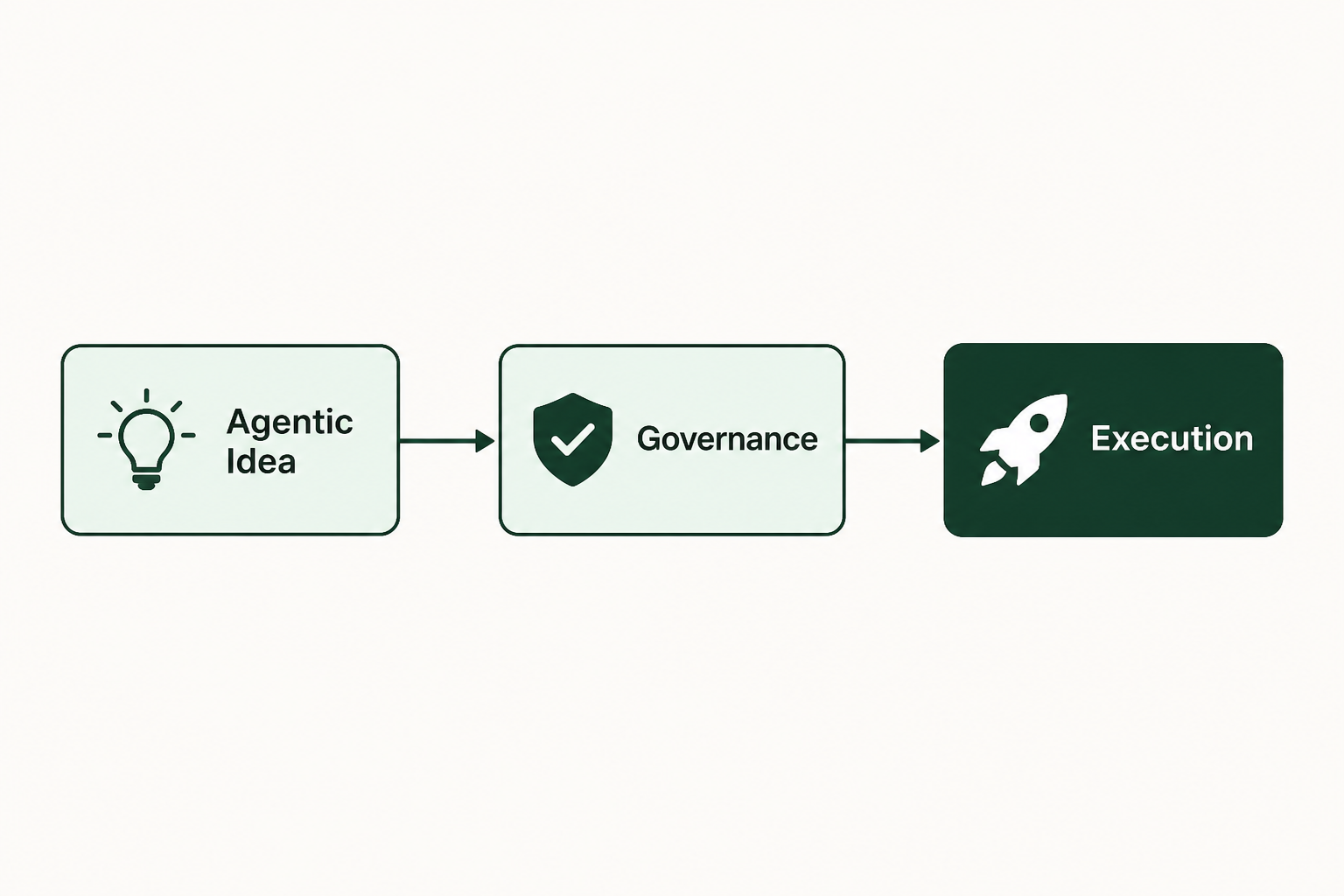
From Agentic Idea to Governed Execution
The implementation question follows directly from the control model: separate the agent from the action. If the agent is allowed to reason and execute directly inside enterprise systems, the model becomes both planner and operator, which gives the business very little room to apply process control between intent and change.
The Role of the Execution Layer
The execution layer changes that operating model. The agent can still interpret the goal and propose a course of action, but the actual work runs through controlled procedures. AI agents are fundamentally different from traditional software due to five properties: non-determinism, dynamic tool use, variable-length paths, self-modification, and multi-agent interaction.
Those properties make agent behavior flexible, and they also make conventional governance weaker. A fixed integration expects known inputs and known calls. An agent may decide which tool to use at runtime, adjust its path based on intermediate results, or coordinate with another agent that has its own context. The governance layer has to control the execution path while allowing useful reasoning to happen upstream.
In practice, an execution layer should translate agent intent into deterministic workflows. The agent can say, "This invoice appears ready for approval." The workflow then checks vendor status, invoice amount, purchase order match, policy limits, segregation-of-duties rules, exception history, and approval requirements before changing anything in the finance system. The model proposes. Governed execution controls the change.
Contrasting with Agent Engineering Frameworks
Agent engineering frameworks do useful work for teams that need to build, test, and orchestrate agents. They help developers connect models, tools, prompts, memory, and multi-agent flows. What they leave unresolved is the governed execution layer between agents and enterprise systems, especially when those systems include legacy systems, no-API systems, regulated workflows, and approval-heavy operations. Upware centers on that governed execution layer instead, with the Agentic Harness mediating the path from agent intent to controlled system action.
That distinction keeps the architecture honest. Building an agent and governing the consequence of its action are different jobs. A model framework may help the agent reason. An Agentic Harness defines what happens before that reasoning changes a customer record, updates a claim, moves money, modifies inventory, or sends sensitive information into another application.
Enabling Deterministic Workflows for Predictability
Deterministic workflows give enterprises a practical way to make agentic execution predictable without pretending the model itself is predictable. The workflow constrains the action path. It defines required checks, approved tools, expected system states, failure handling, and escalation points.
This is why 100% predictability in runtime can be a meaningful governance claim when it applies to the controlled workflow path rather than to every internal model token. The agent’s reasoning can remain probabilistic, while the execution layer enforces fixed process behavior for approved actions. That separation is the basis for scalable, compliant agent deployment.
 From Agentic Idea to Governed Execution
The trade-off is discipline. Teams must decide which actions deserve deterministic workflows and which should remain recommendations. Not every agent output needs a governed execution path, but any workflow that touches sensitive data, customer commitments, financial records, safety-related processes, or regulated decisions should be treated as consequential.
Benefits of an Agentic Harness for the Enterprise
The governed execution model has a specific business purpose: it lets agents participate in operational work while the enterprise keeps policy, access, audit, and recovery in the execution path. That is a narrower claim than vague AI control, and it is the one that matters in production.
An Agentic Harness is most useful when pilots are blocked by the same recurring objections: security will not approve broad access, compliance cannot see the decision trail, operations cannot tolerate unexplained failures, and engineering does not want to build one-off connectors for every workflow. By placing controls between agent intent and system action, the organization can separate useful reasoning from approved execution.
The business case usually shows up in four places:
Deployment pace: Governance solutions can be deployed in days, as evidenced by proof metrics. Runtime predictability: Deterministic workflows can deliver 100% predictability in runtime for the governed action path, while the agent remains responsible for reasoning and task interpretation, as evidenced by proof metrics.
- Cost discipline: Controlled execution can reduce unnecessary model calls and lead to up to 80% lower token costs in supported deployments, as evidenced by proof metrics. Engineering load: A governed execution approach can require 0 engineering resources for certain deployments, especially where the platform mediates interactions rather than asking teams to build every integration from scratch, as evidenced by proof metrics.
For leaders accountable to audit, the most important benefit may be evidentiary. If an agent acted, the organization can show the policy applied, the context used, the system state checked, the approval path followed, and the final change made. That record is what turns agent adoption from a pilot demonstration into an operating model.
A related next step is to prepare for an agentic AI audit, because the audit question arrives quickly once an agent touches production systems. The discussion shifts from "did the agent work?" to "can we prove that the agent was authorized, bounded, monitored, and recoverable?"
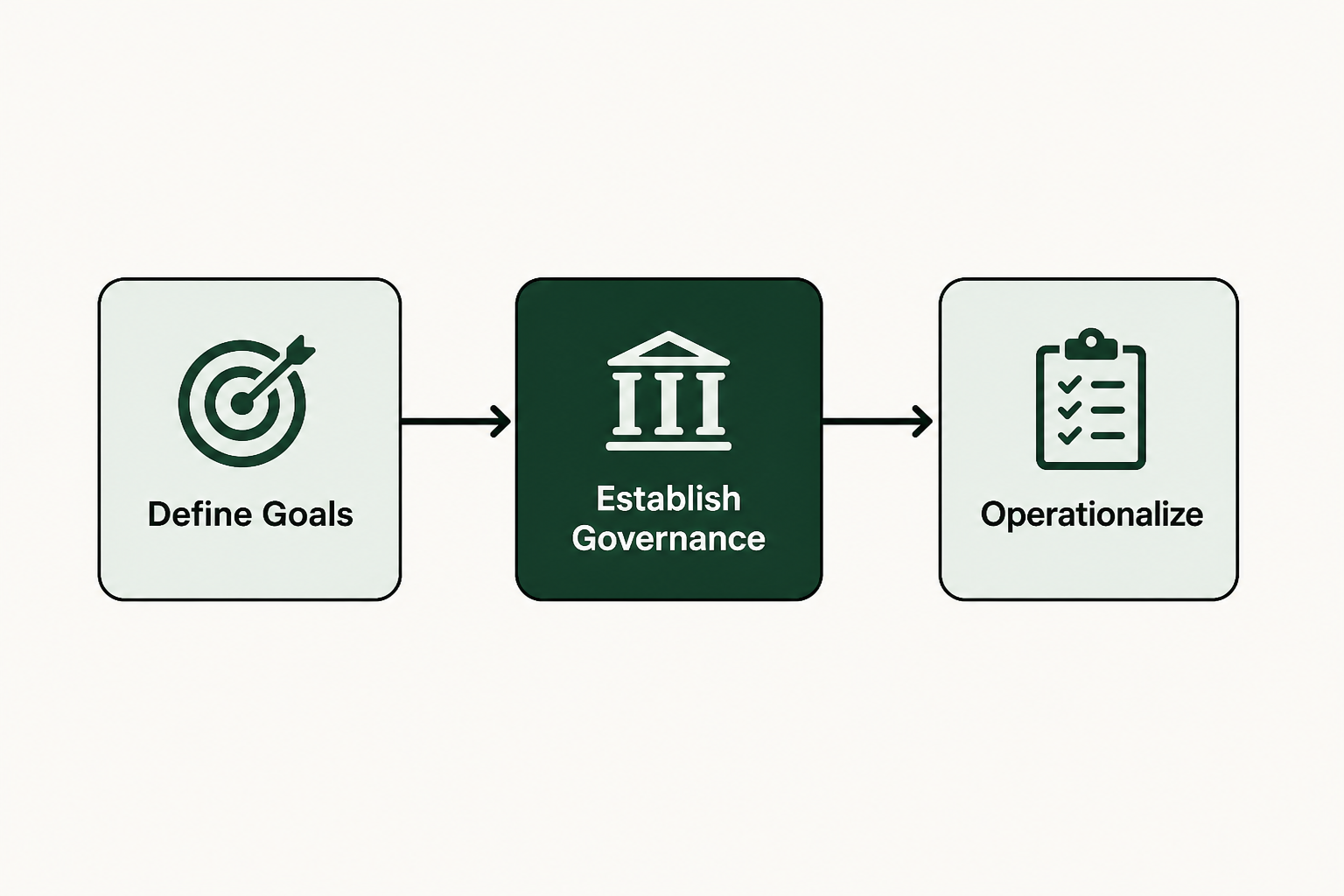
Next Steps: Establishing Your Governance Strategy
The practical next move is to treat ai agent governance as an operating design problem, rather than a policy afterthought. Standards work is active, but enterprises deploying agents cannot wait for every control to be finalized before deciding how consequential actions are authorized and audited.
NIST's Center for AI Standards and Innovation (CAISI) issued a Request for Information on January 8, 2026, specifically regarding cybersecurity controls for autonomous AI agent systems. The NIST AI Agent Standards Initiative, announced on February 17, 2026, is a multi-year standards effort, with substantive deliverables expected no earlier than late 2026 at the earliest. That means organizations are operating in a standards gap, even as agent deployment continues.
 Next Steps: Establishing Your Governance Strategy
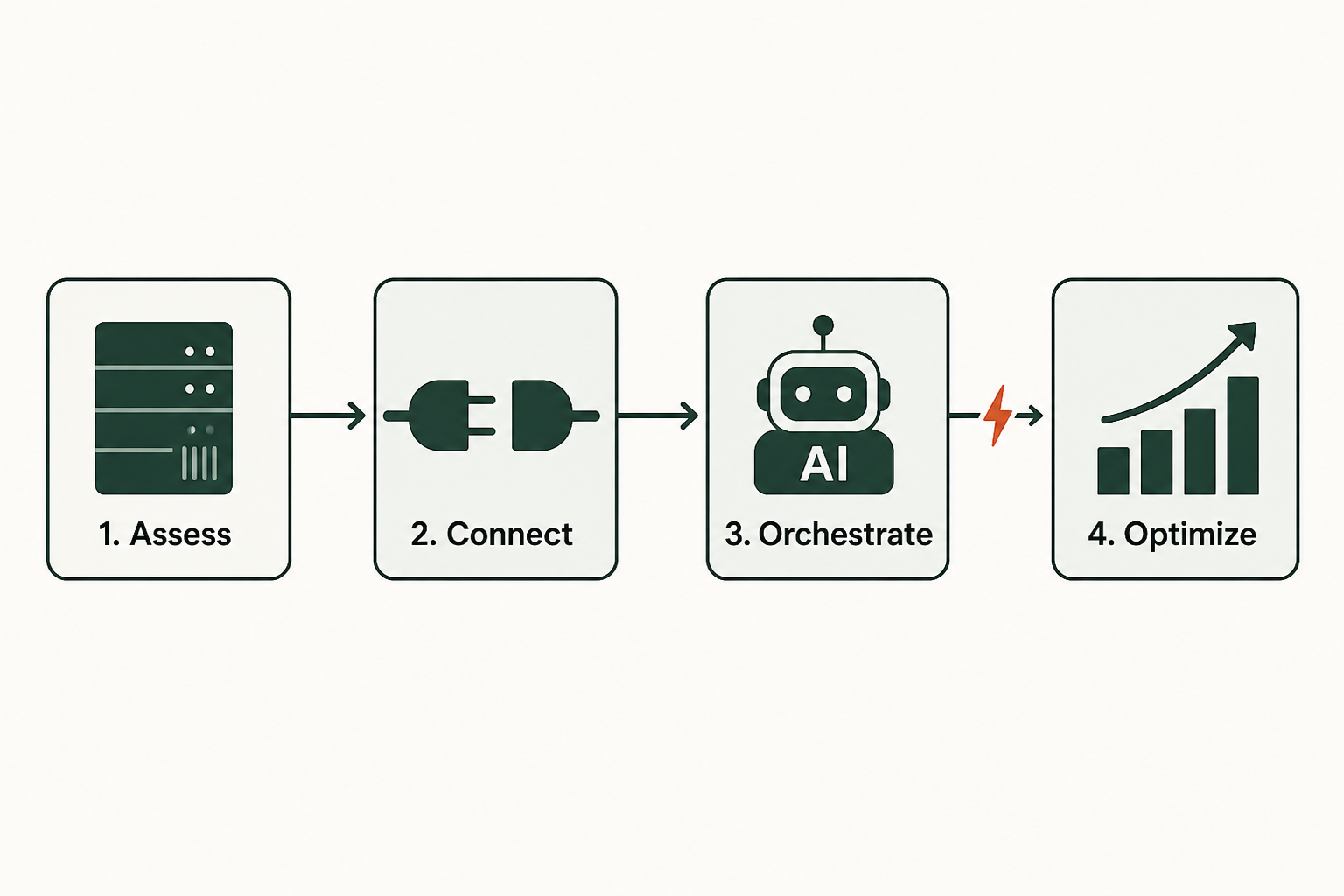
A practical strategy starts with a bounded inventory. Identify which agents only advise, which agents call tools, and which agents can change systems. Then rank the workflows by consequence, because governance effort should follow operational risk.
Use a simple decision sequence:
- Map agent authority: Document what each agent can read, call, approve, update, and trigger.
- Classify consequential actions: Flag actions involving regulated data, customer impact, financial movement, safety, legal exposure, or business-critical systems.
- Define runtime controls: Set policy checks, approval rules, verification steps, and recovery paths before production execution.
- Capture the execution path: Preserve the evidence needed for incident review, audit, and compliance.
- Move from pilots to governed execution: Prioritize workflows where a controlled execution layer can turn stalled prototypes into approved operations.
For a deeper operating model, read the guide on implementing a governance framework. The real decision is whether the enterprise is comfortable letting open-ended agents modify systems directly, or whether consequential work must pass through an Agentic Harness that makes execution bounded, auditable, and cost-disciplined. For regulated and complex environments, governed execution is the more defensible path.
Define and deploy AI agent governance with confidence.
Discover solutions for secure AI agent execution or discuss tailored strategies for your organization.
Frequently asked questions
What is the main benefit of implementing AI agent governance?
The main benefit is that the enterprise can let agents act without treating every action as an unmanaged model decision. Governance gives security, compliance, operations, and business owners a shared control structure for access, approvals, monitoring, and audit. That matters because large-enterprise leaders have identified security, compliance, and auditability as critical requirements for agent deployment, and governed execution gives those requirements a place to operate at runtime.
How do I get started with governing our AI agents?
Start by forming clear ownership across AI, security, operations, legal, compliance, and the business process owners who understand the workflow. Approximately half of large enterprises had dedicated AI governance committees as of February 2026, which shows that many organizations already treat governance as an operating function. From there, inventory agents, classify consequential actions, define approval and verification rules, and capture the execution path for audit.
Who in my organization is this most important for?
It is most important for the executives and operators accountable for production adoption: the CIO, CAIO, Head of AI, enterprise architect, security leader, compliance leader, and business owner of the affected process. The common thread is accountability. If a model-backed agent changes a system, exposes data, triggers a customer action, or creates an audit question, these roles need proof of what happened and control over what is allowed.
What are the most common mistakes to avoid when deploying AI agents?
The most common mistake is assuming prompts and manual review are enough for consequential actions. Other mistakes include giving agents broad system access through weak identities, logging only performance metrics instead of the full execution path, skipping runtime verification, and allowing production writes before escalation rules exist. The risk is visible in reported AI system failures and risky agent behaviors such as unauthorized system access and data exposure. Understand AI agent governance now. Dive in.