What is an agentic AI audit?
An agentic AI audit reviews how autonomous AI agents make decisions and take action, plus the outputs they produce, with enough evidence to show that the work followed enterprise policy and authorization rules, plus operational intent. In plain English, it answers a hard operational question: when an agent reads data, chooses a tool, updates a system, or escalates a case, can the enterprise prove what happened and why?
That proof matters because agentic systems do more than generate text. They can plan, use tools, keep context, and act across enterprise systems. Deloitte describes agentic AI as the use of autonomous agents that can [execute multistep audit processes with oversight](https://deloitte.com/us/en/services/audit-assurance/blogs/accounting-finance/agentic-ai-in-audit.Deloitte describes agentic AI as the use of autonomous AI agents that can execute multistep audit processes with oversight.
The simplest dividing line is action. A stand-alone generative model may summarize a contract or draft an email, and it may also answer a research question, but it often loses context, produces inconsistent outputs, and requires substantial human oversight when asked to execute audit workflows. An agentic system is built to keep memory, call tools, plan steps, and reason through a goal. Research on agentic auditing puts the contrast plainly: large language models behave more like "co-pilots" that support auditors upon request, while AI agents behave more like "autopilots" that can independently take actions to accomplish audit procedures on behalf of an auditor.
That autonomy creates a different kind of audit requirement. The risk is not limited to whether the model said something inaccurate. The risk is whether an agent selected the wrong source system, treated stale context as current, skipped an approval, retried a failed action in an unsafe way, or completed a workflow that looked successful while violating policy. The higher the system's "agenticness", meaning the degree to which a system can adaptably achieve complex goals in complex environments with limited direct supervision, the more the audit has to inspect behavior over time instead of a single model output.
An agentic AI audit therefore sits close to operations, security, compliance, and enterprise architecture. It reviews the full chain of work: the prompt or goal, the context retrieved, the reasoning trail available for review, the tools called, the systems changed, the approvals requested, the exceptions encountered, and the evidence retained. For production use, governed execution matters as much as model quality, because the agent is the brain, but the operating controls decide what the brain is allowed to change.
Core principles of an effective agentic AI audit
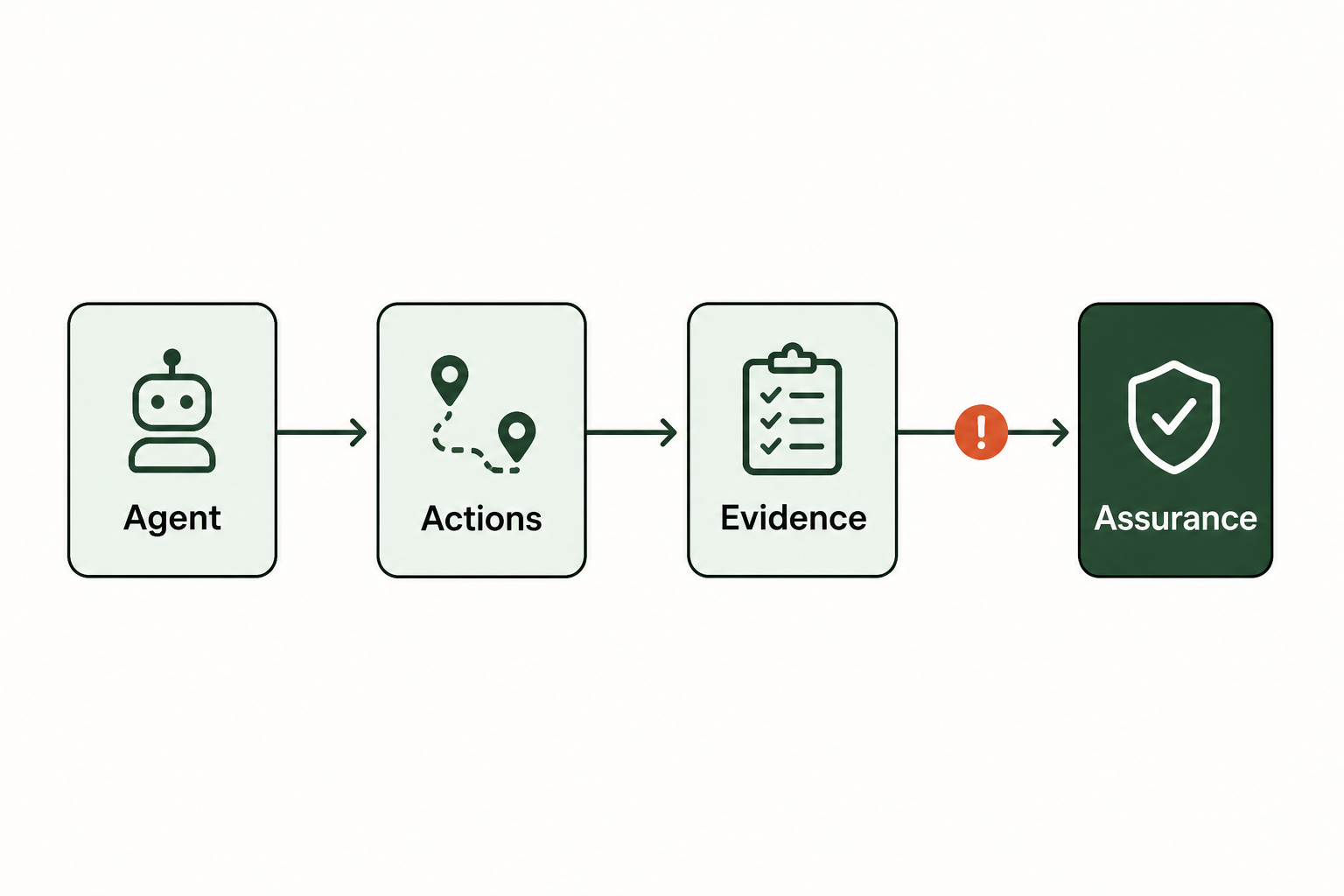
Once the audit target is the agent's behavior over time, the control standard becomes clear. A useful agentic AI audit has to make agent behavior traceable and verifiable while showing alignment to policy; otherwise, it becomes a pile of logs that explains performance without explaining control.
NIST frames the confidence problem in practical terms: users need increased visibility into the chain of reasoning, tool usage, and gathered evidence that led to each agentic decision, to know whether an agentic workflow executed correctly. That visibility is the base layer. Without it, a team may know that an agent called a claims system, updated a record, or generated a report, but still lack a defensible account of why the action was allowed.
The first principle is traceability. Each meaningful step needs a record that connects the agent's goal, the context it used, the tool or system it called, and the output or action that followed. The record should survive beyond the live session because compliance and incident response teams, as well as internal audit, usually review the event after the fact, not while the agent is acting.
The second principle is verifiability. NIST's research into audit trails focuses on building an audit trail to ensure that factual claims made by agents are well grounded by scrutinizing AI outputs against a human-curated corpus of reference documents. In an enterprise workflow, the same idea applies to actions. If an agent approves a refund, changes a shipment, updates a policy field, or escalates a fraud flag, the organization needs evidence that the action followed the permitted path.
The third principle is policy alignment. Deloitte's work on agentic AI in audit, aligned with its Trustworthy AI™ framework, emphasizes transparency and compliance throughout the AI life cycle. For enterprise agents, that means the audit cannot stop at model behavior. It should inspect whether the agent respected authorization boundaries, routed high-consequence actions to a human reviewer, and used deterministic workflows when the process required predictable execution.
 Core principles of an effective agentic AI audit
Key terms for auditing agentic AI
The vocabulary matters because agentic audits sit between AI evaluation and enterprise operations. Some terms describe reasoning quality, while others describe whether a system can act under control inside production workflows.
Agentic AI means an AI system that represents the next evolution of language models, capable of planning multi-step tasks and autonomously taking actions, such as using tools and searching databases.
- Agentic AI audit means the review of an agent's decisions and actions, plus outputs and evidence trail, to confirm that work followed policy and operational intent.
- Reasoning chain means the reviewable path from goal to decision, including context, assumptions, tool choices, and intermediate results where available.
- Tool usage means the systems, databases, APIs, files, browsers, or enterprise applications an agent calls while completing a task.
- Audit trail means the durable record of what the agent saw, decided, called, changed, escalated, and produced.
- Human-in-the-loop means a person reviews, approves, corrects, or stops an agent action, often at a checkpoint tied to risk or policy.
- Execution layer means the controlled layer between an agent and the systems it affects, where permissions, workflow steps, verification, and logging are enforced.
- Agentic Harness means the plain operational concept of giving agents controlled hands: the agent can reason, but the Agentic Harness governs how work is executed across enterprise systems.
- Governed execution means agents act through approved paths rather than open-ended tool calls, especially for write actions and high-consequence workflows.
- Deterministic workflows means predefined process paths that produce predictable runtime behavior for the same approved conditions, rather than letting the agent improvise each operational step.
These terms keep the audit grounded. A model review asks whether the AI answer is acceptable. An operational audit asks whether the system changed the business in a controlled way.
How agentic AI audits differ from traditional AI model reviews
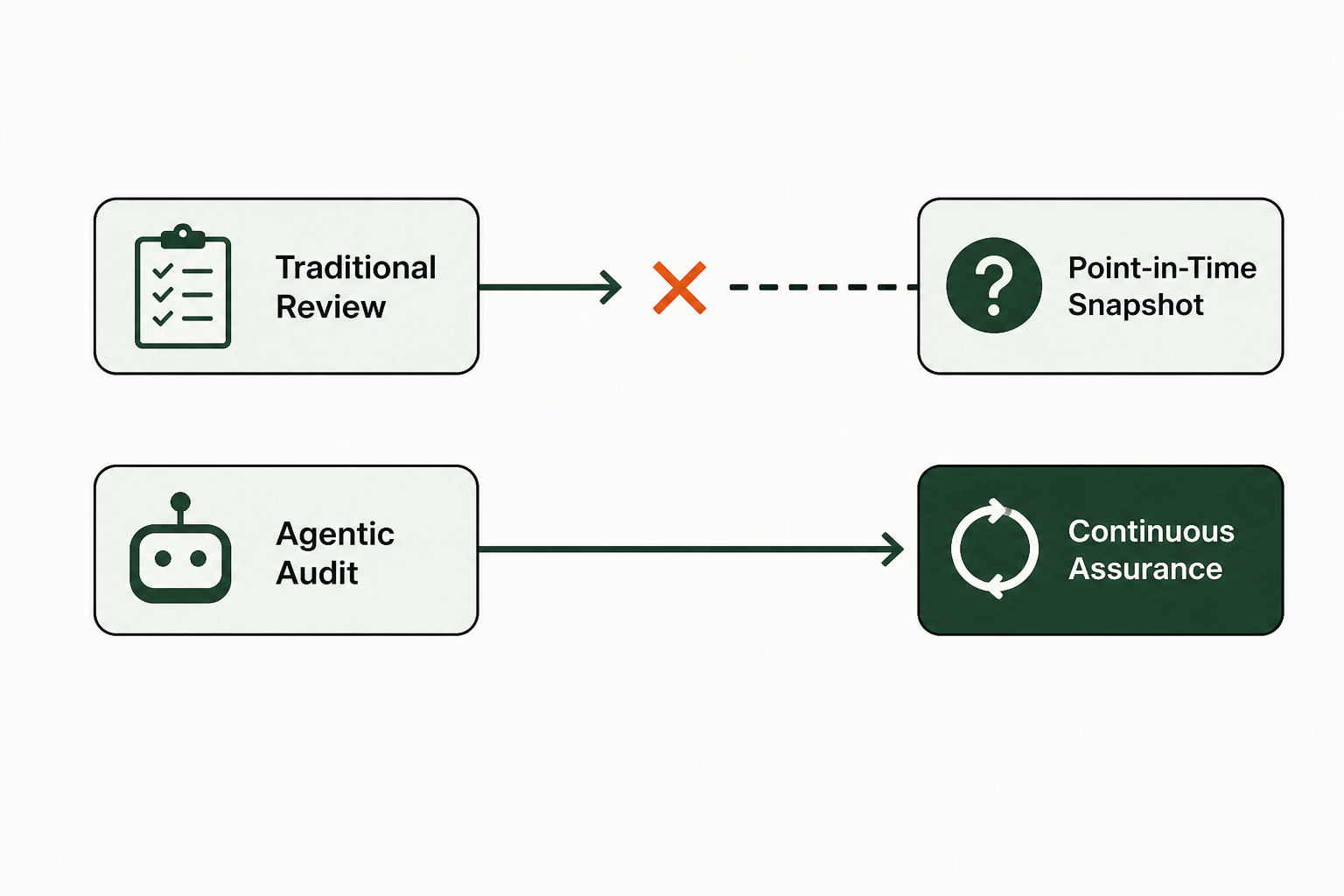
With the terms clear, the harder issue is scope. Traditional AI model reviews often focus on inputs, outputs, accuracy, bias, drift, data lineage, and model performance against defined test sets. Those controls still matter, but they do not cover the full risk surface of an autonomous agent.
The difference begins with iteration. AI agentic audit workflows, characterized by iterative refinement and specialized tool use, can execute advanced audit procedures. That means the audit target is not one prediction or one response. It is a sequence of decisions that may branch depending on intermediate results, retrieved documents, tool errors, human feedback, or system state.
Research on agentic auditing describes agentic systems as capable of a wide range of actions and adaptive enough that auditors can mandate multiple interacting agents for increasingly complex tasks. That creates audit questions that a static model review usually does not answer:
- Which agent made the decision if multiple agents participated in the workflow?
- Which system state was visible when the agent chose its next action?
- Which tool call changed the record and whether that call was authorized?
- Which checkpoint failed or passed before a high-consequence action completed?
- Which fallback path ran when the intended action did not match reality?
 How agentic AI audits differ from traditional AI model reviews
Agentic AI also changes the role of human oversight. Deloitte describes agentic systems as able to execute complex workflows with less supervision, with full human-in-the-loop monitoring to adapt when encountering errors or suboptimal results. The audit therefore needs to verify both automation and escalation. A system that routes every action to a person may be safe but economically weak. A system that routes nothing to a person may look efficient until a boundary case creates exposure.
The examples show why the review expands beyond output quality. Embedded agents within Deloitte's Omnia can automate tasks such as gathering and comparing data from diverse sources, managing complex project plans, and researching transaction fact patterns. In a traditional review, the output might be a comparison table or research summary. In an agentic audit, the review covers where the data came from, how conflicts were handled, whether the project plan changed a downstream assignment, and whether the research conclusion had enough evidence to support the next action.
That is why governed execution becomes central. The enterprise does not need an open-ended agent with broad rights and a weak memory of what it did. It needs bounded authority and deterministic workflows where predictability is required, plus an audit trail that lets reviewers reconstruct the decision chain without guessing.
Beyond agent frameworks: the need for a governed execution layer
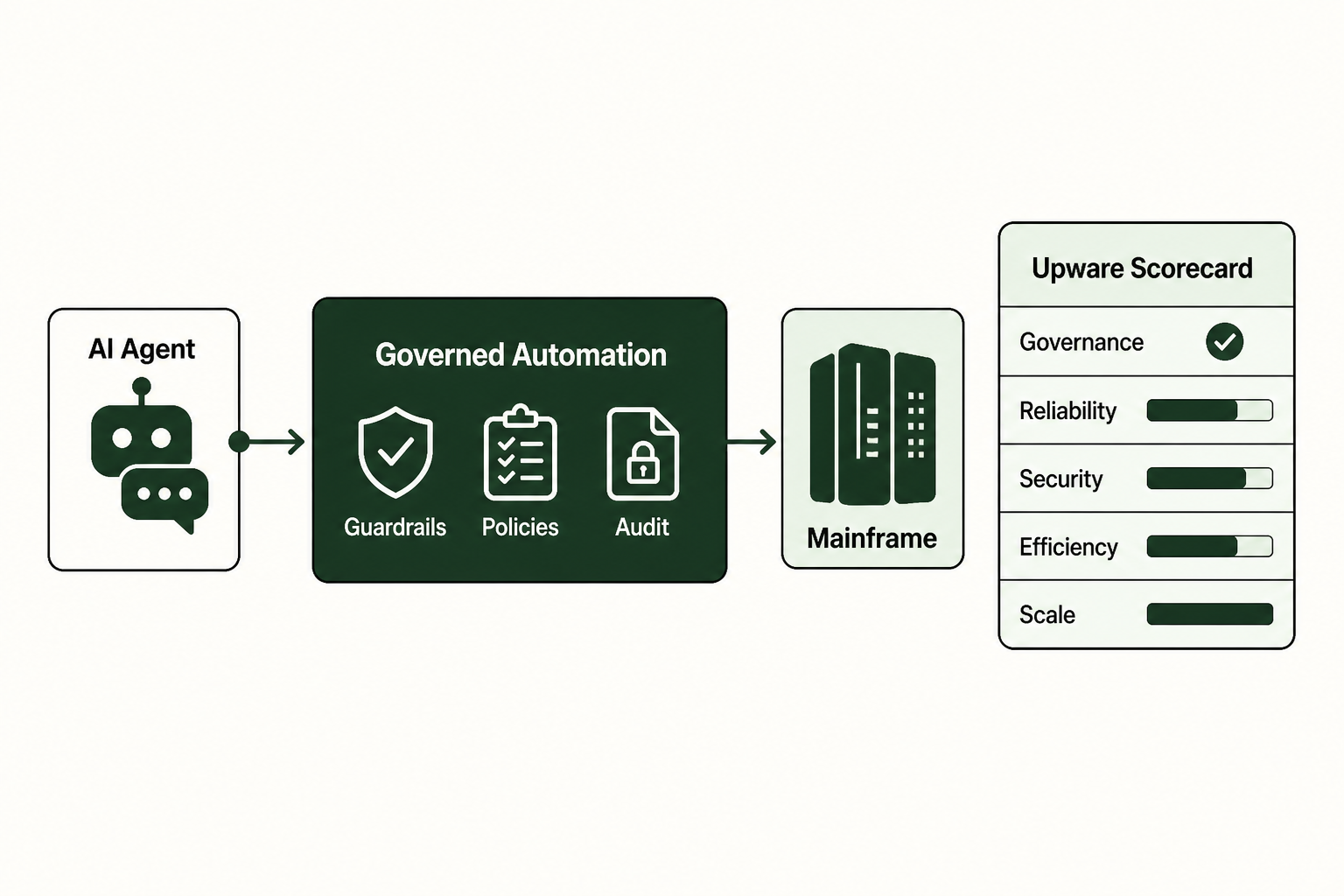
That expanded audit scope exposes a gap in many agentic AI implementations. Conversational agent platforms and agent engineering frameworks can be useful, as can integration and orchestration platforms, for building agents and connecting tools while coordinating tasks. They help teams move from prompt experiments to working prototypes. What they often leave unresolved is the governed execution layer between agents and enterprise systems, where permissions, verification, deterministic workflows, state handling, and failure recovery decide whether a live action is allowed. Upware centers on that governed execution layer instead: the agent remains the brain, while the Agentic Harness controls the hands that touch production systems.
This distinction is practical, not cosmetic. Enterprise systems include ERP platforms, claims systems, policy administration tools, CRM records, finance applications, legacy systems, no-API systems, and internal portals with business rules that were never designed for autonomous agents. A prototype can often prove that an agent understands the task. Production approval depends on proving that the agent can act within a controlled path.
The operating requirement is straightforward. Agents should not receive broad access and then rely on prompt instructions to behave. Prompts are part of the control set, but they are not enough for write actions, regulated workflows, or mission-critical processes. The audit should show that each consequential action passed through policy checks and verification checkpoints, plus recoverable process states.
At that point, an Agentic Harness becomes an audit object, not merely an implementation choice. The platform's agentic AI solutions can be deployed in days, and they offer 100% predictability in runtime. That does not mean all AI risk disappears, and it does not remove the need for enterprise governance. It means the runtime path can be made predictable enough for audit review because the execution layer constrains how agents operate.
For a CIO, CAIO, Head of AI, enterprise architect, or security leader, the practical test is simple: if a compliance reviewer asks how an agent was authorized, what it saw, what it changed, and why the action was permitted, the answer should come from the governed execution record, not from a meeting full of reconstruction.
A framework for governed execution in agentic audits
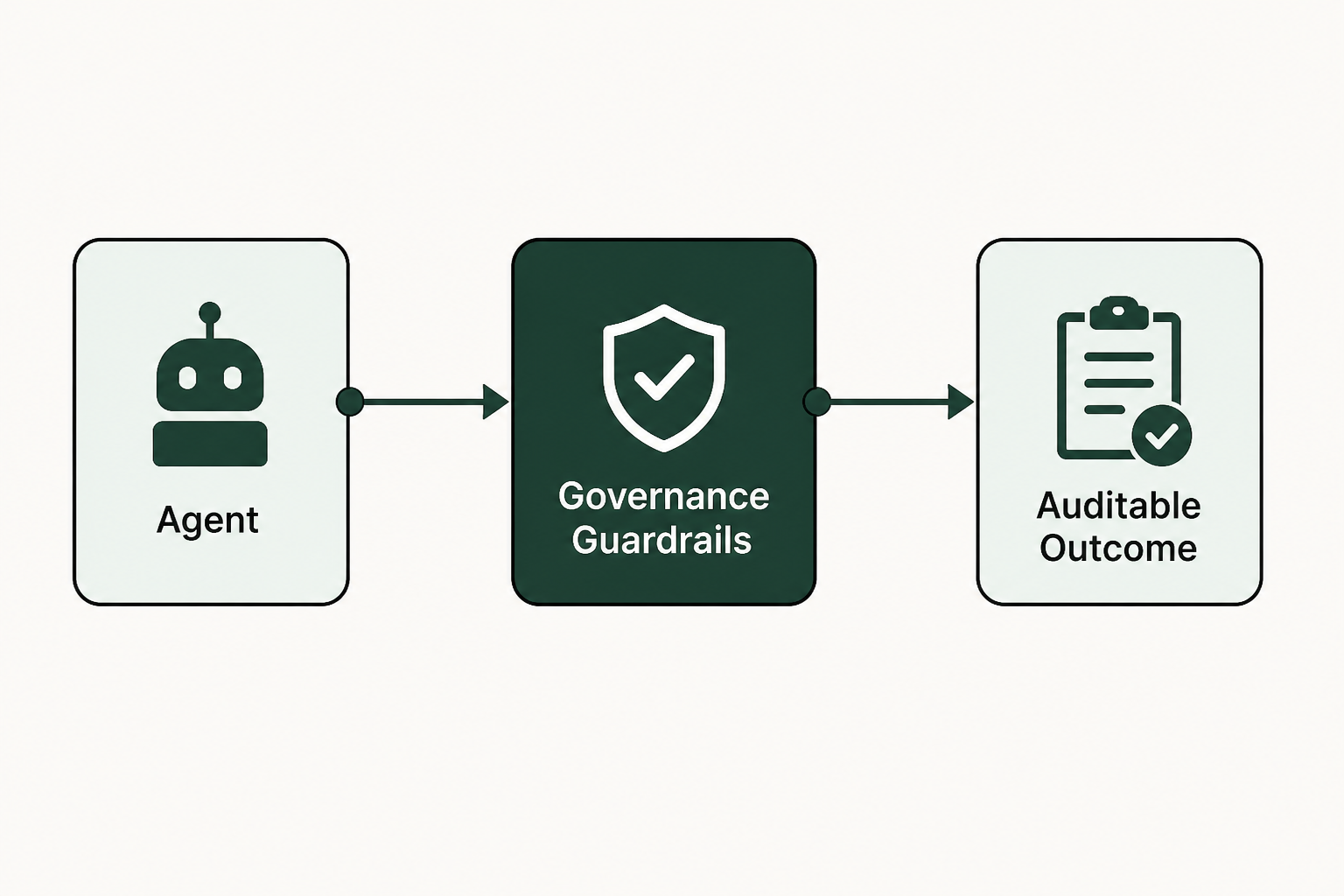
The architectural answer is an operating layer that makes control visible before agent action, while it occurs, and after it finishes. An Agentic Harness gives enterprise agents a controlled path: context is captured, connectivity is bounded, compliance checks are enforced, cost is managed, and control remains visible to the people accountable for production systems. In plain terms, it is the hands that let the agent act without letting it improvise every operational move.
NIST's work on traceability points in the same direction. NIST's Information Technology Laboratory (ITL) AI Program hosted a technical webinar on April 7, 2026, focusing on developing automated measurement tools, called probes, to build traceability into agentic AI ecosystems. Those probes can be executed as part of an active agentic workflow for immediate feedback or applied as post-hoc evaluations, returning a structured verdict with a rationale detailing exactly how the source supports or fails to support the claim. That pattern is useful for enterprise audits because it treats evidence review as part of the system, not an afterthought.
A governed execution framework should cover five operational checks:
- Context capture records the documents, records, user instructions, system state, and business data the agent used before acting.
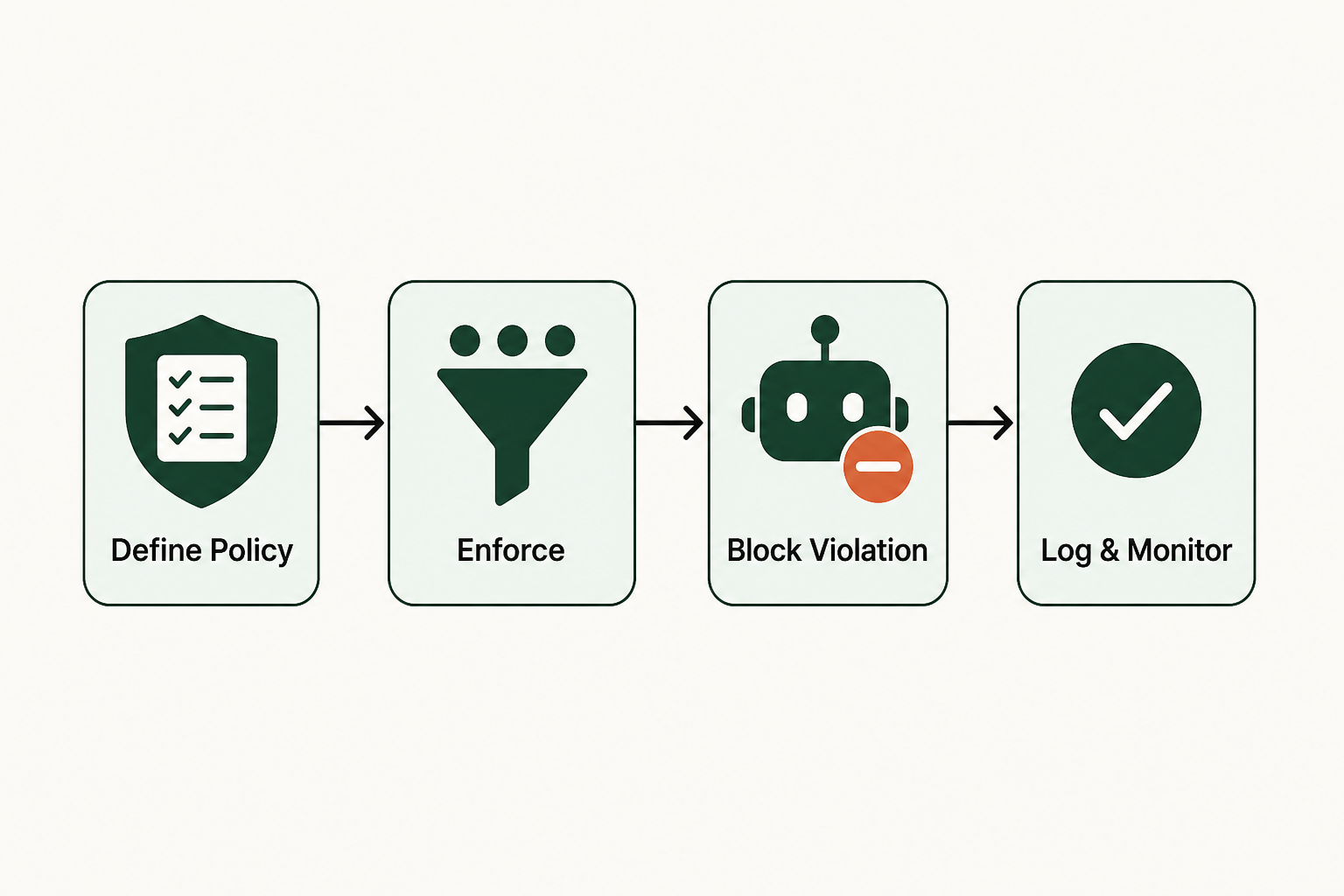
- Policy enforcement checks whether the proposed action is allowed for the role, workflow, risk level, jurisdiction, or customer state.
- Verification checkpoints test whether the agent's claim or planned action is supported by evidence before the system changes.
- State management records where the workflow stands, what has completed, what failed, and what requires human review.
- Failure recovery defines what happens when reality differs from the agent's plan, including retry limits, rollback paths, and escalation.
 A framework for governed execution in agentic audits
The NIST probe examples are useful because they separate different evidence failures. A claim can be unfaithful (anti-hallucination) when the source does not actually support it, incomplete (anti-cherry-picking) when it ignores the source's full message, or insufficient (anti-overreaching) when the source cannot carry the evidentiary burden the claim requires. Enterprise actions have similar failure modes. A customer refund may be based on the wrong policy. A compliance escalation may omit a contradictory record, while an inventory change may use evidence that is too thin for the business rule.
That is why deterministic workflows and governed execution belong together. The agent may reason about a case, but the execution layer decides which path can run. If the evidence is strong, the workflow may proceed. If the evidence is incomplete, the workflow can pause for review. If the agent calls a tool outside its authority, the action can be blocked and logged.
The Upware platform applies this idea through an Agentic Harness around enterprise processes. For audit purposes, the important point is architectural: controlled execution creates records that can be reviewed. Results from NIST's experimental testbed are stored in a structured audit trail alongside the report, to assess agent actions and outputs. The audit record should show the work, not merely assert that the work was safe.
Putting audits into practice: next steps for your enterprise
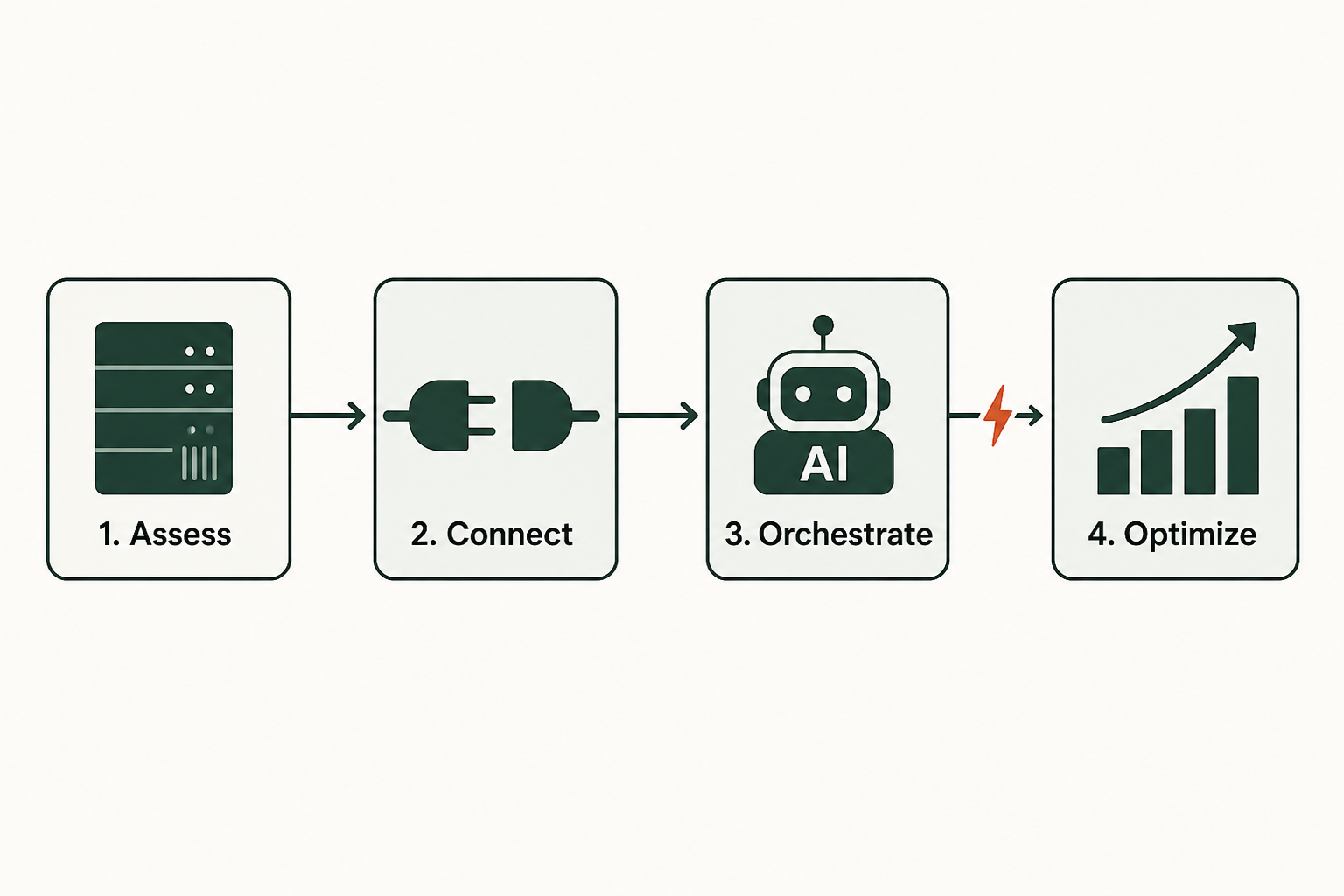
The framework only matters if it changes what teams inspect before agents receive production authority. Start by identifying the workflows that touch consequential systems, especially workflows with write actions, regulated data, customer impact, financial movement, or operational recovery requirements. Those are the places where an agentic AI audit has the clearest purpose.
Then inspect the gap between the agent and the system it affects. If approvals live in chat messages, if logs show tool latency but not decision rationale, or if a human reviewer cannot see which evidence supported the action, the audit will struggle. Metrics are useful, but they do not replace a decision trail.
A practical first pass can group workflows into three categories:
- Read-only workflows need evidence grounding, source tracking, and output review.
- Assisted-action workflows need human approval, policy checks, and clear escalation points.
- Autonomous-action workflows need governed execution, deterministic workflows, verification checkpoints, and recoverable failure states.
For a deeper governance path, read about implementing an AI agent governance framework before expanding production authority. The honest trade-off is that controlled execution adds structure. That structure is the price of letting agents act inside real enterprise systems without turning every incident review into forensic guesswork.
Discover agentic AI audits: understand risks, ensure responsible deployment.
Now that you understand agentic AI audits, what's your next step?
Deepen your knowledge of agentic AI governance or discuss your enterprise's specific audit needs.
Frequently asked questions
What benefit should I expect from an agentic AI audit?
The main benefit is confidence that agentic workflows executed correctly and within policy. That confidence comes from visibility into the reasoning chain and tool usage, as well as the evidence, approvals, and actions behind each decision. For enterprises, the value is not a vague statement that an agent is safe. It is a reviewable record showing what the agent saw, what it called, what it changed, and why the action was permitted.
How do I get started with auditing my company's AI agents?
Start with the workflows where agents can affect enterprise systems, customer outcomes, regulated data, or financial records. Map the action path from goal to system change, then check whether you have evidence capture, policy enforcement, verification, human escalation, and a durable audit trail. If the agent already acts through a governed execution layer, the audit can focus on whether those controls are complete and consistently applied.
Who should own agentic AI audits in the enterprise?
Ownership usually needs to be shared because agentic risk crosses functions. The executive sponsor may be the CIO, CAIO, or Head of AI, while security, compliance, internal audit, enterprise architecture, and process owners each review different parts of the control set. The cleanest model gives one accountable owner authority over the audit process, with clear input from the teams that understand the systems and policies, plus the operational consequences.
What mistakes should I avoid when implementing agentic AI?
The most common mistake is treating a useful prototype as a production-ready system. Stand-alone generative AI can help with documentation review, drafting, and research, but it can lose context, produce inconsistent outputs, and require substantial human oversight when asked to execute workflows. For agentic AI, the risk grows when teams rely on prompts instead of governed execution, skip audit trails, or give agents broad tool access before defining policy checks and escalation paths.