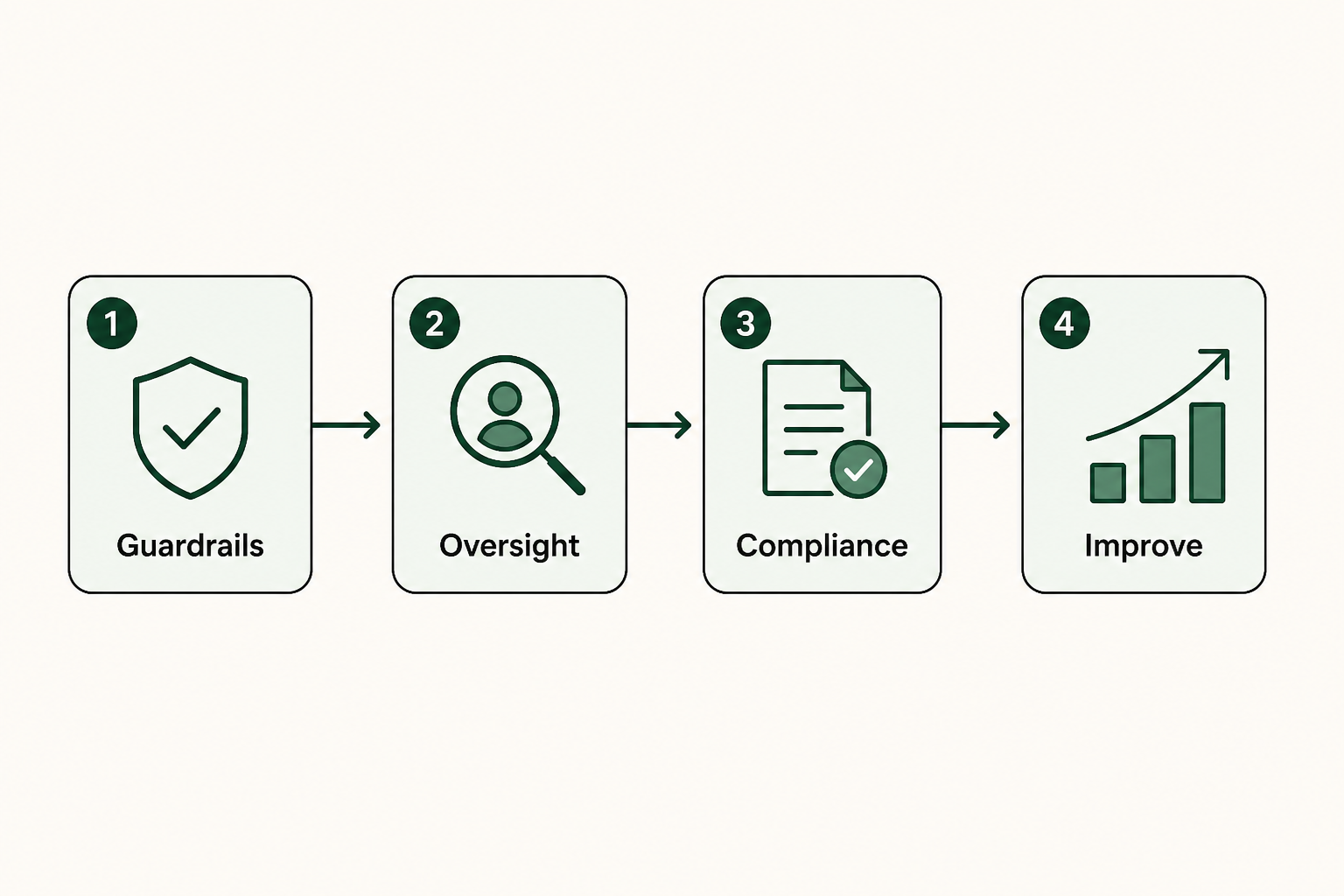
Choosing AI agent guardrails: the stakes
AI agent guardrails are the controls that bound what an AI agent is allowed to do before it touches an enterprise system. For low-consequence work such as drafting, summarizing, and classifying, prompt-based and in-model controls are enough. For agents that write to systems of record, trigger payments, or handle regulated data, the stronger choice is a governed execution layer: an Agentic Harness that turns a model's proposed action into a policy-checked, auditable system change.
A useful agent becomes harder to approve the moment it can change a record or send a message, then trigger work inside a system the business depends on. For the CIO, CAIO, or Head of AI, the useful question has shifted from whether agents can help to how the organization controls them without turning every production action into an unmanaged model decision.
That control gap shows up in enterprise adoption data. Deloitte found that only 21% of enterprises report mature governance for agentic AI, even as surveyed organizations expect much broader agent use by 2027, including 74% expecting at least moderate use. The risk is practical rather than theoretical. A pilot can pass a demo, then stall when security and compliance teams, along with operations, ask who approved the action, what data the agent saw, which system it changed, and how the decision can be audited.
 Choosing AI agent guardrails: the stakes
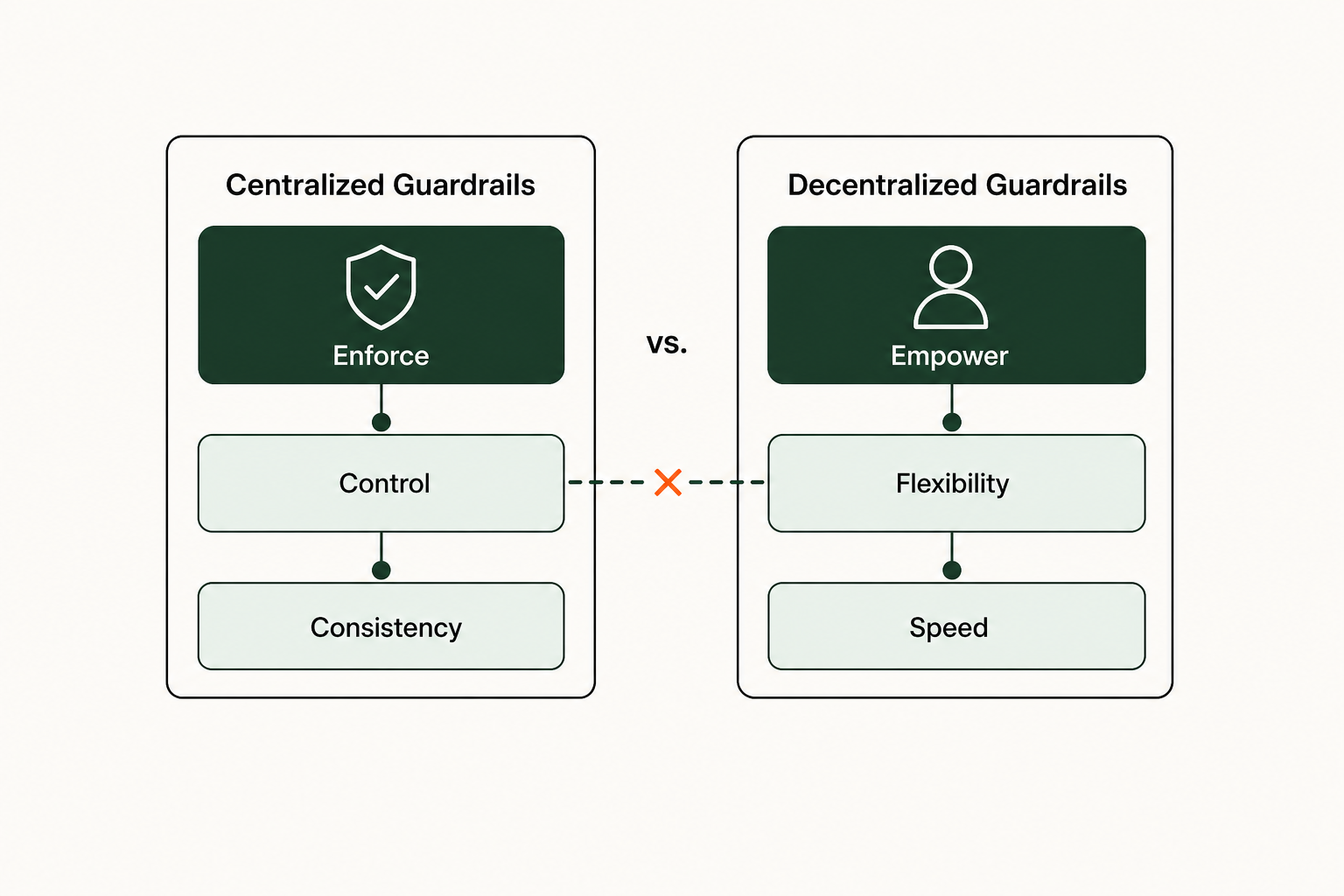
The verdict: which guardrail approach is right for you?
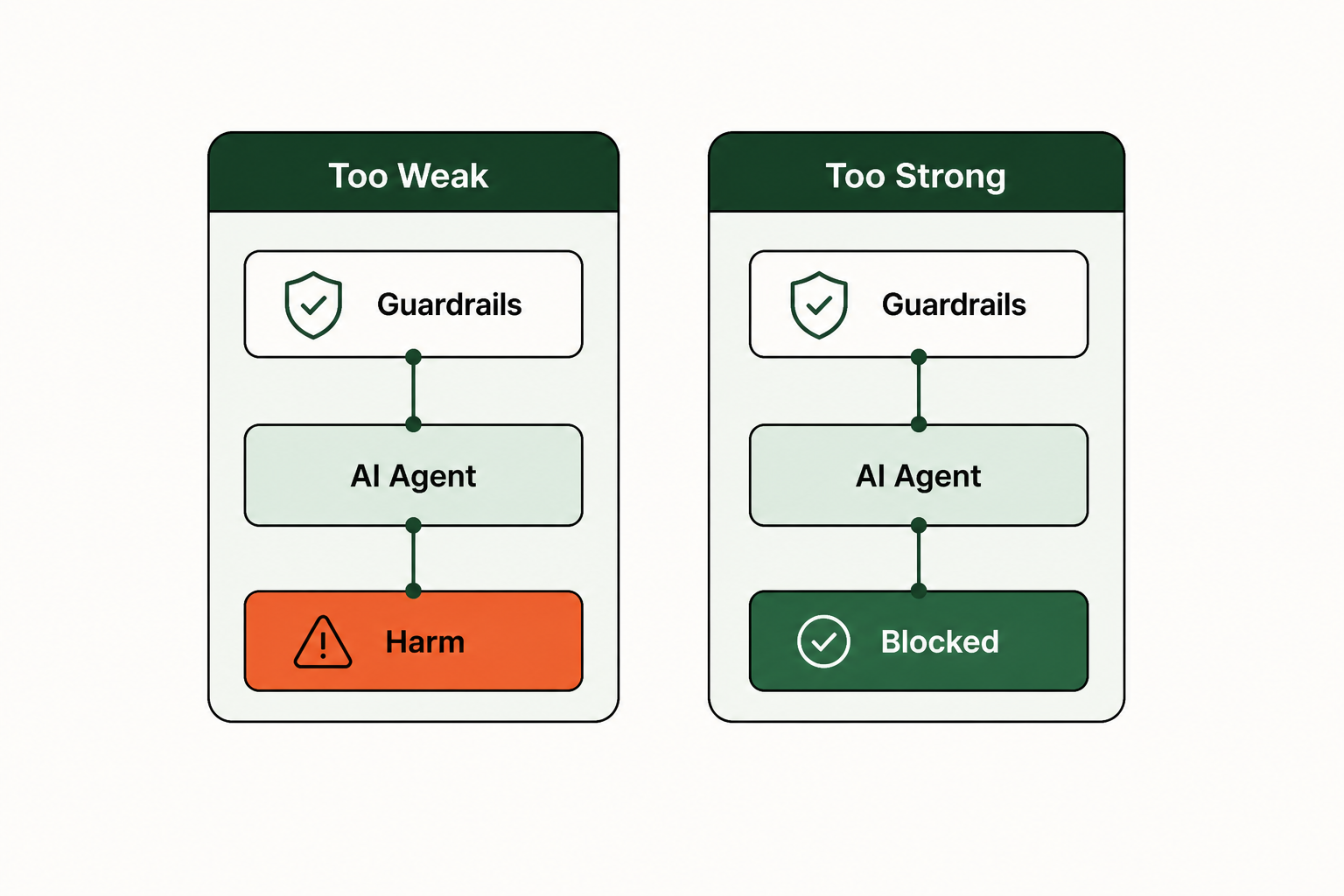
Prompt-based controls are acceptable for low-consequence tasks, but they are thin protection for agents that act across enterprise systems. For production workflows that touch regulated data, customer records, finance operations, claims, inventory, or other consequential systems, the stronger choice is an Agentic Harness with governed execution.
Prompt instructions, model-native policies, and post-response filters can reduce obvious misuse. They help at the edge of the interaction, especially when the agent is summarizing, drafting, classifying, or recommending without taking action. They also fit early experimentation because teams can add them quickly and test whether a use case deserves more investment.
The weakness appears when the agent becomes operational. A 2026 arXiv paper on runtime governance for agentic systems describes agents as non-deterministic and path-dependent, meaning their behavior cannot be fully governed at design time, and it argues that controls built for deterministic systems cannot express or enforce the path-dependent constraints agents require. That is a hard limit for AI agent guardrails that live mainly in prompts, because the risk often emerges from the sequence of actions, not from any one instruction or tool call in isolation.
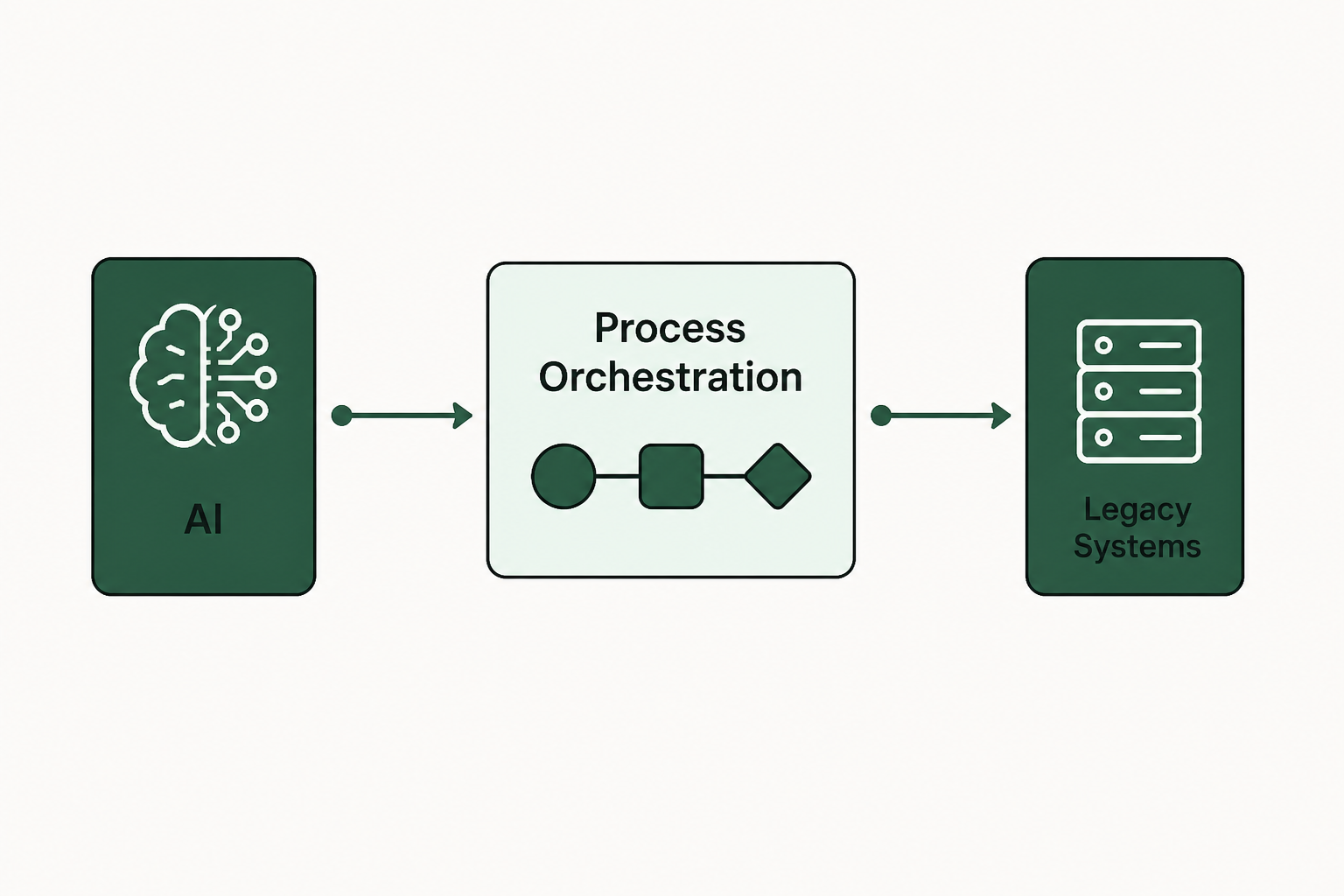
For high-consequence execution, the safer operating model is to separate reasoning from execution. Agents supply the reasoning. The governed layer supplies the execution path. In that model, governed execution happens through an execution layer that mediates what the agent can do, checks policy before action, records state, verifies outcomes, and escalates where required. The important shift is practical: the model can propose an action, but deterministic workflows decide how that action becomes a system change.
That does not put every enterprise workflow in the same control tier. A support-drafting assistant and an agent that updates a core banking record do not deserve the same governance budget. The decision turns on consequence, system access, audit exposure, and recovery needs. If the agent only produces text, start with prompts and model controls. If the agent acts on enterprise systems, choose governed execution.
The 4 dimensions of effective agent governance
A clear comparison needs objective criteria, because vendor feature lists often blur the issue. They describe what a tool can configure, while enterprise leaders need to prove what the organization can control and observe, and how well it can recover.
Large-enterprise leaders have been explicit about the bar. A 2026 KPMG survey of large-enterprise leaders, cited in runtime governance research, found that 75% name security, compliance, and auditability as the most critical requirements for agent deployment. That points to four practical dimensions:
- Action control asks whether the organization can bound what the agent may do before it touches enterprise systems.
- Path awareness asks whether the control system can evaluate the chain of steps, rather than each step as an isolated event.
- Audit evidence asks whether reviewers can reconstruct what the agent saw, called, decided, and changed.
- Failure handling asks whether the workflow can verify outcomes, recover from mismatch, and route exceptions to a human.
The EU AI Act provisions for high-risk AI systems apply as of August 2026, which raises the cost of vague governance for regulated or rights-affecting workflows. The closer an agent gets to consequential execution, the more those four dimensions matter.
Comparison matrix: guardrail approaches
Read the matrix as a statement about operational limits, not a vendor feature list. "Medium for simple tasks" means a prompt-level control can refuse a single obvious request, such as emailing a customer list, while offering little protection once the same outcome is assembled from several reasonable-looking steps. Path awareness separates the two approaches: it asks whether the control system can judge a chain of actions against policy and live system state. Audit evidence and failure handling follow from it, because both depend on a layer that observed the whole path.
| Guardrail approach | Action control | Path awareness | Audit evidence | Failure handling | Best fit |
|---|---|---|---|---|---|
| Prompt-based and in-model controls | Medium for simple tasks | Low for multi-step actions | Limited to logs and model traces | Weak unless manually added | Drafting and summarization, plus recommendations |
| Agentic Harness with governed execution layer | High for bounded system actions | High through deterministic workflows | Stronger because execution is recorded | Stronger through verification and escalation | Regulated operational workflows that span systems |
The matrix treats AI agent guardrails as a control decision, not a model-tuning exercise.
Approach 1: prompt-based and in-model controls
Prompt-based guardrails are the common starting point. They tell the model what it should and should not do, while in-model controls may add moderation, tool restrictions, structured outputs, or policy text around the interaction. The approach is familiar and fast to test; it is also good enough when the agent cannot directly change systems.
For low-consequence work, that is a rational trade-off:
- The approach uses instructions, policies, tool limits, and model-side checks to shape the agent's response or tool selection.
- The governance cost is that control depends heavily on prompt quality, model behavior, and after-the-fact inspection.
- The breaking point comes when the violation depends on a sequence, a system state, or a business rule outside the model context.
The path-dependent problem is the critical one. A single database read may be permitted, and a single external email may also be permitted. Put those steps together, though, and the sequence can become a potential exfiltration event, while inspecting either step alone does not reveal the violation. A prompt-level control sees a permitted read at step one and a permitted send at step two. It does not see that the recipient sits outside the company and that the payload is the record it just read, because neither fact lives in the instruction it is checking. Prompt text is poorly suited to enforce that kind of chain-level rule across live systems.
Prompt controls remain a necessary layer for tone, content boundaries, refusal behavior, and tool-use discipline. They are not sufficient AI agent guardrails for operational execution. Once an agent can write to a system of record, trigger a payment path, open a claim, or email regulated data, the enterprise needs control outside the model's own reasoning loop.
Approach 2: the Agentic Harness and governed execution layer
The alternative focuses on the agent's actions rather than the agent alone. An Agentic Harness is the controlled governed execution layer between an AI agent and the enterprise systems it wants to change. In plain language, it turns an agent's proposed action into governed execution: policy checks and deterministic workflows, system calls and verification, state tracking, and human escalation where the action requires approval.
That architecture matters because the agent remains probabilistic, while the execution path can be made predictable. The model can decide that a customer record needs an update, but the execution layer decides whether the update is allowed, which fields may change, which system should be called, what evidence must be recorded, and what happens if the system response conflicts with the plan. For enterprise teams comparing enterprise AI integration methods, that distinction is usually the point where a promising pilot becomes a production design.
- The approach is a governed execution layer that mediates agent-to-system work through deterministic workflows.
- The governance cost is that teams must define policies, action boundaries, verification points, and exception paths before scaling sensitive actions.
- The breaking point is casual experimentation where no system action occurs and governance requirements are minimal.
Agent engineering frameworks do useful work for building and orchestrating agents, especially around prompts and memory, plus tools and multi-agent coordination. They leave unresolved the operational question of how an agent's proposed action becomes a controlled change inside enterprise systems. Like the incumbent platforms, but Upware centers on the governed execution layer between agents and enterprise systems.
The measurable gains are narrow and operational: deployment in days and up to 80% lower token costs. They also include 100% predictability in runtime, a claim scoped to the execution path the layer controls at runtime, and one that does not cover model output quality or the elimination of AI risk. The harness is what makes agent execution predictable, compliant, and cost-disciplined at runtime, because consequential actions stay inside deterministic workflows and the business can prove what happened after the model made a recommendation.
Recommendations by role and requirement
The right path depends on how much authority the agent has and what the organization must prove after the fact. The more direct the agent's system access becomes, the less credible prompt-only governance looks.
- If you are a CIO moving from pilot to production, use governed execution for workflows that change records or trigger downstream work, especially when they touch regulated data. Prompt-only controls leave too much of the execution path inside the model's behavior.
- If you are a CAIO standardizing agent governance, use prompt-based controls for model behavior, but require governed execution for live system actions. That split keeps experimentation moving while protecting production systems.
- If you are a CISO or security leader, prioritize path awareness and audit evidence. A control that cannot evaluate the sequence of actions will miss violations that only appear across steps.
- If you are an enterprise architect, focus on the execution layer, especially where agents need to work across legacy systems and no-API systems, as well as systems of record with strict change controls.
- If you own compliance or audit, choose deterministic workflows for high-risk actions because they create a clearer record of policy checks, approvals, system calls, and exception handling.
- If the agent only drafts or summarizes, or it only recommends, prompt-based AI agent guardrails may be enough to start, provided the agent cannot execute consequential changes without a controlled handoff.
Your next step: secure your agent deployment
Prompts still matter. They shape model behavior and reduce bad outputs; they also help teams move quickly in low-consequence use cases. They should not carry the burden of governing consequential execution inside enterprise systems.
A production agent needs a bounded action path, auditable evidence, verification, and recovery when the real system state differs from the plan. That is what governed execution provides. The trade-off is that control has to be designed before broad deployment, but that design work is what lets useful agents move beyond demos without asking the business to trust an open-ended model.
The practical first move is narrow. Take the one agent workflow that has a business case but cannot get approved, write down the actions it may perform, the policies to check, the approvals a human owns, and the evidence an auditor will ask for, then run that workflow through a governed execution layer before widening scope. If those four lists cannot be written, that is the finding, and it is cheaper to learn on one process than across a portfolio.
 The verdict: which guardrail approach is right for you?
Put audit-ready guardrails behind your own agents
See how the Agentic Harness enforces them, or book a walkthrough against the systems you already run.
Frequently asked questions
What is the main benefit of using an Agentic Harness for guardrails?
The main benefit is controlled execution. An Agentic Harness lets an enterprise keep agent reasoning separate from system change, so consequential actions pass through policy checks, deterministic workflows, verification, and audit capture. For large enterprises where security, compliance, and auditability are central requirements, that separation is the difference between a useful assistant and an agent that can be approved to act.
How do I get started with implementing governed execution for my AI agents?
Start with one workflow where the agent already has a clear business case but cannot be approved because it needs system access or write authority. Define the permitted actions, the data the agent may use, the policies that must be checked, the human approvals required for high-consequence steps, and the audit evidence reviewers need. The approved proof point for the platform is deployment in days, but that still requires a real setup process around policies and workflow boundaries.
Who are AI agent guardrails like an Agentic Harness designed for?
They are designed for midsize-to-large enterprises with production agent workflows, especially regulated or complex environments where agents need to act across enterprise systems. The likely buyers include CIOs, CAIOs, Heads of AI, enterprise architects, security leaders, and compliance owners who need proof of what an agent saw, called, decided, and changed.
Why can't I just use prompt engineering for my AI agent guardrails?
Prompt engineering can shape the agent's behavior, but it cannot fully govern non-deterministic, path-dependent execution at design time. The harder risks appear across a chain of actions, such as reading one system and sending information through another channel. If the control only inspects individual steps or model text, it can miss the policy violation created by the sequence.
How do deterministic workflows help with AI agent compliance and audit?
Deterministic workflows give the enterprise a known execution path for sensitive actions. They define what checks happen, what system calls are allowed, what evidence is captured, when a human must approve, and how exceptions are handled. That makes audit review more concrete because the record covers the action path, not only the model output or a generic activity log.