Executive verdict: governing autonomous agents with an execution layer
Verdict: 4.4 / 5. A safe production design separates an agent's reasoning from its authority to change enterprise systems.
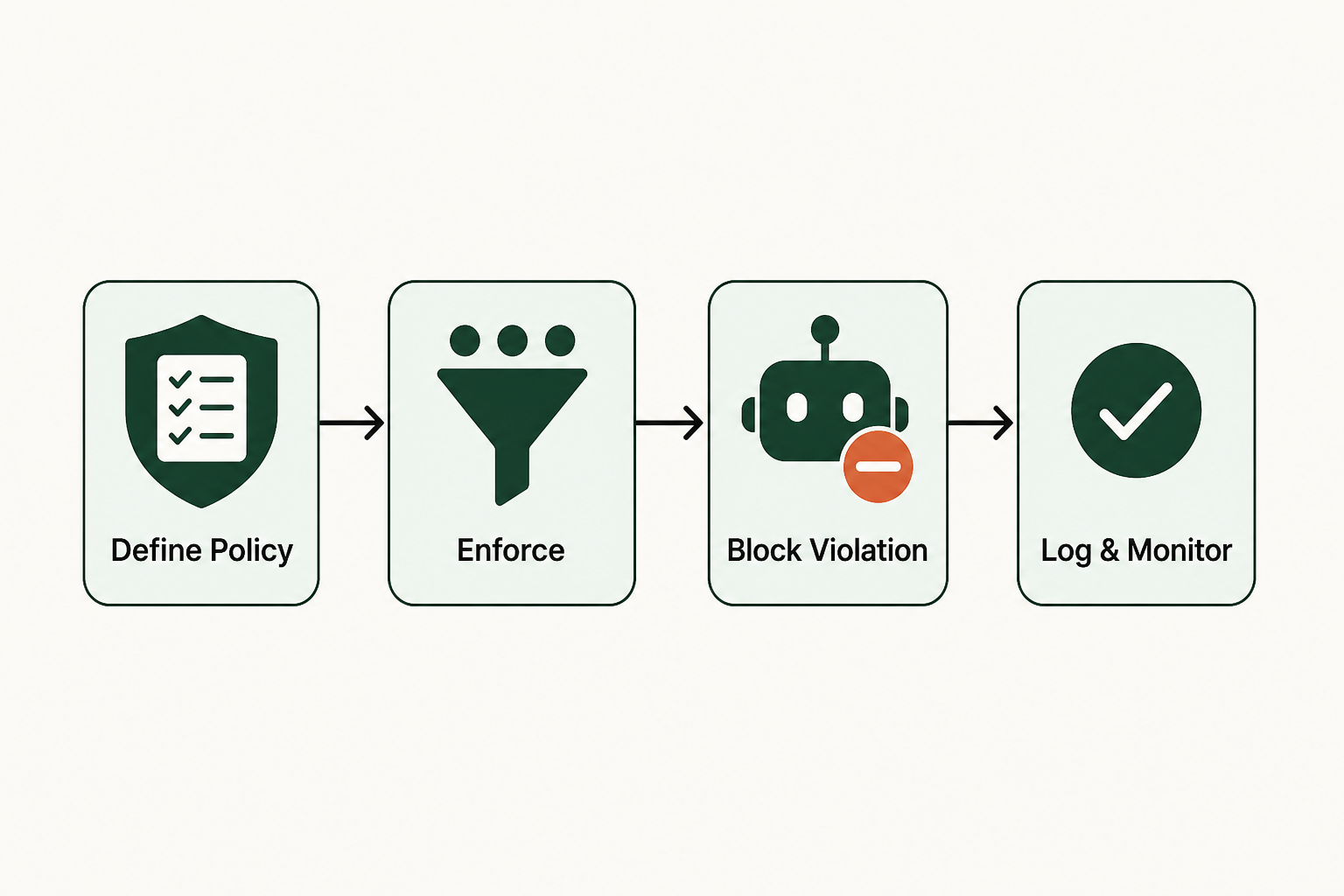
A write-enabled agent that can update a customer record, approve an exception, or trigger a financial workflow without a hard approval stop creates liability the business may struggle to explain later. The stronger pattern is an execution-layer control that pauses stateful agent workflows at deterministic policy checkpoints. It requires auditable human sign-off and resumes only when the approved action is clear.
The bottom line: rating and core findings
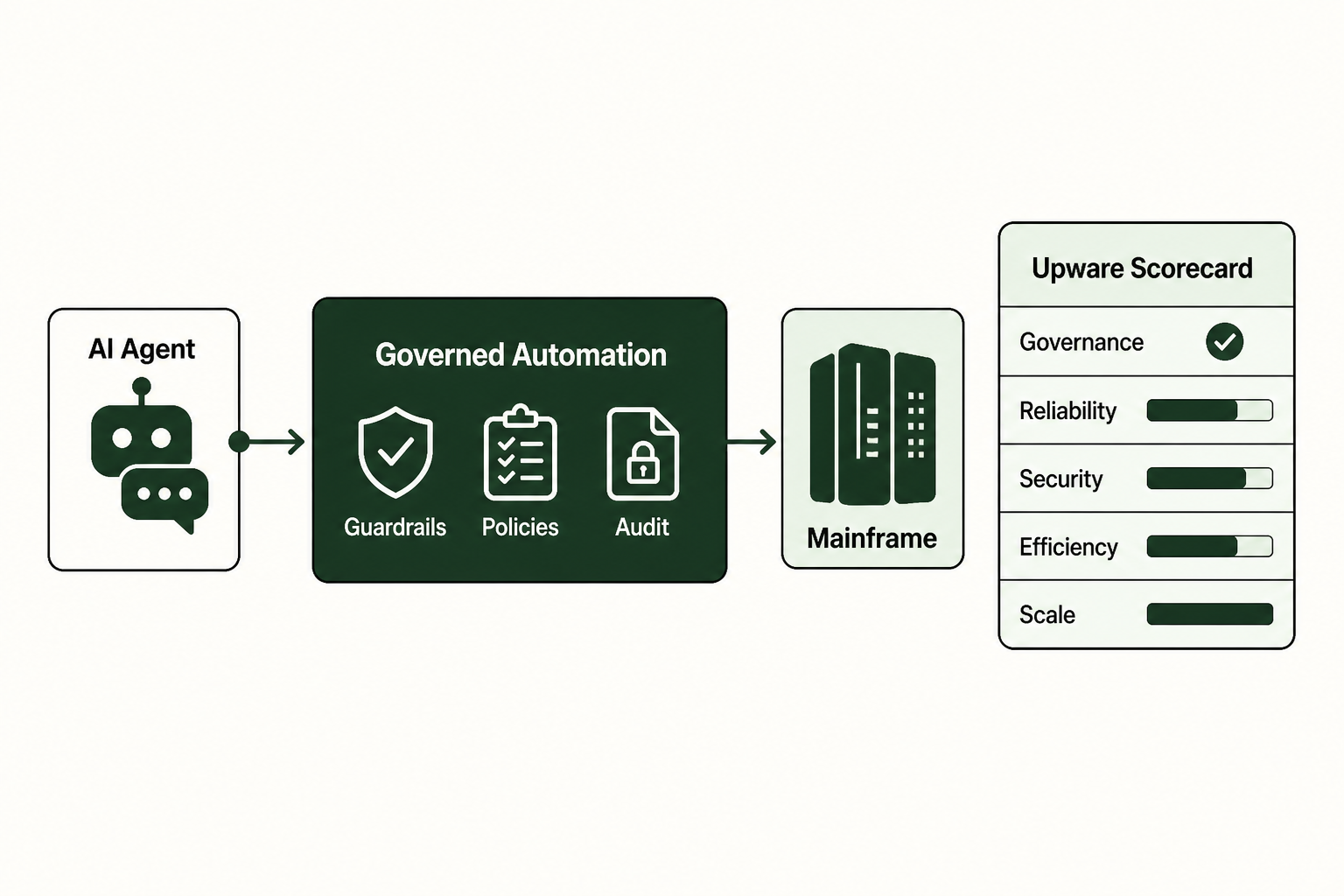
This review rates execution-layer human-in-the-loop governance highly because it addresses the failure mode that blocks many enterprise agent deployments: the agent may reason well, but the enterprise still needs controlled action. The practical design treats the agent as the brain and the Agentic Harness as the hands, so production changes happen through governed execution rather than open-ended model behavior.
The rating is strongest on auditability and production control through policy enforcement. It is weaker on organizational simplicity, because the model works only if business owners define approval policy and reviewer responsibility across exception paths before agents receive write access. That is a healthy constraint, not a flaw.
Why prompt-level guardrails fail in regulated systems
Prompt instructions can tell an agent what it should do, but they do not create a deterministic pause point, preserve approval state, or prove who authorized a consequential action. That distinction matters because trust in agents rises when human review is explicit: PwC found that 37% of surveyed respondents named expert review of high-risk situations as a top factor that would increase trust in AI systems handling important or personal tasks.
A mature AI Agent Governance Framework needs more than model policy. It needs an execution layer that can serialize state and stop the workflow for approval routing. It also needs to record the decision and resume only after the required sign-off. That is the operating difference between advice and governed execution.
HITL governance scorecard: evaluation criteria and performance
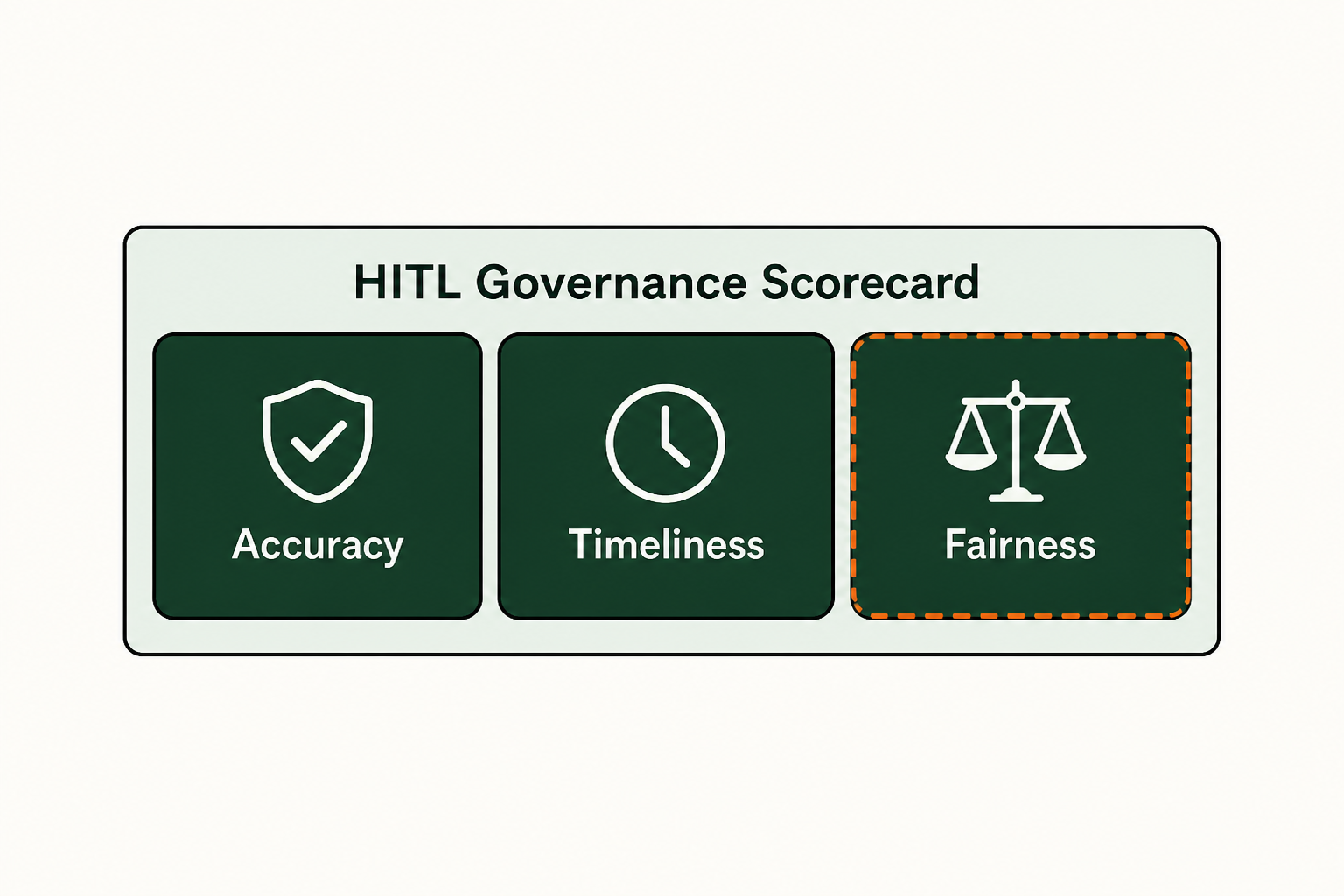
With the core verdict established, the next question is whether this architecture performs under enterprise pressure. The scorecard below focuses on whether agents can act in production without turning every sensitive task into a manual ticket queue.
| Dimension | Score | Assessment |
|---|---|---|
| Auditability | 4.6 / 5 | Strong when every action has state, policy, reviewer identity, and decision record attached. |
| Determinism | 4.5 / 5 | Strong when execution paths are encoded as deterministic workflows rather than improvised by the model. |
| Review latency | 3.9 / 5 | Depends on reviewer capacity, escalation design, and how tightly approval thresholds are scoped. |
| Compliance fit | 4.4 / 5 | Strong for high-consequence workflows where human oversight must be evidenced. |
| Cost discipline | 4.3 / 5 | Strong when the runtime avoids repeated agent loops and narrows model calls to defined steps. |
Operational bottlenecks and review latency
Keeping humans in the loop is not the main operational risk. Trouble starts when that loop is a vague escalation path instead of a queue with policy and ownership, including service expectations. Research on human-in-the-loop systems found that early deployments often underestimate human workload demands, which creates bottlenecks in system performance.
That finding maps directly to enterprise agents. If every uncertain action goes to the same overloaded group, approval becomes the new production bottleneck. The architecture should define:
- Approval thresholds, so low-risk actions can proceed under policy while consequential actions pause.
- Reviewer roles, so decisions land with accountable business owners, not a generic operations inbox.
- Escalation timing, so stalled approvals do not leave workflows half-executed.
- Fallback handling, so the system can recover when the real environment differs from the plan.
Compliance and state serialization dimensions
Compliance depends on whether the system can show what happened, not merely whether a reviewer clicked approve. Article 14 of the EU AI Act requires human oversight for high-risk AI applications, and the same human-in-the-loop research summarizes those Article 14 human oversight requirements as both a legal requirement and an implementation challenge.
That is why state serialization matters. A paused workflow should preserve the agent's proposed action, the evidence it used, the policy checkpoint it hit, the reviewer decision, and the system state at the time of approval. Without that chain, the organization has an approval event but not a defensible audit trail. For a deeper audit design, an internal What Is an Agentic AI Audit model should connect the approval record to the agent's system calls and exception handling.
 HITL governance scorecard: evaluation criteria and performance
Architectural breakdown: the Agentic Harness and governed execution
Once the scorecard is clear, the architecture has to carry the burden. The strongest design pattern is an Agentic Harness, a controlled operating layer that sits between autonomous agents and enterprise systems. In plain English, the agent decides what should happen, while the Agentic Harness controls how anything actually changes.
Execution layer vs. conversational agent frameworks
Conversational agent platforms do useful work when teams need agents to reason, answer, route, summarize, or coordinate tasks across a defined environment. They help teams build and orchestrate agents. What they often leave unresolved is the governed execution layer between agents and enterprise systems, where approvals, state, retries, exception handling, and audit evidence must be enforced before the system of record changes. Upware centers on that governed execution layer instead, so the consequential step is controlled by deterministic process logic rather than left to an open-ended model loop.
That distinction is the core architectural bet. An execution layer differs from a chat surface, a prompt template, and a general identity platform. It is the runtime control point where an agent's proposed action becomes a bounded operation with policy checks and verifiable state.
Deterministic workflows for consequential system actions
Deterministic workflows are the reason this approach is reviewable. If an agent proposes a credit adjustment, policy override, claims action, order change, or account update, the path should be clear before execution begins. The system should know which checks apply, which approvals are mandatory, what evidence the reviewer must see, and what happens if approval is denied.
The practical architecture has five control points:
- Intent capture, where the agent's proposed action is converted into a structured request.
- Policy evaluation, where the request is checked against rules for consequence, scope, and authority.
- Human approval, where high-risk actions pause with enough context for a reviewer to decide.
- System execution, where approved work is performed through controlled connectors or UI automation.
- Audit preservation, where the full decision chain is stored for compliance, incident review, and operational learning.
That is governed execution in a form operators can trust. It does not claim to remove all AI risk. It narrows the action surface and makes high-consequence work inspectable.
For teams designing the evidence model around those checkpoints, agent audit trail implementation should be treated as part of architecture, not documentation after the fact.
Pros and cons of execution-layer HITL governance
These mechanics lead directly to the practical advantages and trade-offs. The model works best when the enterprise accepts that autonomy and approval are not opposites. Agents can keep moving until the consequence of the next step requires a human decision.
Pros
The strongest advantage is controlled trust. PwC's Trust and Safety Outlook found that 85% of US respondents reported confidence in enterprise AI agents conducting at least one task in their daily work, which suggests adoption pressure is real. But confidence in task execution is not the same as permission to change regulated systems.
Execution-layer HITL governance gives teams a way to convert that confidence into production control:
- Clear decision boundaries, because agents can reason broadly while the platform constrains system-changing actions.
- Auditable approval records, because sign-off is tied to state, policy, and the proposed execution step.
- Better failure recovery, because denied or expired actions, along with failed ones, can follow known paths instead of leaving agents to improvise.
- Cost-disciplined operation, because deterministic workflows reduce repeated reasoning loops and keep execution predictable.
The result is not full autonomy everywhere. It is governed execution where autonomy is useful and human approval is reserved for decisions that justify it.
Cons
The trade-off is design discipline. Enterprises must define what counts as consequential, who can approve it, what evidence they need, and how long a workflow may wait before escalation. Poorly scoped approval policies can slow the exact workflows the business intended to automate.
The common failure modes are predictable:
- Approval sprawl, where too many low-risk steps require review and throughput collapses.
- Reviewer overload, where teams underestimate workload and create queues the agent cannot bypass.
- Weak state capture, where the reviewer sees a summary but not enough operational context to make a defensible decision.
- Policy drift, where exceptions are handled informally and the audit trail loses meaning.
These are solvable problems, but the model does not solve them by itself. They require process ownership and policy design, plus a runtime that enforces the path every time.
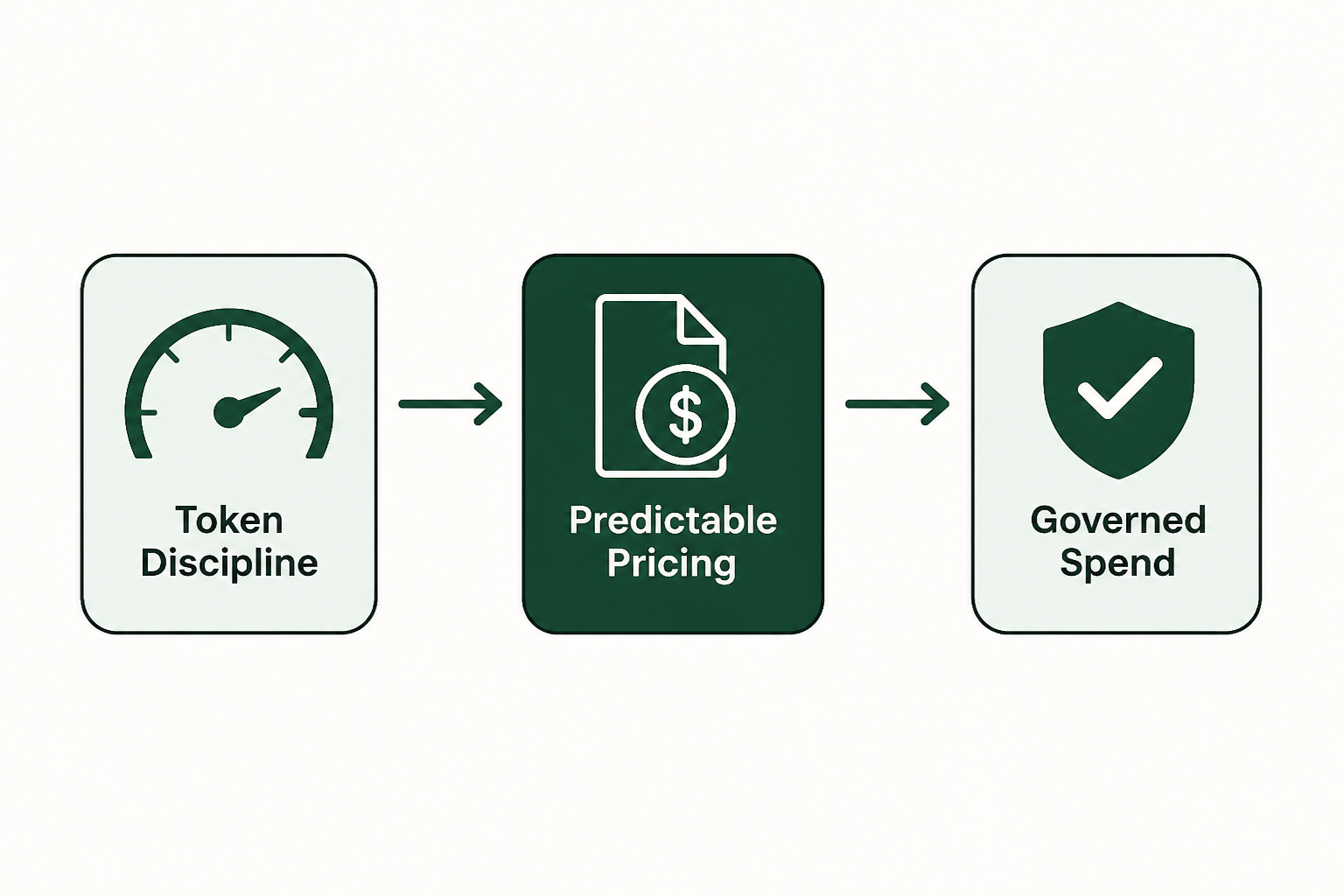
Pricing model: predictability and token discipline
Architecture is only one side of the decision. Enterprises also have to evaluate infrastructure spend and run rates, along with the cost of operating approvals at scale. Public, fixed per-seat pricing is not the right lens for this category because the economic unit is governed execution capacity, not chat access. A practical buyer should price the platform against the number of controlled workflows, systems touched, approval checkpoints, and execution volume.
Deployment tiers and capacity units
The available quantitative proof points are operational rather than list-price based: deployment in days, 0 engineering resources, up to 80% lower token costs, and 100% predictability in runtime. That supports an enterprise pricing conversation built around capacity and control rather than a public self-serve plan.
A realistic tier structure for evaluation should be framed this way:
| Pricing lens | What to ask | Why it matters |
|---|---|---|
| Governed workflow scope | Which deterministic workflows are included in the first deployment? | Scope controls implementation effort and review complexity. |
| System coverage | Which enterprise systems, legacy systems, or no-API systems are touched? | Execution cost depends on the systems where actions occur. |
| Approval volume | How many human checkpoints and reviewer roles are expected? | Review design affects operating cost and latency. |
| Runtime economics | How is token use reduced and measured? | The disclosed benchmark is up to 80% lower token costs. |
| Predictability | What does 100% predictability in runtime cover? | Buyers need clarity on runtime bounds before production approval. |
Upware's pricing should therefore be assessed as an enterprise quote tied to production scope. For buyers comparing it with internal builds, the 0 engineering resources claim matters because custom integration work is often the hidden cost in agent execution programs.
Token efficiency and predictable runtime overhead
Open-ended agents can spend tokens while deciding, checking, retrying, and re-planning. Deterministic workflows reduce that waste by moving repeated operational logic into the execution layer. The model still reasons where reasoning is needed, but the runtime handles policy enforcement, approval routing, state management, and system execution through predefined paths.
That cost discipline is especially relevant for high-volume processes. A workflow that requires a model to reason through every retry and exception can become expensive and hard to forecast. A workflow where the Agentic Harness governs execution can keep model calls focused on interpretation and decision support, then use controlled steps for the rest.
For authorization policy around those actions, enterprise AI agent authorization should be evaluated alongside pricing because uncontrolled access can turn a cheap pilot into an expensive governance problem.
 Pricing model: predictability and token discipline
Implementation roadmap: who should deploy and next steps
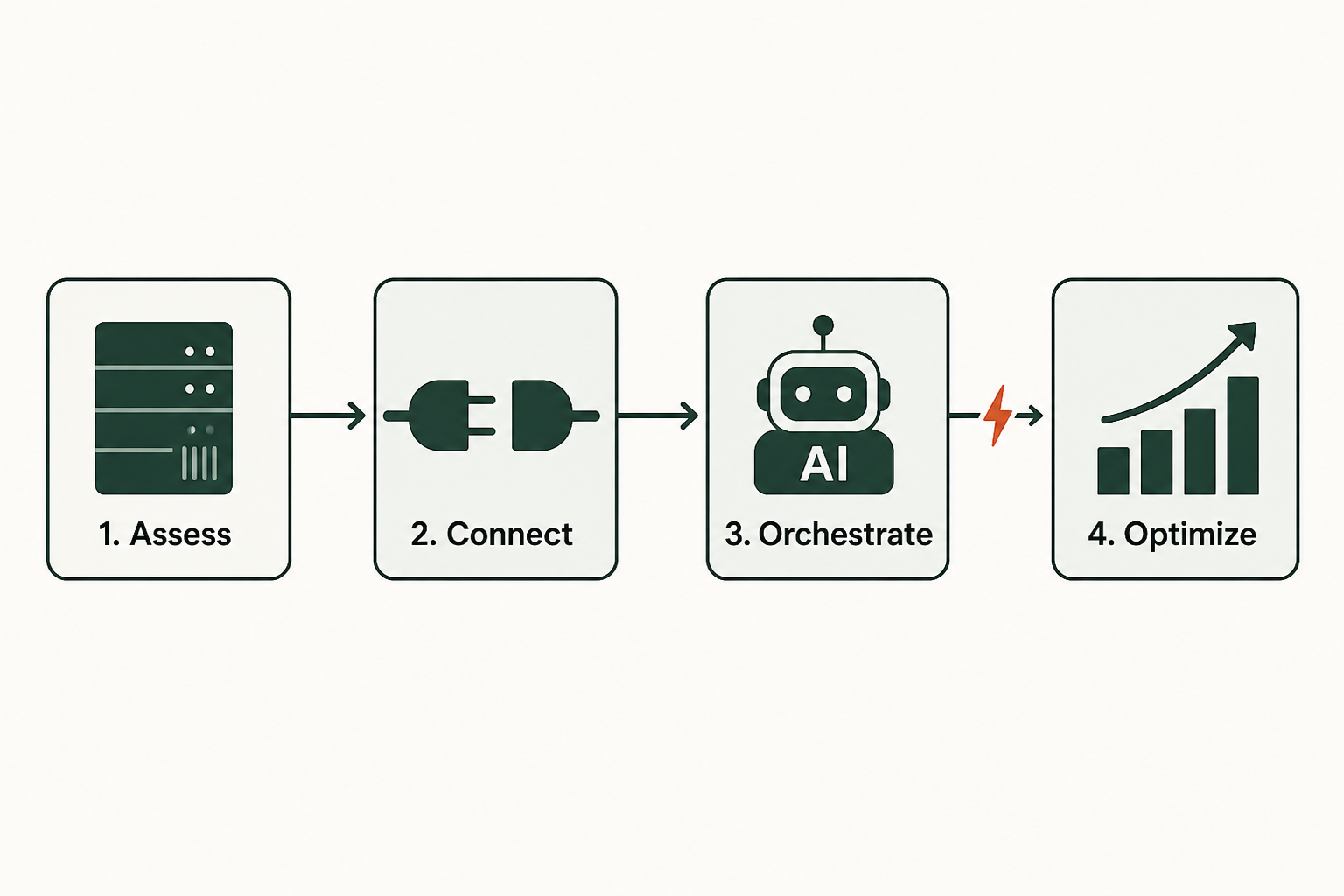
After architecture, performance, trade-offs, and pricing, the final question is fit. This is not a general automation pattern for every company. It is for organizations where agents need to move from recommendations to controlled action in systems that matter.
Who this architecture is built for
The strongest fit is a CIO, CAIO, Head of AI, enterprise architect, or security leader responsible for production agent adoption in a midsize-to-large enterprise. The pattern fits regulated or operationally complex environments where an agent must touch customer, financial, operational, clinical, claims, or ERP workflows, and where the business needs evidence of what the agent saw, requested, approved, and changed.
It also fits teams whose pilots are stuck at the handoff point. If an agent can identify the right action but cannot safely execute it, the missing component is often the Agentic Harness and the approval architecture around it. For risk planning before deployment, AI agent risk management should define the consequence levels that drive approval policy.
When to skip execution-layer governance
Skip this architecture if the agent only drafts content, answers questions, or makes recommendations with no write access to enterprise systems. Also skip it if the organization is unwilling to define policy ownership, reviewer accountability, or exception paths. A governed execution model depends on those decisions.
For production agent work, the next step is straightforward: pick one consequential workflow, define the policy checkpoints, identify the human approvers, and test whether the execution layer can pause the workflow, preserve evidence, handle approval, execute the action, and recover without losing state. If it can, the enterprise has a credible path from agent usefulness to controlled production action.
Architect human-in-the-loop controls into your workflows.
Explore the platform directly or talk through your governance requirements with an engineering specialist.
Frequently asked questions
What is the main benefit of human-in-the-loop governance?
The main benefit is controlled execution of consequential agent actions. Instead of letting an autonomous agent directly change enterprise systems, the architecture pauses the workflow at deterministic policy checkpoints and requires human approval when the consequence justifies it. That creates a cleaner audit trail and helps enterprises keep runtime predictable while still allowing automation to proceed where policy permits it.
What mistakes should I avoid when designing approval workflows?
The biggest mistake is underestimating the human workload. If every exception and uncertainty, plus minor updates, needs the same approval path, the review queue becomes the bottleneck. Teams should define clear consequence thresholds, route decisions to accountable reviewers, preserve workflow state, and create escalation paths for expired or denied approvals. Human oversight works only when the human role is designed as part of the system.
Who is this governance architecture designed for?
It is designed for enterprise teams deploying agents into regulated, complex, or mission-critical workflows where write actions need proof, control, and review. The ideal buyer is accountable for production AI adoption and needs agents to operate across enterprise systems without treating each system change as an unmanaged model decision.
How long does it take to deploy and see results?
The disclosed deployment proof is deployment in days, with 0 engineering resources, up to 80% lower token costs, and 100% predictability in runtime. Actual timing depends on workflow scope, system complexity, approval policy, and how quickly business owners define what requires human sign-off. Ready to implement the top-rated HITL solution? Schedule your demo today.