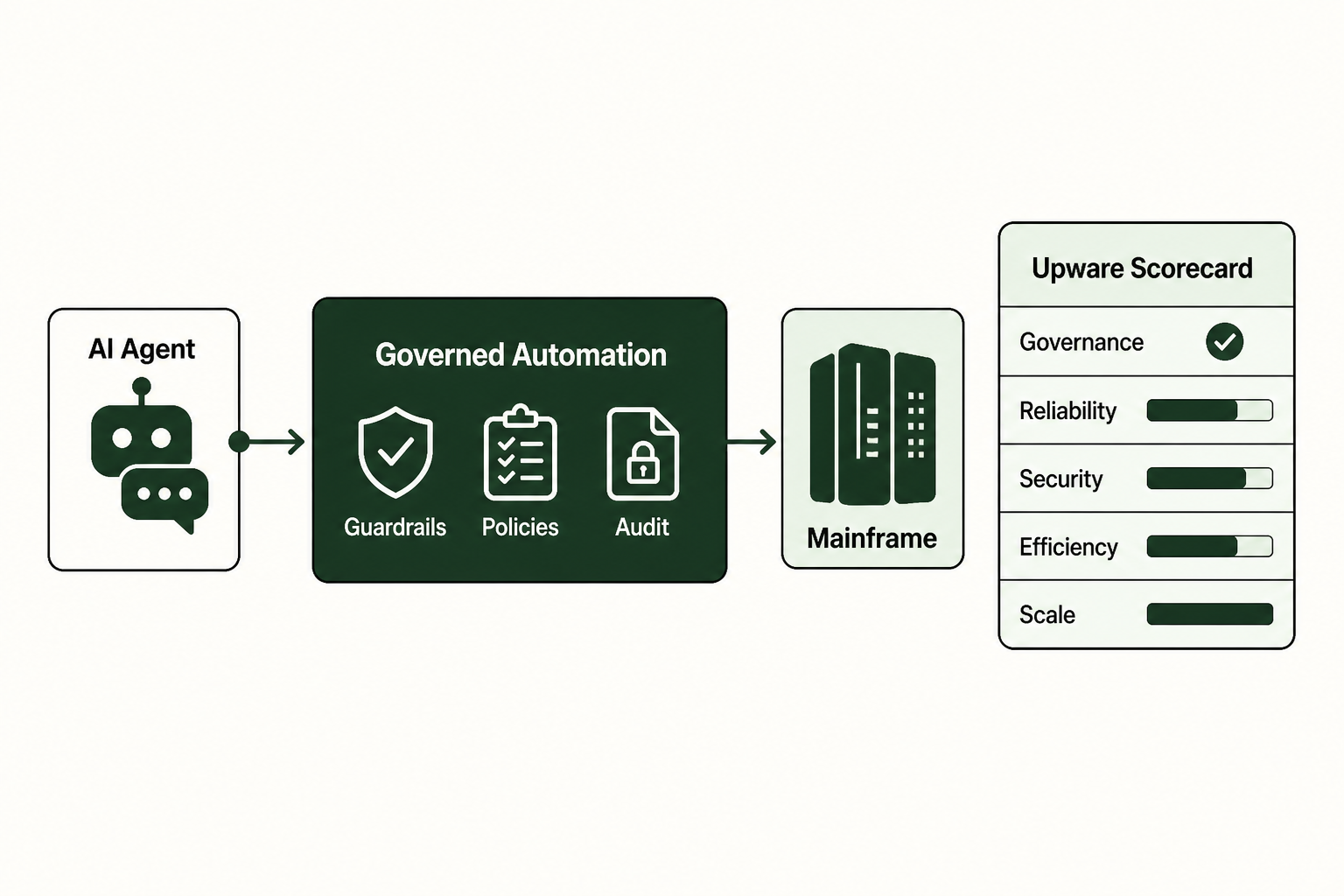
AI agent access control is the framework for setting rules for what autonomous AI agents may do, enforcing those rules, and auditing their actions inside enterprise systems. It covers read access to records and allowed tool calls. It also governs permitted changes and the evidence that must be captured when an agent acts. Once an agent moves from recommending an action to changing a record or triggering a workflow, access control becomes the boundary between useful automation and unmanaged operational risk. The same is true when it calls another system.
What is AI agent access control?
AI agents differ from earlier software assistants because they can perceive and reason, then act with varying levels of autonomy. MIT Sloan describes agentic AI systems as semi- or fully autonomous systems that can act independently, unlike traditional chatbots that mainly respond to prompts, according to research as of 2025. That distinction matters because an agent with tool access can do more than produce text. It can execute a multi-step plan or call an external application, according to research as of 2025. It can also update a workflow or hand work to another agent.
Traditional access control was built around people and applications. It also covered service accounts and defined system roles. A human user signs in, receives permissions based on role, and acts through an application with known boundaries. AI agent access control has to answer a harder question: what should a non-human actor be allowed to do when it can choose a path and call tools, then adapt its next step based on what it observes?
For an enterprise, the definition has three practical parts:
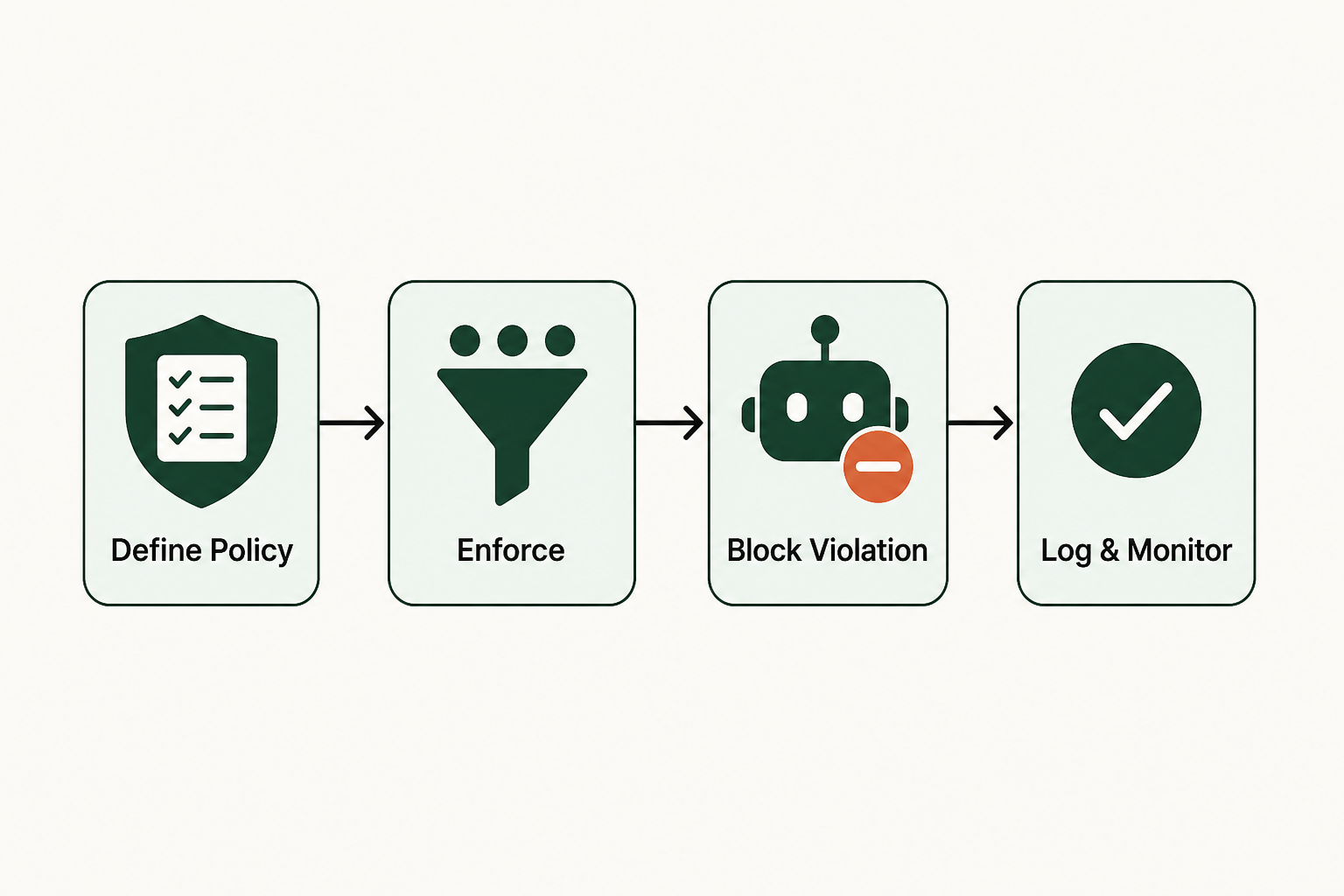
- Define the permitted actions so the agent has a clear role and scope, with an operating boundary.
- Enforce those permissions at runtime so the agent cannot exceed policy because a prompt or tool call, or because a subtask points it there.
- Audit the full action trail so security and compliance teams, along with operations, can see what the agent saw and called, plus what it decided and changed.
The risk of inaction is operational, not theoretical. Agentic systems create new attack surfaces, blur accountability, and can create new categories of privilege escalation when they interact with enterprise infrastructure. An agent that reads a policy document is one level of concern. An agent that changes a customer record or updates a claim needs governed execution, not trust in prompt wording. The same applies when an agent sends a payment instruction or modifies an ERP field.
Foundations: why agent access is a unique challenge
The access model changes because the actor changes. A person usually understands the business context and carries accountability. That person can also be questioned after the fact. A conventional application follows fixed logic written by engineers. An AI agent sits between those models: it can interpret context and choose among tools, while producing actions that were not individually scripted by a developer.
That autonomy is why enterprises need a specialized control layer. NIST-related analysis cited by the Cloud Security Alliance describes the security risk from agentic AI as qualitatively different from earlier enterprise AI because agents can invoke tools and execute code. They can also delegate to sub-agents and persist state across sessions. NIST red-team research documented an 81% attack success rate against AI agent systems using novel adversarial strategies in controlled exercises, according to research as of 2025. That finding does not mean every agent deployment fails. It means ordinary application controls do not map cleanly onto agents that reason and act across system boundaries.
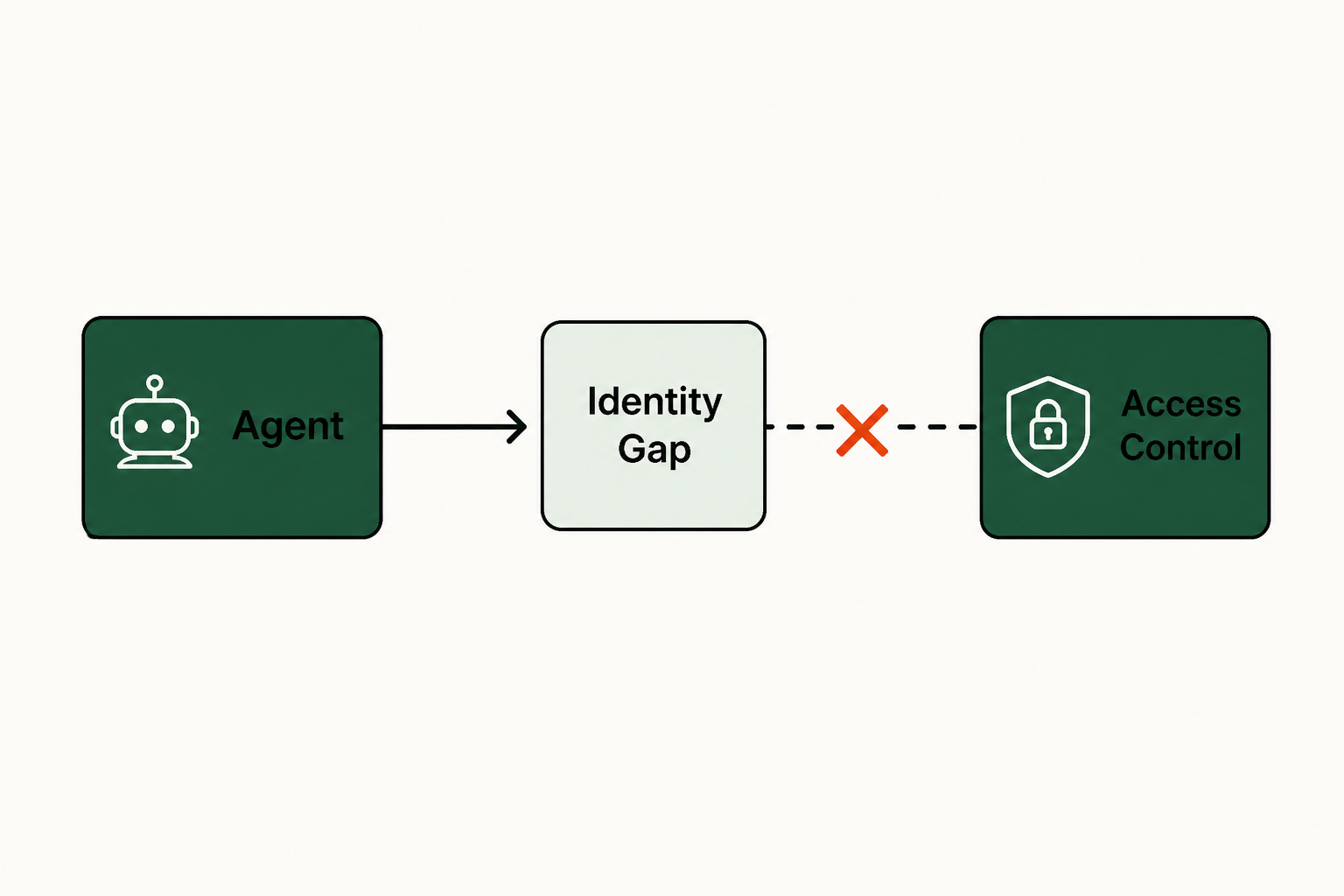
The enterprise gap becomes clear when agents are treated as generic service accounts. A service account may let a system perform a task, but it rarely explains why a specific agent made a specific decision. It also may not show which instruction shaped the action, what context it used, or whether the action matched the approved business purpose. The National Cybersecurity Center of Excellence addressed that gap in a concept paper published on February 5, 2026, on software and AI agent identity and authorization, focused on agent identity and authorization, with accountability controls.
The most severe deficiencies identified for agentic deployments fall into familiar control families, but the agent context changes their meaning:
- Access control must apply to intent and task as well as tool, data, and system state, not only a static role.
- Identification and authentication must distinguish one agent or sub-agent from another, including workflow-level and delegated actions.
- Audit and accountability must preserve the decision trail, not only the final API call or log line.
- Supply chain risk management must account for models and tools, as well as integrations and external dependencies that shape action.
That foundation is simple: agents create value because they act, and the risk comes from the same source. Control has to live where action happens.
 Foundations: why agent access is a unique challenge
Glossary: key terms in AI agent access control
A useful access model starts with shared language. Enterprise teams often use "governance," "security," "identity," and "guardrails" as if they cover the same territory. For agent access, those differences matter because each term points to a different control obligation.
- AI agent means a semi-autonomous or autonomous system that can reason and plan, use tools, and interact with digital environments.
- Agent identity means the verified identity assigned to a specific agent or agent instance, so actions can be attributed and controlled.
- Role means the business function the agent is allowed to perform, such as triage or reconciliation. Claims support and data entry are other examples.
- Task-specific permissions define what the agent may do within that role. They cover which records it may read, which actions it may take, and which tools it may call.
- Agent-to-agent interaction means one agent delegating work to another agent, making a request, or receiving work from another agent, which creates a chain of authority that must be visible.
- Audit trail means the record of the agent's context and tool calls. It also covers decisions, approvals, failures, and completed actions.
- Worlds are discrete environments with defined networks of applications and APIs that an agent is allowed to interact with. PwC describes these boundaries as a way to help prevent data leakage, support compliance, and make AI behavior more predictable.
- governed execution means actions are carried out through approved policy and verification, with state management and escalation paths rather than open-ended agent behavior.
- deterministic workflows are predefined execution paths that produce predictable behavior for specific business actions, even when the agent provides reasoning or context.
This vocabulary gives security and AI teams, along with operations, a shared map. Without it, one team may think access control means identity, another may mean prompt rules, and a third may mean a manual approval queue. Those are pieces of the system, but none is sufficient alone.
Core principles of the Agentic Harness for governed execution
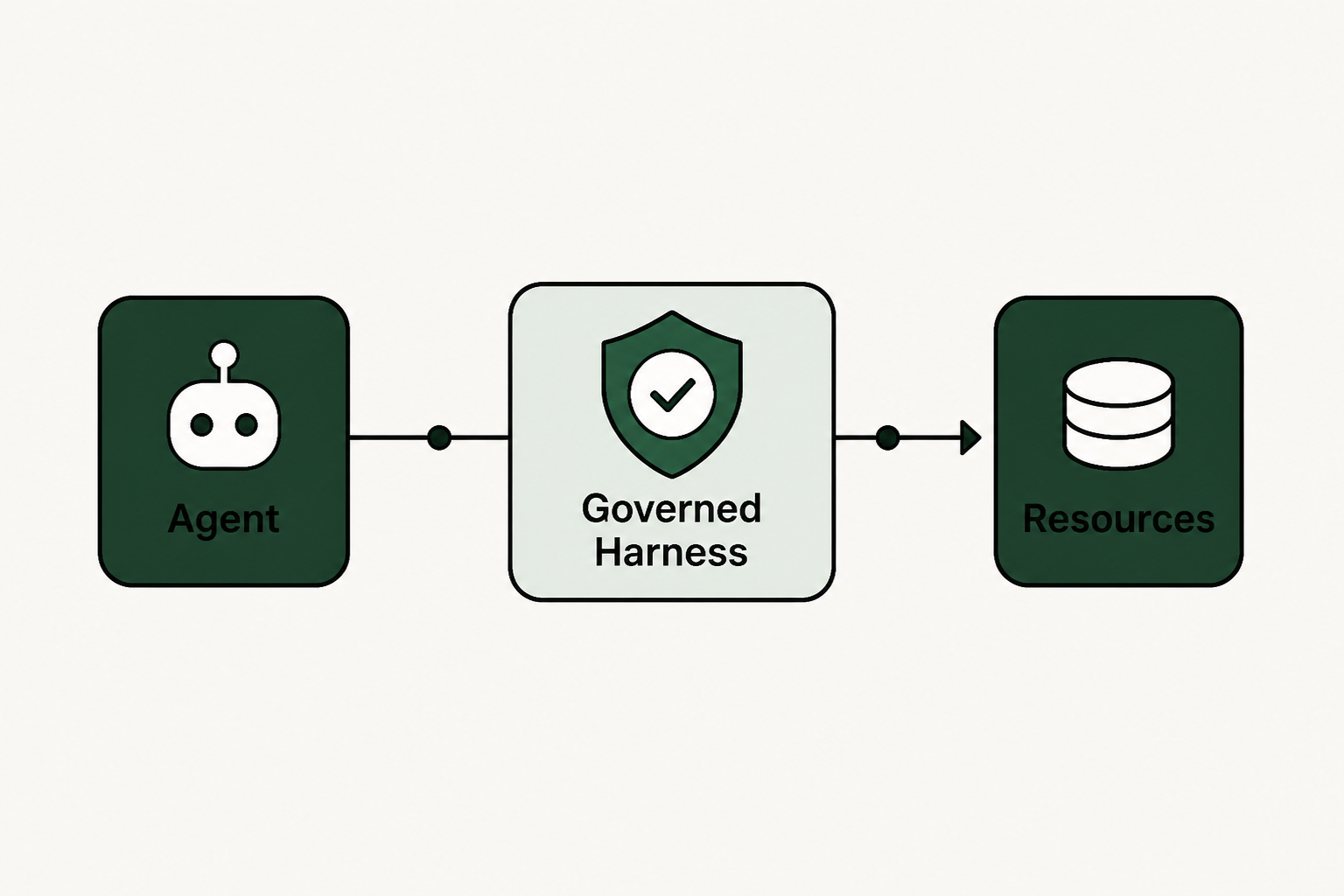
With the key terms defined, they can be assembled into an operating model. An Agentic Harness is the controlled structure around an AI agent: the agent supplies reasoning, while the Agentic Harness gives it approved hands to act through enterprise systems. Put plainly, agents supply the reasoning and the Agentic Harness provides the approved path for action. That separation keeps the model from becoming the authority for changing production data.
The core principle is governed execution. The agent may propose and plan. It may also classify or decide within a bounded task, but execution happens through policy-bound steps that can be checked and recorded. That is very different from letting the agent hold broad credentials and asking it to behave. For high-consequence workflows, intent must be converted into controlled action.
An enterprise framework should include four operating controls:
- Verified identity for every agent so each action can be tied to a known actor and role, as well as a workflow.
- Defined scope for each task so the agent can act only within the systems and records required for that job, along with the allowed operations.
- Runtime enforcement so policy is checked before and during action, not reviewed only after something has changed.
- Auditable records so compliance and security teams, along with operations, can reconstruct the decision path.
Human oversight also has to scale with consequence. As agent autonomy and the impact of an action increase, oversight should increase as well. That does not mean every step must stop for manual review. It means the access control model should separate low-risk actions, such as reading approved status fields, from high-consequence actions, such as changing payment details or closing a regulated case.
The useful pattern is a graduated control model:
- Read-only actions need identity and logging, plus data boundary controls.
- Low-impact write actions need task-specific permission and validation, with rollback paths.
- High-consequence actions need verification checkpoints and human approval, or escalation.
- Cross-system actions need state tracking so the agent does not leave one system updated and another out of sync.
The Agentic Harness turns policy into an execution path the agent can actually use. In that model, governed execution is not a report generated after the fact. It is the way the work gets done.
 Core principles of the Agentic Harness for governed execution
How an execution layer differs from agent orchestration tools
This approach marks a shift from how many platforms build agents. Agent engineering frameworks and conversational agent platforms do useful work: they help teams design agent behavior and connect tools. They also help manage prompts and coordinate multi-step reasoning. They are strongest where the problem is building or orchestrating the agent itself. What they can leave unresolved is the governed execution layer between agents and enterprise systems, especially when actions touch legacy systems or no-API systems. The same issue appears with regulated data or processes that require evidence. Upware centers on that governed execution layer instead: the controlled space where an agent's intent is converted into policy-bound, auditable action across enterprise systems.
That distinction matters because orchestration is not the same as authorization. An orchestrator may decide which tool to call next, but the access control question is narrower. Is that tool call permitted for this agent, in this role, on this record, under this business condition, and at this point in the workflow? The first concern is sequencing. The second is controlled authority.
An execution layer also handles operational realities that prompts cannot reliably solve. Legacy systems may not expose clean APIs. Internal portals may require screen-level steps. A process may require verification against another system before a change is allowed. When those realities are handled directly in the execution path, deterministic workflows can keep runtime behavior predictable for the actions under control.
Good agents still matter. The point is to give them a governed path to act. The agent remains the reasoning component, while the execution layer decides how approved work is carried out and checked. It also records the work and supports recovery if conditions differ from the plan.
Implementing deterministic workflows for predictable outcomes
A practical implementation plan should start with the workflow, not the model. AI agent access control works best when the enterprise begins with a consequential process where permissions and evidence requirements can be clearly described, along with exception handling. A claims update or ERP field change is easier to govern than a vague instruction to "help operations." Customer-service remediation and back-office reconciliation processes are other practical starting points.
From there, define the agent's operating boundary before granting access. The NIST AI Agent Standards Initiative focuses on industry-led standards and open protocol development, plus research in AI agent security and identity, according to an initiative launched on February 17, 2026, which reinforces the same practical starting point: identity and authorization cannot be afterthoughts. The related COSAiS work, announced in mid-2025, is also developing control overlays for AI deployment categories, including single-agent and multi-agent systems, which shows why enterprises should design for both one-agent and delegated workflows.
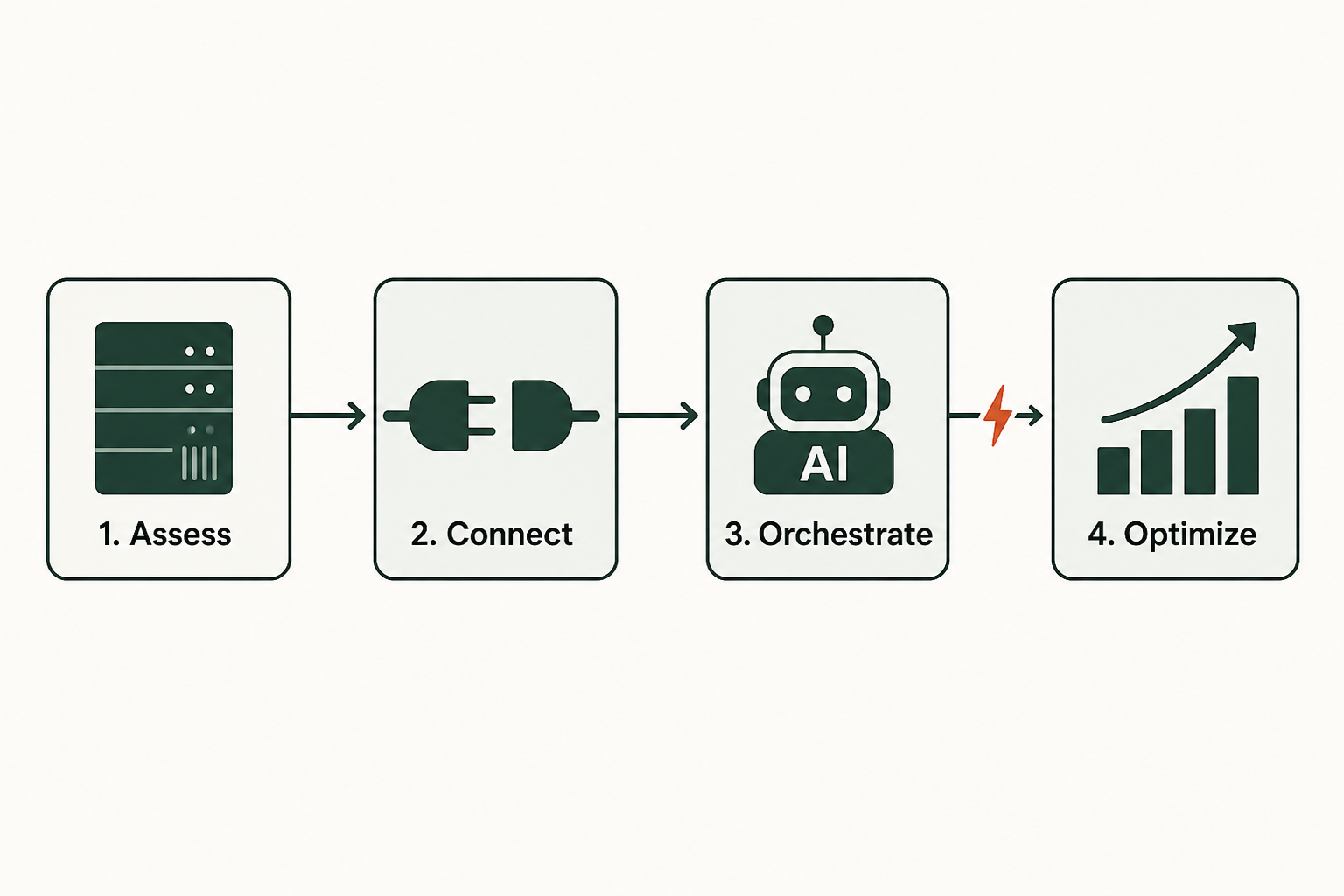
A workable implementation path usually follows this order:
- Name the agent and its role so the organization knows which non-human actor is taking action, what role it has, and which workflow it belongs to.
- Map the systems it may touch including APIs and legacy systems; no-API systems, internal portals, and downstream tools should be included too.
- Separate read, propose, and write permissions so access expands only when the business case and control level justify it.
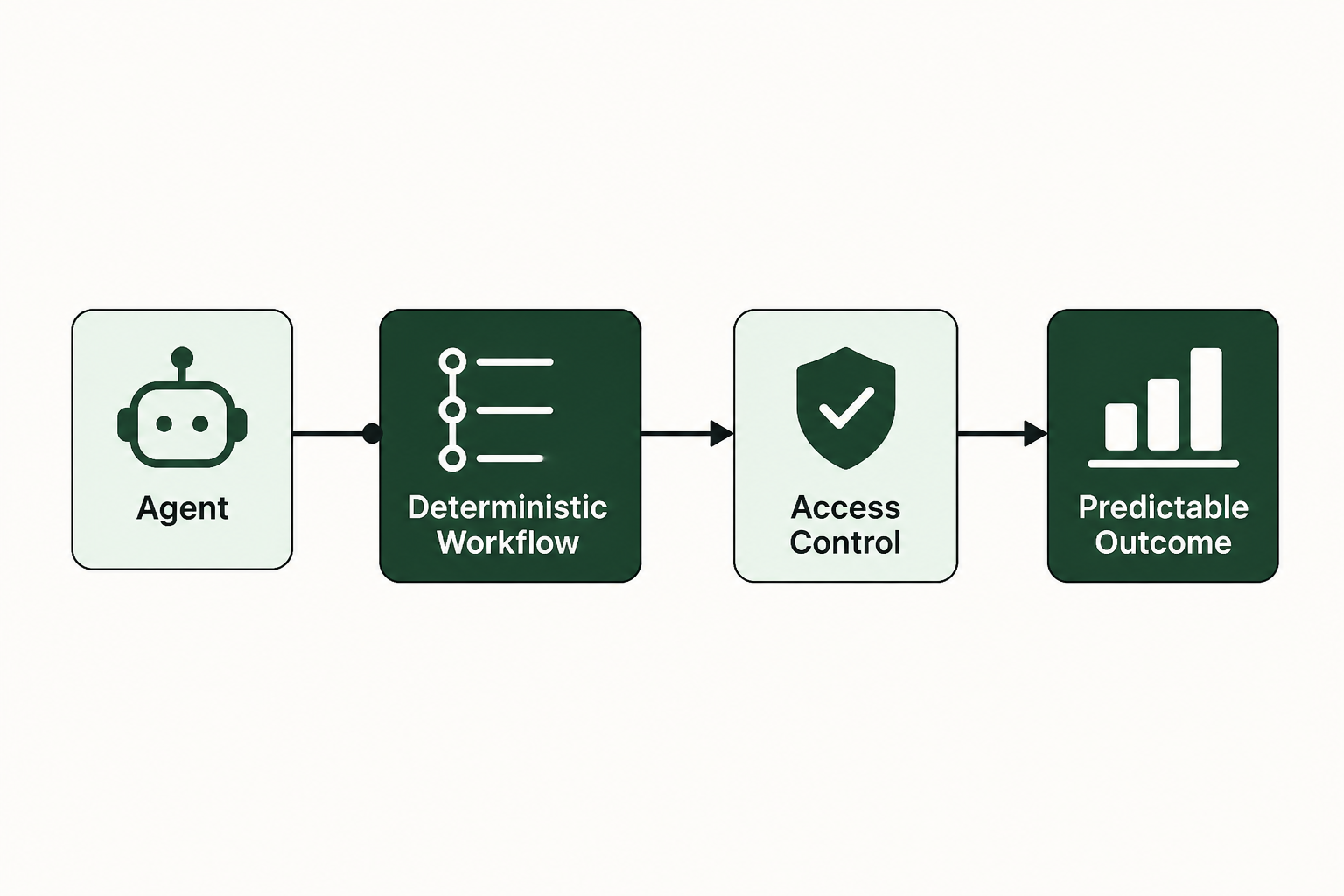
- Define deterministic workflows for approved actions, including validation checks and required context, along with allowed system changes.
- Add escalation points for high-consequence decisions and missing data, as well as policy conflicts or unexpected system responses.
- Record the evidence trail with enough detail to explain what the agent saw and called, plus what it decided and changed.
The goal is not to freeze every agent into a rigid script. It is to make the execution path predictable where the business needs predictability. A controlled runtime can deliver 100% predictability in runtime for the governed actions it manages, while still allowing the agent to reason within approved boundaries. That distinction is important: predictable execution does not mean all AI risk disappears, and it does not mean humans are removed from judgment. It means system changes happen through approved paths.
Cost control belongs in the same conversation. Open-ended agent loops can consume tokens while exploring paths or retrying actions. They can also spend tokens reprocessing context. When the action path is bounded through deterministic workflows, implementation can result in up to 80% lower token costs because the agent is not forced to reason through every operational step from scratch.
The common failure is to start with broad credentials and tighten later. That creates the evidence gap that slows production approval. A better pattern is narrow access first, then expansion by task, consequence, and proof.
 Implementing deterministic workflows for predictable outcomes
Next steps: from control to confident deployment
With the control model in place, deployment becomes a narrower and more useful decision. The enterprise does not need to decide whether it trusts AI agents in general. The better test is whether a specific agent can take a specific action through a governed path while operating in a specific role that security, compliance, and operations can review.
That test is deliberately practical. If the agent cannot be identified, it should not act. If the task scope is unclear, access should stay narrow. If the workflow touches regulated or financial records, governed execution needs verification and escalation. The same applies to customer records or operationally sensitive records. If the audit trail cannot explain the decision chain, the deployment is not ready for high-consequence work.
The honest trade-off is that control takes design. You have to define roles and permissions, as well as worlds, workflows, and evidence requirements before scaling production use. But that design is what prevents every agent deployment from becoming a one-off exception negotiated among AI, security, and business teams.
For a deeper next step, focus on building an agentic AI audit trail, because access control and auditability belong together. Permission decides whether an agent may act. The audit trail proves what happened after it did.
Ready to secure your AI agents with enterprise-grade controls?
Discover how our platform ensures auditable and secure AI agent operations, or consult with an expert to tailor a solution.
Frequently asked questions
What is the main benefit of AI agent access control?
The main benefit is controlled authority. AI agent access control gives each agent a verified identity and defined role. It also sets task-specific permissions and auditable records, so the enterprise can let agents act without giving them unmanaged access to production systems. In a governed execution model, runtime behavior can be made predictable for the controlled actions in scope, which is what security and compliance teams need before approving broader deployment.
Who in the enterprise is this for?
It is mainly for CIOs, CAIOs, Heads of AI, enterprise architects, security leaders, and operations owners responsible for moving agentic workflows into production. The work also involves risk, compliance, and business-process owners because access governance should reflect industry risk and organizational role, along with agent-to-agent interaction and task scope. The buyer may sit in technology, but the approval path usually crosses security and business operations.
How do I get started with implementing these controls?
Start with one consequential workflow and define the agent's identity and role before granting production access. Define the systems it may touch, its permissions, and its allowed actions as part of the same step. Then create deterministic workflows for the actions the agent may take, add verification checkpoints for sensitive steps, and make sure the audit record captures context and tool calls. It should also capture decisions, approvals, failures, and final system changes. Standards work around AI agent security and identity reinforces the same starting point: authorization has to be designed before scale.
What are the most common mistakes to avoid?
The most common mistake is treating an AI agent like a generic service account with broad access and thin accountability. Other mistakes include relying on prompts as the main control and logging only operational metrics instead of the decision trail. Teams also create risk by skipping escalation paths for high-consequence actions or allowing agents to cross system boundaries without clear policy. Red-team findings against agent systems show why these gaps matter in practice. Master AI agent access control. Explore our guide.