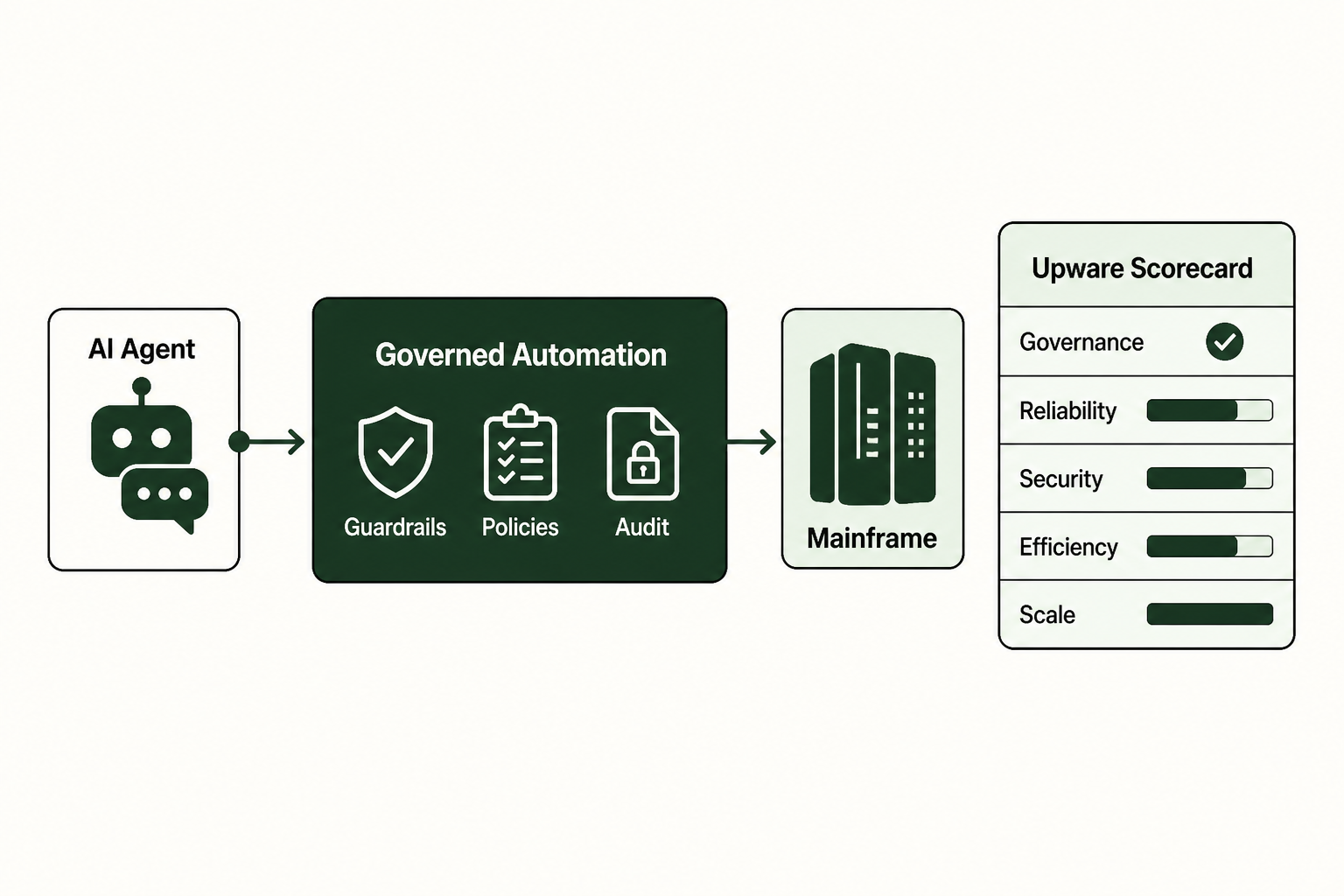
A useful agent becomes hard to approve when it can change records or trigger workflows. The risk grows when it can call tools without a clear record of why it acted. The practical answer is an AI agent audit trail that captures the input and state for each run, then ties them to tool calls, outputs, and policy decisions in one evidence chain. Security and compliance teams should be able to inspect that chain directly. Operations teams need the same evidence, without rebuilding the story from chat transcripts, application logs, and model memory.
Why your AI agent audit trail is critical for governance
Most stalled agent programs do not fail because the model cannot reason. They fail because nobody can prove what the agent saw, what it decided, which system it touched, and whether the action stayed inside policy. A 2026 industry governance survey found that most organizations it surveyed could not verify what their AI agents actually do across business systems, even though more than a third had already deployed agents inside finance and accounting functions.
That gap has moved agent risk out of policy decks and into live operations. The Cloud Security Alliance reported that 53% of organizations had AI agents exceed their intended permissions, and nearly half (47%) of respondents experienced a security incident involving an AI agent in the past year measured by the study.
An ai agent audit trail is the control plane for that problem. It cannot make every agent safe on its own, and it should not replace human judgment for high-consequence decisions. What it can do is give the organization a defensible record of governed execution. That record should identify the agent, show the input context, summarize the reasoning trace or state, document tool calls and outputs, record policy checks and approvals, and preserve failures with final system changes.
Prerequisites for a compliant audit trail
With the risk defined, the setup work matters. Start with ownership, because an agent that can act across systems needs an accountable owner, not just a model card. Deloitte recommends treating agents as accountable actors similar to human employees, with unique agent IDs, output tagging, immutable tool-use logs, and real-time monitoring so each decision leaves a clear audit trail.
You also need access to the systems where the agent reads and writes. That may include API gateways and workflow engines, along with identity systems, CRM records, ERP screens, internal admin portals, or no-API systems where the agent operates through a controlled interface. If you cannot observe execution, you cannot audit it.
Before you start, confirm these basics:
- Agent identity
- Each agent, version, role, and delegated permission is uniquely named.
- Policy inventory
- The rules for allowed, blocked, and approval-gated actions are written down.
- Execution access
- You can observe tool calls, application changes, and human approvals.
- Retention requirements
- Your legal or compliance team has defined what must be stored and for how long.
- Regulatory trigger points
- For high-risk AI systems, the EU AI Act (Regulation 2024/1689) has mandated automatic event recording since August 2026.
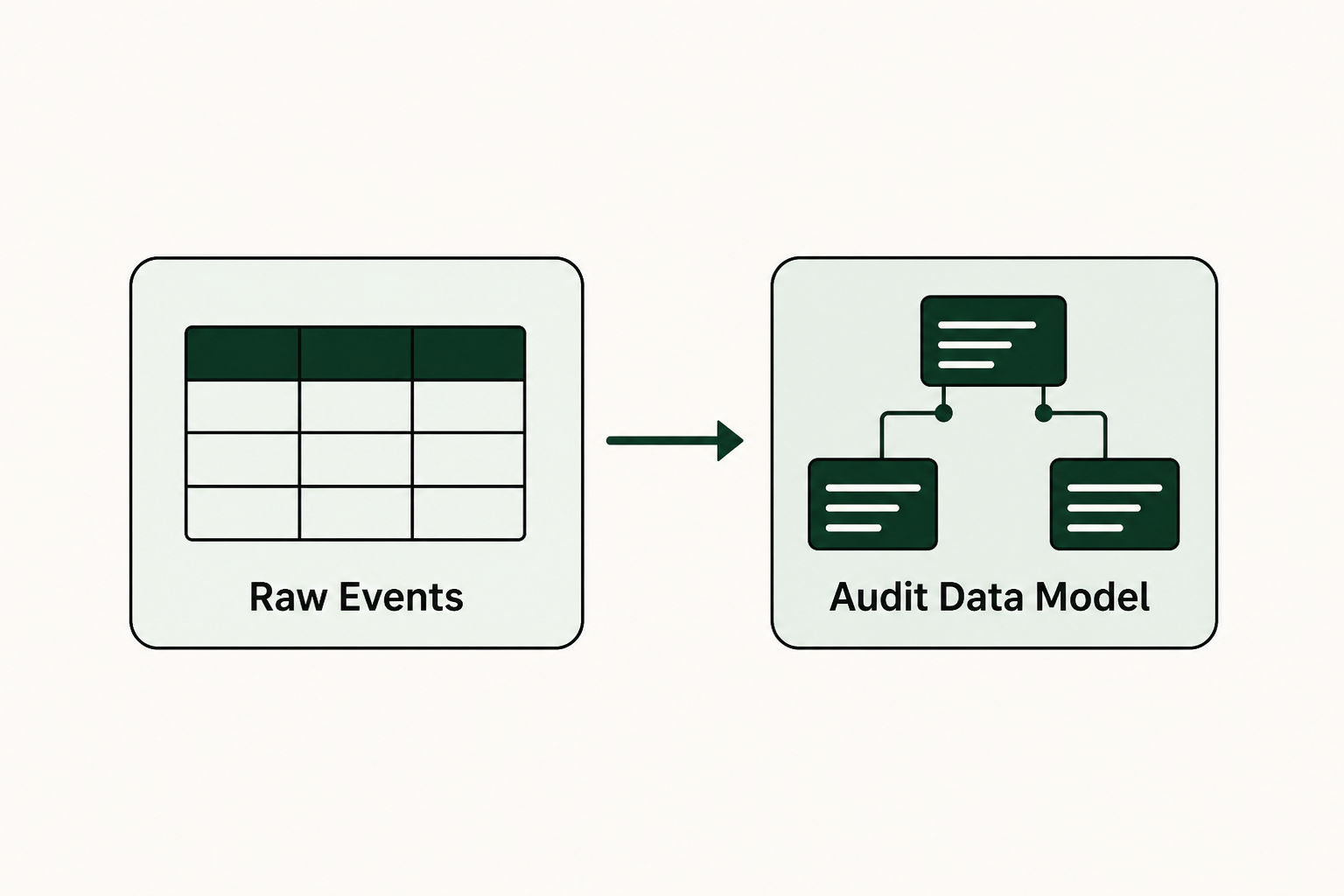
Step 1: define your audit data model
Once the prerequisites are in place, structure the data before you instrument anything. If every team invents its own log format, the audit record becomes fragile: one workflow captures the prompt, another captures only the API call, and a third stores the final output with no policy decision. Consistency is what lets auditors compare actions across systems. It also lets incident teams search by agent, action type, or failure condition.
A useful starting point is the Agent Audit Trail (AAT) standard, which defines a JSON-based record structure with mandatory fields for agent identity, action classification, outcome tracking, and trust level reporting. For broader context on policy ownership and operating models, connect this data model to your AI agent governance work instead of treating logging as a separate engineering task.
Your first schema should capture the minimum record needed to explain an action:
{
  "agent_id": "claims-review-agent-v3",
  "session_id": "case-48291",
  "input_ref": "hashed-input-7741",
  "action_type": "update_record",
  "tool_called": "policy_admin_portal",
  "policy_check": "approval_required",
  "human_approval": "approved_by_role",
  "outcome": "completed",
  "trust_level": "bounded"
}
Keep the record focused. Buyers in one IAB study said they also wanted an AI agent audit trail for explainability (36%) and guardrails that limit what agents can do (31%). That points to two design requirements: the log must explain the action, and it must show whether the action was permitted.
 Step 1: define your audit data model
Step 2: implement governed execution for logging
After you define what to log, decide where the logging happens. Logging after the fact is weak because the agent may already have touched a system before the record is complete. Governed execution means the agent's intended action passes through a controlled path. That path checks policy, records state, routes approvals, and only then performs the system change.
The plain-language model is simple: the agent is the brain, and the Agentic Harness is the hands. The agent can reason, propose, and decide within its assigned role, but the Agentic Harness mediates execution across enterprise systems, legacy systems, and no-API systems. That execution layer is where deterministic workflows matter, because policy checks and system actions should not depend on a prompt behaving the same way every time.
In practice, build your logging around the execution path:
- Before action
- Capture the user request and agent identity.
- Record the tool intent, target system, relevant policy, and current state.
- During action
- Record tool calls and retries.
- Capture approval checks, exception handling, and any state change.
- After action
- Store the final outcome and output reference.
- Record the policy result, human approver where required, and evidence hash.
Shifting from agent-centric frameworks to an execution layer
Agent engineering frameworks and agentic process automation tools are useful for building agents, connecting tools, and orchestrating multi-step reasoning. They often leave unresolved the governed execution layer between agents and enterprise systems, where consequential writes, approvals, verification checkpoints, and audit records have to be controlled consistently. Upware centers on that governed execution layer instead: the platform's Agentic Harness routes agent-to-system interactions through deterministic workflows, policy enforcement, state management, and failure recovery.
That positioning is operational, not cosmetic. If the agent can update a customer record, approve a refund, modify an invoice, or trigger a service workflow, the audit trail should be generated by the execution layer that performed the work. This is also where runtime predictability matters. The platform offers 100% predictability in runtime, which supports repeatable logging because the workflow path is bounded rather than improvised at each step.
Step 3: secure and store audit trail data
With a reliable stream of audit data, the next concern is integrity. An audit trail that can be edited without evidence is only a diary. For compliance and incident response, your storage design should make tampering visible, preserve the sequence of events, and support selective privacy controls without breaking the chain.
The AAT design links records through tamper-evident hash chaining using SHA-256 and includes optional ECDSA signatures for non-repudiation. It is also transport-agnostic, with support for export to JSONL, Syslog, and CSV while maintaining chain integrity.
For storage, separate the audit record from the operational system the agent changed. That prevents a compromised workflow from changing both the business record and its evidence in the same place. Then apply these controls:
- Write-once storage or append-only logs
- Preserve the event sequence.
- Hash-linked records
- Expose deleted or modified entries.
- Digital signatures
- Prove which system produced the record.
- Input and output hashing
- Reduce sensitive data exposure while preserving traceability.
- Tombstone-based deletion
- Support privacy deletion workflows without pretending the event never existed.
Troubleshooting your AI agent audit trail
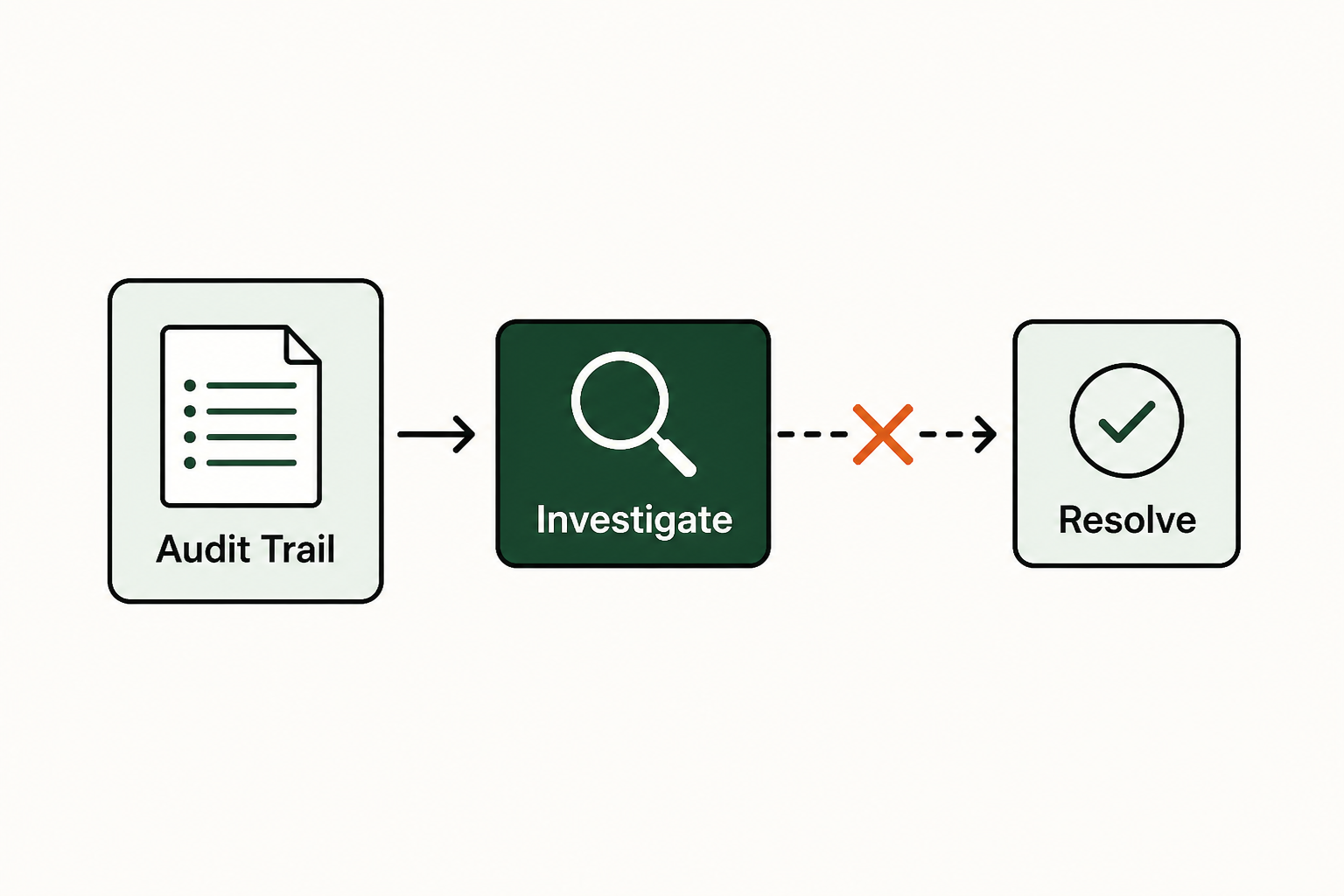
Even with a sound plan, implementation problems usually show up at the same point: the handoff between reasoning and execution. The simplest test is whether an investigator can answer one concrete question without asking the original developer for help: what did the agent do, why did it do it, and what system changed as a result?
If logs are incomplete, the failure usually sits between agent reasoning and system execution. The chat history may show the agent's intent, while the application log shows a database update, but neither proves the policy decision that connected the two. Move the capture point into governed execution so the Agentic Harness records the decision and the action together.
If detection still takes too long, test your incident workflow. The Cloud Security Alliance found that detection and response times for AI agent incidents can extend to hours or even days, which means audit records must be searchable by agent ID and tool. They should also support searches by target system, action type, and policy outcome. A long forensic hunt is a sign that the log exists but is not operationally useful.
If you cannot distinguish human and agent actions, add identity tagging at the point of execution. A CSA survey found that 68% of organizations could not clearly differentiate between human and AI agent activity, according to a new survey report from the Cloud Security Alliance (CSA). That problem is avoidable when every execution record includes actor type, delegated authority, session ID, and human approver where applicable. For adjacent controls, use safe agent operation guidance to align guardrails with audit fields.
You know the setup worked when:
- A reviewer can replay the event chain
- No missing handoff between reasoning, approval, and system change.
- A policy owner can see violations
- Blocked, approved, and escalated actions are visible.
- A security analyst can filter by agent
- Agent activity is not mixed with human user activity.
- A compliance reviewer can verify integrity
- Hashes, signatures, or append-only controls expose tampering.
 Troubleshooting your AI agent audit trail
Next steps: from audit to actionable governance
A working audit trail is the foundation for active control. Done means your organization can verify agent identity and inputs from one evidence chain. The same chain should show tool calls, policy checks, approvals, outputs, and final system changes. It also means the record is secure enough to support review, rather than merely descriptive after something goes wrong.
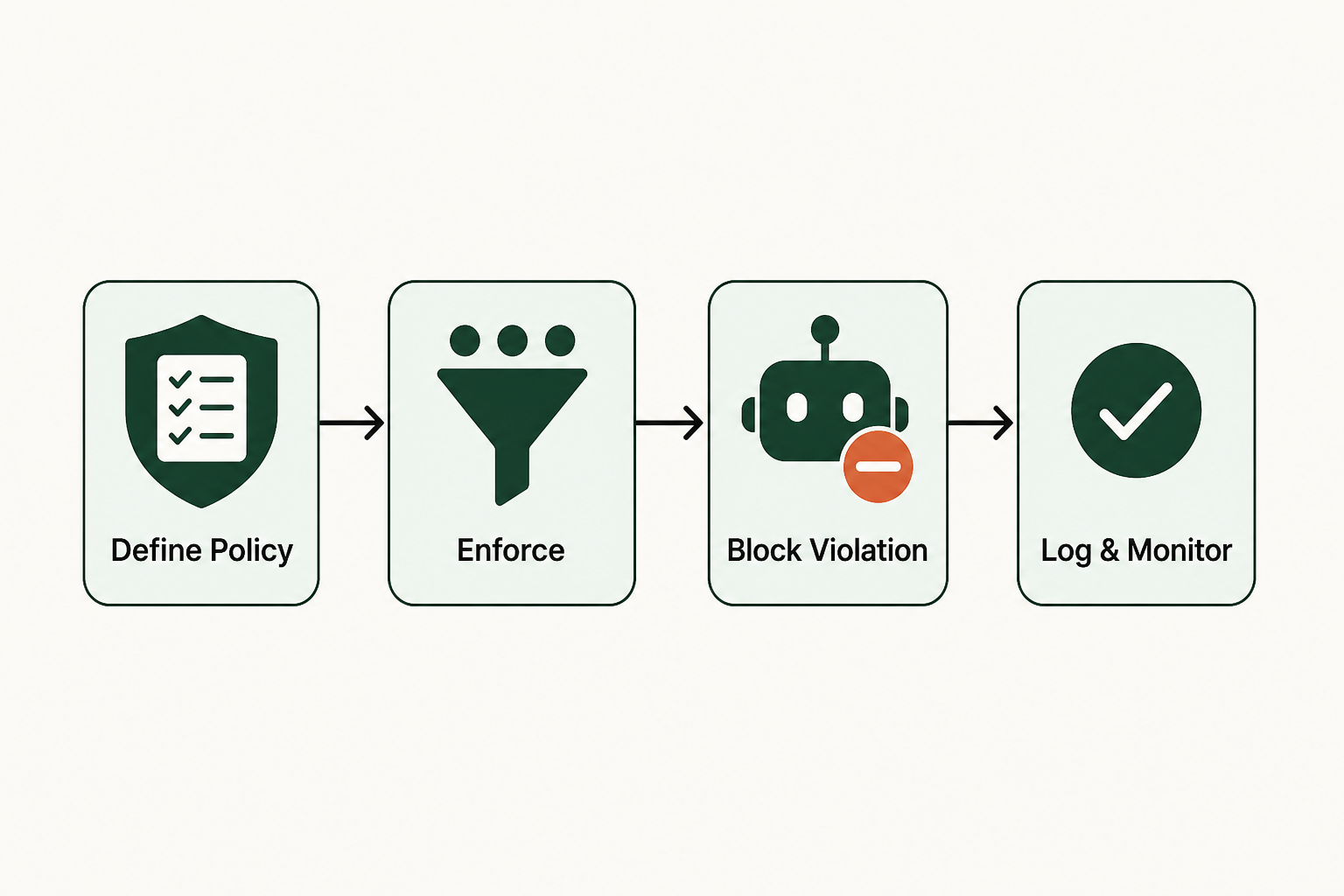
The next move is to turn those same fields into governance actions. Use audit evidence to trigger approvals and block out-of-policy actions. The same evidence can route exceptions and improve deterministic workflows over time. Agentic AI can support audit readiness by logging actions, data sources, and rationale as work happens, creating a clearer audit trail and reducing reliance on institutional memory when questions arise.
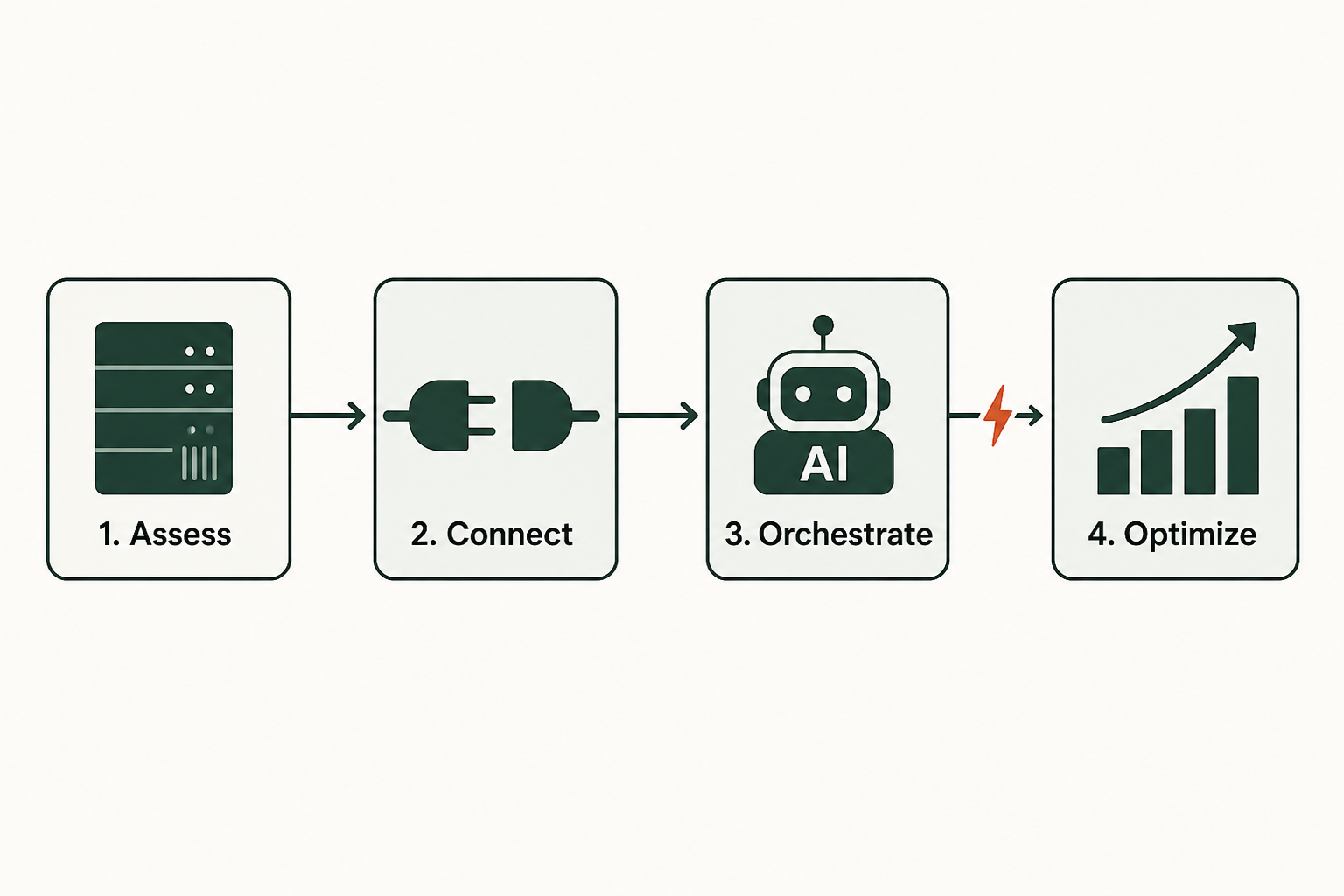
For enterprises moving from pilot to production, the trade-off is clear: open-ended autonomy feels faster at first, but governed execution is what lets consequential work reach production with control. The Agentic Harness can be deployed in days, but the durable value comes from deciding which actions deserve automation, which require human approval, and which should never be delegated.
Implement robust AI audit trails today. Start the tutorial!
How will an AI agent audit trail transform your enterprise operations?
Understand the full scope of benefits and capabilities an AI agent audit trail brings to your governance, security, and operational efficiency, with options to explore further.
Frequently asked questions
What is the main benefit of creating a detailed AI agent audit trail?
The main benefit is verifiability. A detailed audit trail shows what the agent processed, which action it took, what rationale or state supported that action, and whether the action stayed inside guardrails. That matters because explainability without an event record is hard to prove after the fact.
How do I get started with enforcing policies based on my audit trail?
Start by assigning each agent a unique identity and mapping the actions it is allowed to take. Then connect each action category to a policy result: allow, block, escalate, or require approval. The audit trail should record the policy result before the execution layer changes an enterprise system.
What are the most common mistakes to avoid when setting up an audit trail?
The most common mistakes are logging only prompts and outputs, mixing human and agent activity under the same identity, and storing records that do not connect reasoning to system change. Those gaps slow down incident response and make compliance review inconclusive.
Can I make my AI agent audit trail tamper-proof?
You can make tampering evident, which is the practical audit goal. Use append-only storage, hash-linked records, and digital signatures so changed or deleted entries are visible. For sensitive inputs and outputs, use hashing and deletion tombstones so privacy controls do not destroy the event chain.