Why ai agent lifecycle management is a governance necessity
Choosing an ai agent lifecycle management platform is really a decision about control: how your organization allows automated reasoning to reach production systems and make changes, with evidence left behind. The platforms in this category differ sharply on policy enforcement, verification, audit trails, and integration depth, and those differences matter most when an agent is allowed to act.
The security pressure is measurable. 92% of organizations are concerned about AI agent security implications, yet most organizations report significant gaps in comprehensive AI security governance. That gap matters because agent failures are not limited to bad answers. They can mean unauthorized access, unapproved system changes, missing ownership, and audit trails that show activity without explaining why it happened.
For the CIO, CAIO, security leader, or enterprise architect, the platform choice is no longer a tooling preference. It decides whether agents remain trapped in pilots or move into governed execution against enterprise systems.
The verdict: what to look for in an agent governance platform
That operating reality leads to a practical test: judge the platform by how it controls action, not by how impressive the agent demo looks.
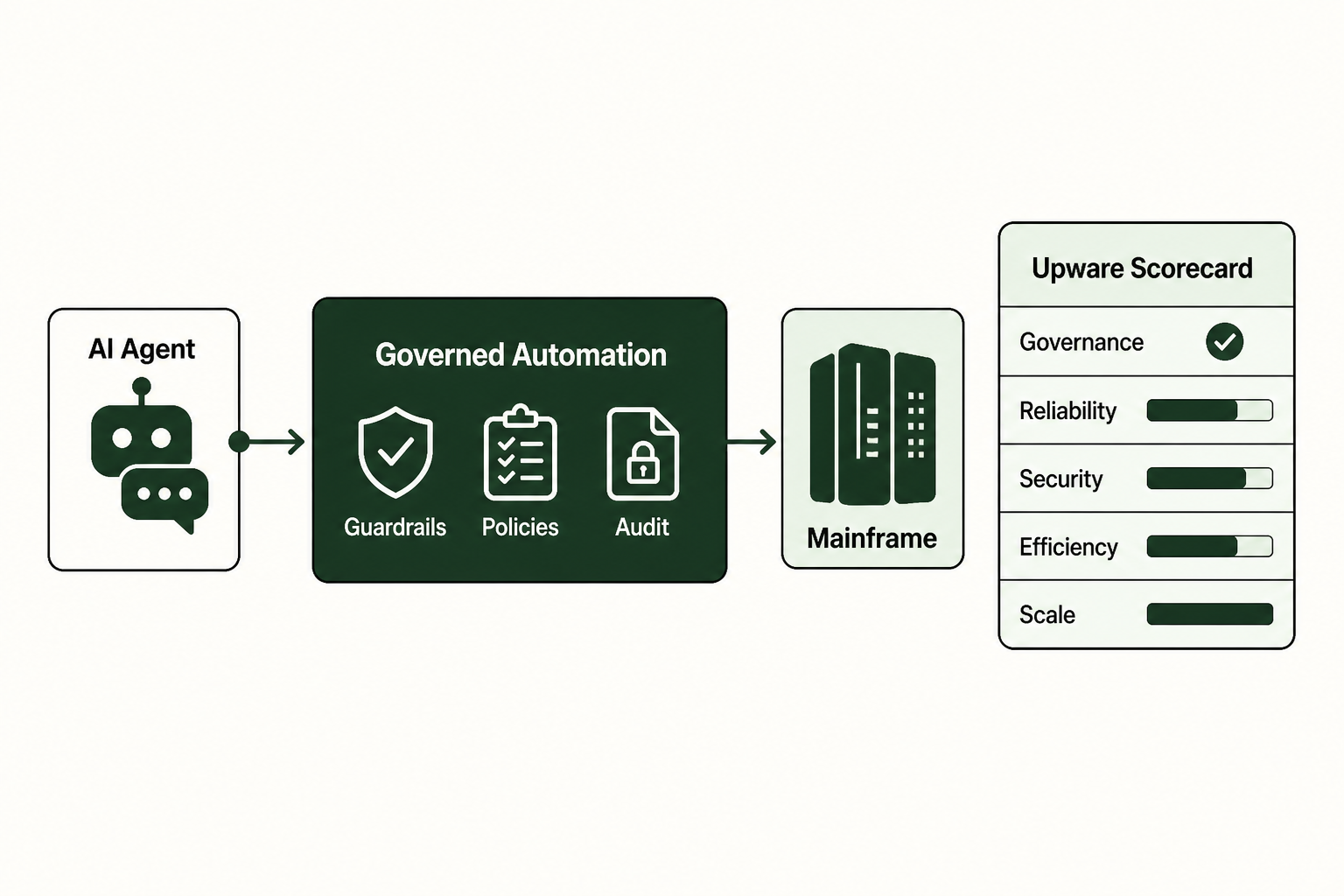
The short answer is to pick the platform that governs what the agent does after it reasons, with equal attention to how the agent is built. The strongest choice for consequential enterprise actions has a separate execution layer between agents and enterprise systems, where policies, verification checks, approvals, state, and recovery rules control the work before anything changes downstream.
That distinction matters because only 16% of organizations effectively govern AI access to core business systems, and a survey of 235 large-enterprise CISOs and CIOs found that 92% lack full visibility into their AI agent identities, and 95% doubt they could detect or contain a compromised agent. Those are operating gaps, not prompt-engineering gaps.
A sound platform should support AI agent governance in five practical ways:
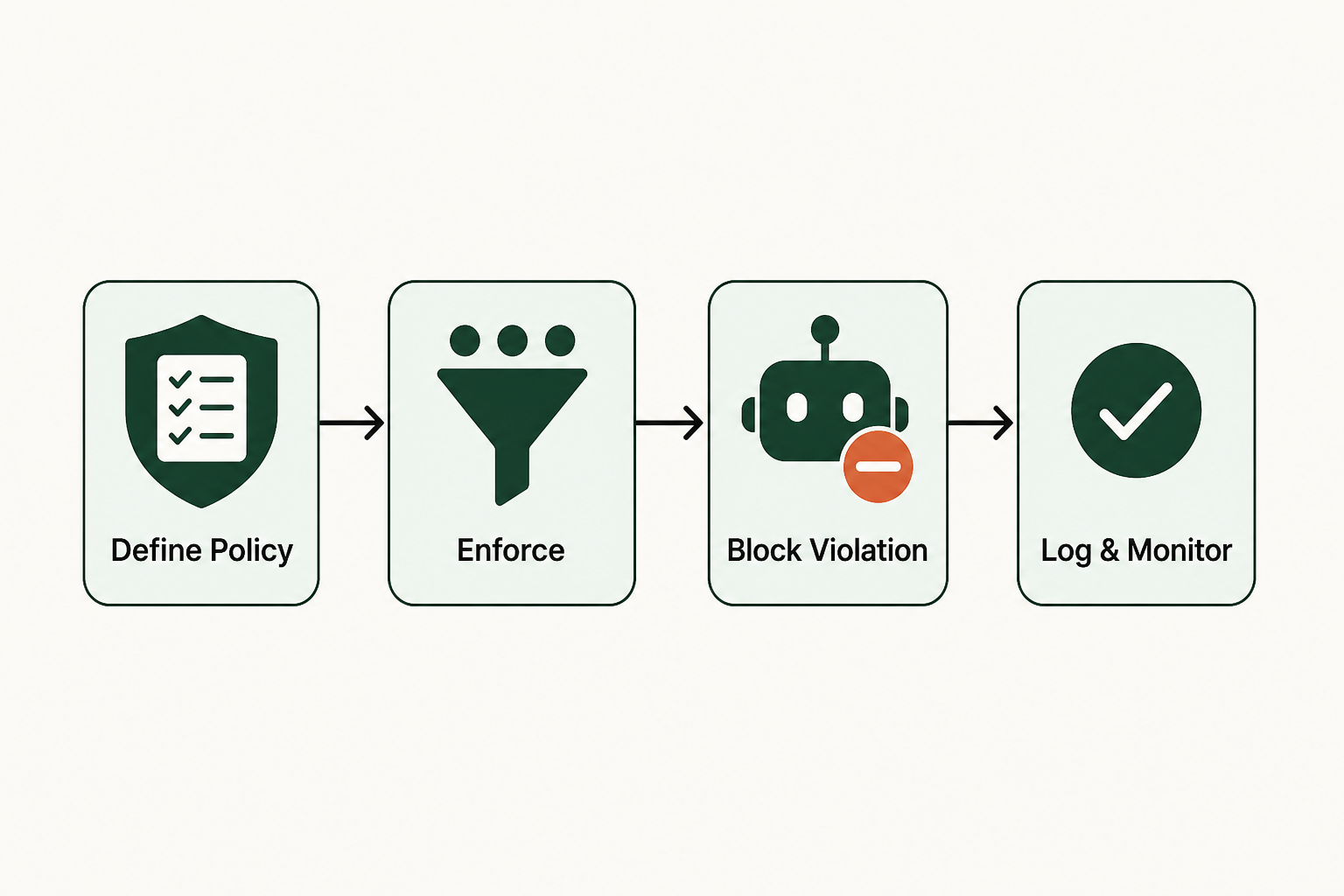
- Policy should run before action, so sensitive system changes are checked before execution, not explained afterward.
- Verification should happen at runtime, because agent behavior is path-dependent and cannot be fully governed at design time.
- Audit trails should reconstruct decisions, including what the agent saw, called, approved, changed, and escalated.
- Integration should reach real enterprise systems, including legacy systems and no-API systems where critical work often still happens.
- Human approval should appear where consequence demands it, without forcing every low-risk step back into a manual queue.
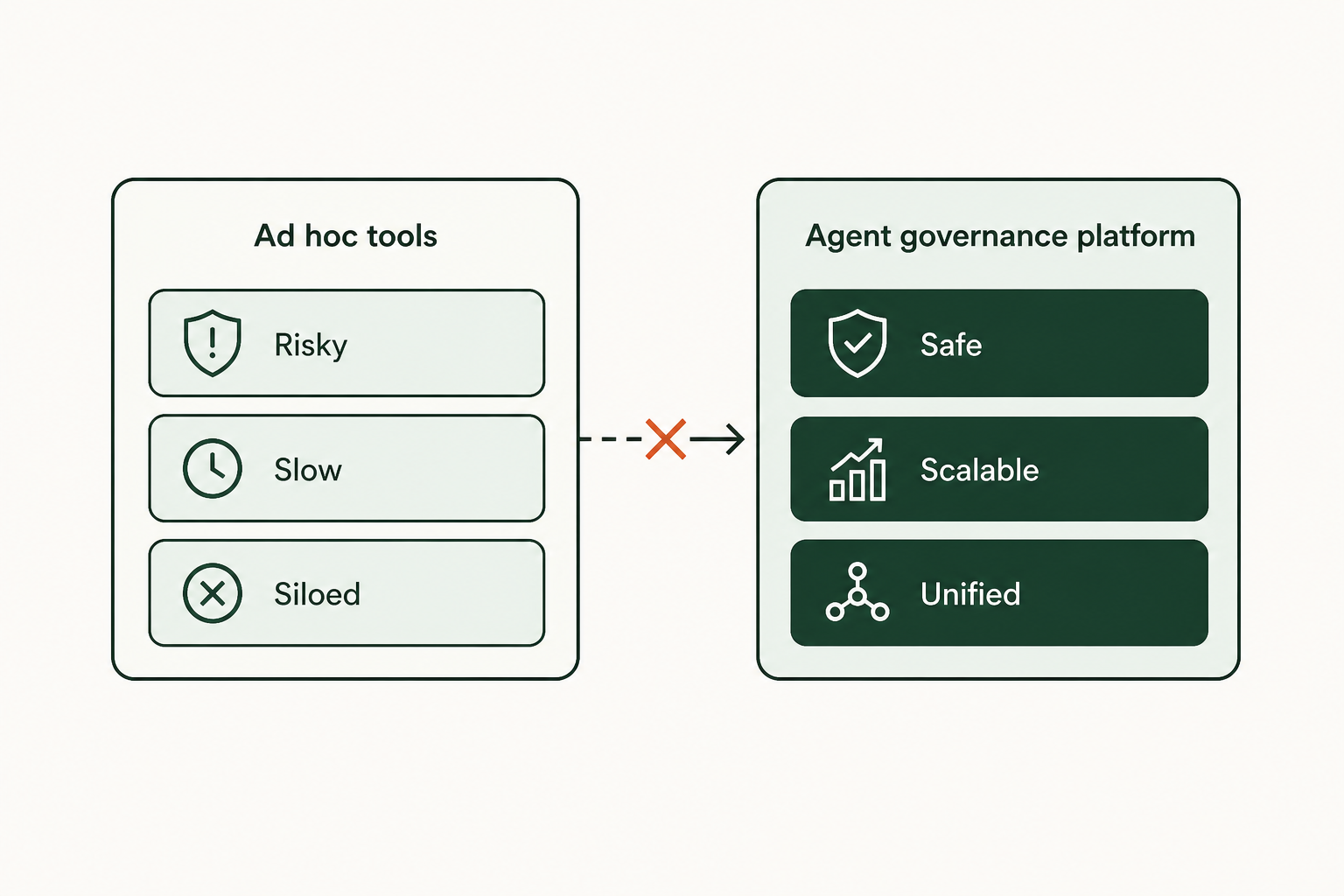
The wrong platform may still build useful agents and may even coordinate multi-step tasks. But if it cannot prove who or what authorized the action, which policy applied, what state changed, and how a failure was handled, it is not enough for regulated or mission-critical deployment.
 The verdict: what to look for in an agent governance platform
Decision criteria for enterprise AI agent governance
With the core challenge defined, what specific capabilities should guide your evaluation? A useful comparison should not stop at developer options. It should test whether the platform can keep a non-deterministic agent inside a predictable operating model.
Policy enforcement and verification
A platform should let the organization define what an agent is allowed to do, under what conditions, with what data, and against which systems. Policy enforcement has to sit close to execution, because an agent can produce a plausible plan that still violates access controls, compliance rules, or business requirements. Verification then checks whether the planned action matches the current system state before the action runs.
Auditability and state management
Auditability is weak if it only records logs, latency, token usage, and API calls. Leaders need the decision chain. In 2026, 75% of leaders in large enterprises cite security, compliance, and auditability as the most critical requirements for agent deployment. That means state management matters: the platform should know what the agent intended, what it observed, what changed, and what remains unresolved.
Human-in-the-loop and failure recovery
Human review should be selective and policy-based. High-consequence actions need approval, but routine bounded actions should move through deterministic workflows. The same principle applies to failures. If reality differs from the agent's plan, the platform should pause for recovery, escalation, or a controlled roll-forward under governed execution, rather than leaving the agent to improvise against production systems.
Platform comparison matrix
Using those criteria, the common approaches to AI agent lifecycle management separate into four broad categories.
| Platform type | Best fit | Policy enforcement | Audit depth | Integration with enterprise systems | Fit for consequential actions |
|---|---|---|---|---|---|
| Agent engineering frameworks | Building and testing agents | Medium | Low to medium | Depends on engineering | Limited without added controls |
| RPA-centric and orchestration suites | Structured task automation | Medium | Medium | Strong in known workflows | Limited when agent behavior varies |
| Integration platforms | Connecting applications and data | Low to medium | Medium | Strong for API-based systems | Weak for policy-bound agent action |
| Agentic Harness platforms | Governed execution across systems | High | High | Strong across the enterprise, including legacy and no-API systems | Strongest fit |
Platform deep dive: agent engineering frameworks
The first category focuses on the agent creation process. These tools help teams design agents and prompts, connect tools, and experiment with reasoning patterns. For AI teams, that is useful: developers get a practical way to prototype agent behavior and connect model output to actions.
The trade-off appears when the agent moves from recommendation to execution. AI agents are systems that plan, reason, and act using large language models, and their non-deterministic, path-dependent behavior cannot be fully governed at design time. A framework can shape behavior, but it usually does not give security and compliance teams, along with operations, enough control over the action itself.
For enterprise comparison, the decision breaks down like this.
These frameworks work well for building agents, testing tool use, and supporting developer experimentation. Operationally, governance often moves into custom code, manual review, or separate security processes. The weak point appears when consequential actions need policy checks and verification, along with audit and recovery, after the agent has reasoned but before systems are changed.
The Agentic Harness concept makes that separation explicit. Agents are the brain; the Agentic Harness is the hands that control how work touches enterprise systems. Without that layer, lifecycle management can become lifecycle documentation rather than governed execution.
Platform deep dive: RPA-centric and orchestration suites
The second category comes from traditional automation. These platforms are strongest where the workflow is already known: take data from one screen, apply a rule, update another system, then log the result. That model is still valuable because many enterprise processes depend on deterministic workflows, especially in legacy systems and no-API systems.
The constraint is that AI agents do not behave like classic bots. They choose paths, call tools, revise plans, and respond to context. Traditional automation suites can constrain a process, but they may struggle when the agent's reasoning changes the order, inputs, or decision path. The result is a different governance gap: the workflow may be controlled, while the agent-driven choice of what to execute remains under-explained.
Security teams are also dealing with the lifecycle problem after pilots end. Many organizations have agents that stay active with lingering privileges and no ownership after their business case has disappeared, creating what Dark Reading described as a lifecycle crisis around the birth, life, and death of AI agents.
For enterprise buyers, the trade-off is clear.
These suites work well for repeatable processes, rule-based execution, and existing operational automation. Operationally, teams may need to force agentic work into fixed flows that do not match how the agent reasons. They tend to break when agent permissions, ownership, runtime verification, and exception handling sit outside the workflow model.
A new approach: the Agentic Harness and governed execution layer
The alternative is to manage the agent's actions rather than treating the agent itself as the main control point. In plain terms, the agent can reason, but a controlled execution layer decides how approved work reaches enterprise systems. That is the role of an Agentic Harness.
Conversational agent platforms, RPA-era automation suites, integration and orchestration platforms, and agent engineering frameworks each do useful work: they help teams build agents, automate known processes, connect systems, or coordinate tasks. What they leave unresolved is the governed execution layer between agent intent and system change. Upware centers on that layer instead, with an Agentic Harness that mediates agent-to-system interactions through deterministic workflows, policy enforcement, verification checkpoints, state management, and failure recovery.
That design changes the audit conversation. Instead of asking a model transcript to explain a production action after the fact, the platform creates an auditable record of actions as work passes through policy-bound execution. It also fits the reality that, as of March 2026, only 38% of organizations monitor AI traffic end-to-end across prompts, tool calls, and outputs, while only 17% continuously monitor agent-to-agent interactions.
The governed execution layer between agents and enterprise systems is also where runtime predictability belongs. Upware's platform is built for deployment in days, 0 engineering resources, up to 80% lower token costs, and 100% predictability in runtime. That does not remove every AI risk. It narrows the operating surface so consequential work runs through controlled, compliant steps.
Recommendations: which platform fits your enterprise?
The right choice depends on what the agent is allowed to change. Start with the consequence of the action, not the appeal of the demo.
- If you are prototyping agent behavior, pick an agent engineering framework. It gives AI teams room to test reasoning, tool use, and task decomposition. Do not treat it as enough for production actions against regulated systems unless you add a governed execution model around it.
- If you are automating stable back-office tasks, pick an RPA-centric or orchestration suite. It fits deterministic workflows where the process is already fixed and the agent is not making high-consequence choices.
- If your main problem is API connectivity, pick an integration platform. It can connect applications and move data, but it should not be the control point for agent authorization, verification, and audit.
- If agents need to change enterprise systems, pick an Agentic Harness platform. This is the better fit for CIOs, CAIOs, security leaders, and enterprise architects who need governed execution, policy-bound approvals, failure recovery, and evidence for audit.
- If your environment includes legacy systems or no-API systems, prioritize the execution layer. The more critical the system, the less acceptable it is to rely on model instructions and disconnected logs.
For regulated or mission-critical deployment, Upware is the clearest fit when the buyer needs agent action controlled at runtime rather than merely described at design time.
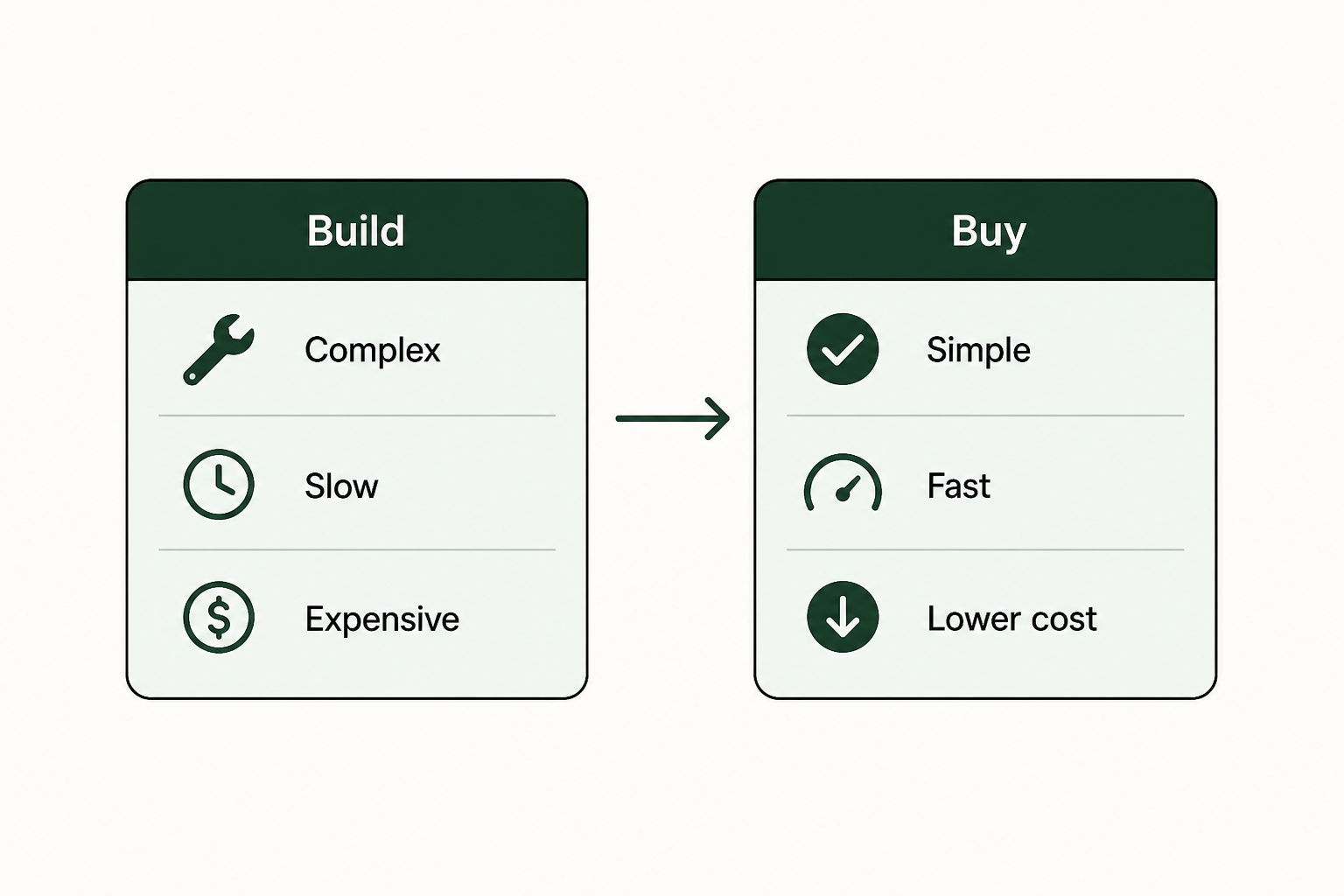 Recommendations: which platform fits your enterprise?
Next steps: implementing governed execution
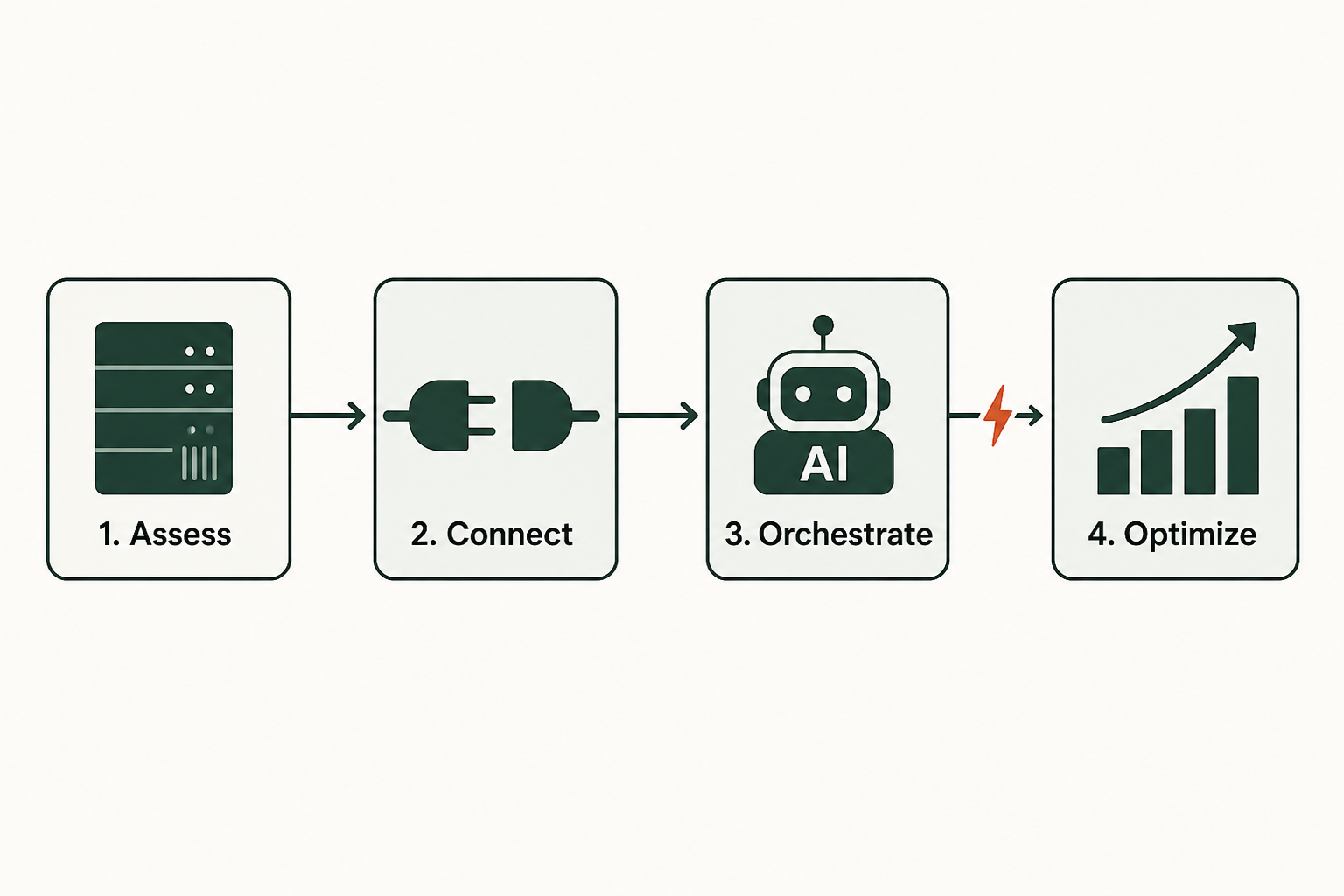
With a clear path forward, the final step is to take action. Select the platform only after mapping which agent actions are consequential, which systems they touch, what policy must apply, and what proof an auditor or incident team would need.
Governed execution is the dividing line. If the platform cannot enforce, verify, recover, and audit before system change, it is not ready for enterprise agent action.
Choose your AI agent lifecycle platform now.
Optimize your AI agent operations with the right platform.
Discover platforms that enhance policy enforcement, audit trails, and verification for governed AI execution.
Frequently asked questions
What is the main benefit if I use a dedicated ai agent lifecycle management platform?
The main benefit is control over consequential action. A dedicated platform gives security, compliance, operations, and AI teams a shared way to define what an agent may do, verify whether the action is allowed, record what happened, and recover when the plan does not match reality. That matters because large-enterprise leaders rank security, compliance, and auditability as critical requirements for agent deployment.
How do I start governing our enterprise AI agents?
Start by inventorying which agents can touch core business systems, which identities they use, what privileges they hold, and which actions can change data, payments, records, customer status, or operational state. Then separate low-risk assistance from consequential execution. The second group needs policy enforcement, runtime verification, human approval rules, and audit records before it moves beyond pilot use.
Who in my organization should own AI agent governance?
Ownership usually spans the CIO, CAIO or Head of AI, security leadership, enterprise architecture, compliance, and the business owner of the affected process. The key is to assign clear accountability for the full lifecycle: approval, access, monitoring, incident response, retirement, and audit evidence. Agents without owners create governance debt because privileges and business context can remain after the original use case disappears.
What mistakes should I avoid when deploying AI agents in the enterprise?
The common mistakes are giving agents broad access before policies are enforceable, relying on prompts as the main control, logging activity without recording the decision chain, and leaving agent identities active after a pilot ends. Another mistake is treating traditional automation monitoring as enough for agentic execution. Enterprise teams need to know what the agent saw, what it called, what it decided, who approved it, and how exceptions were handled.