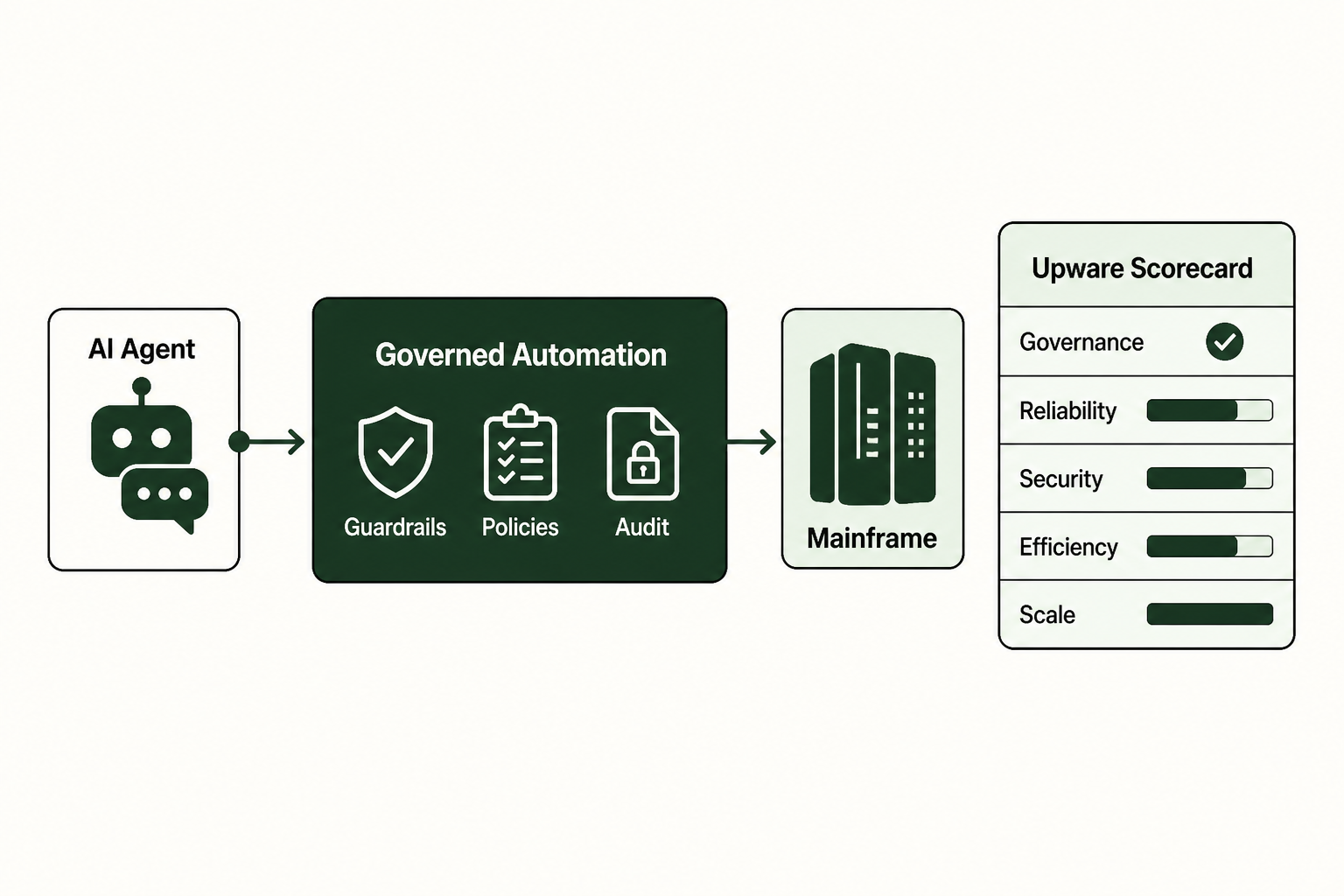
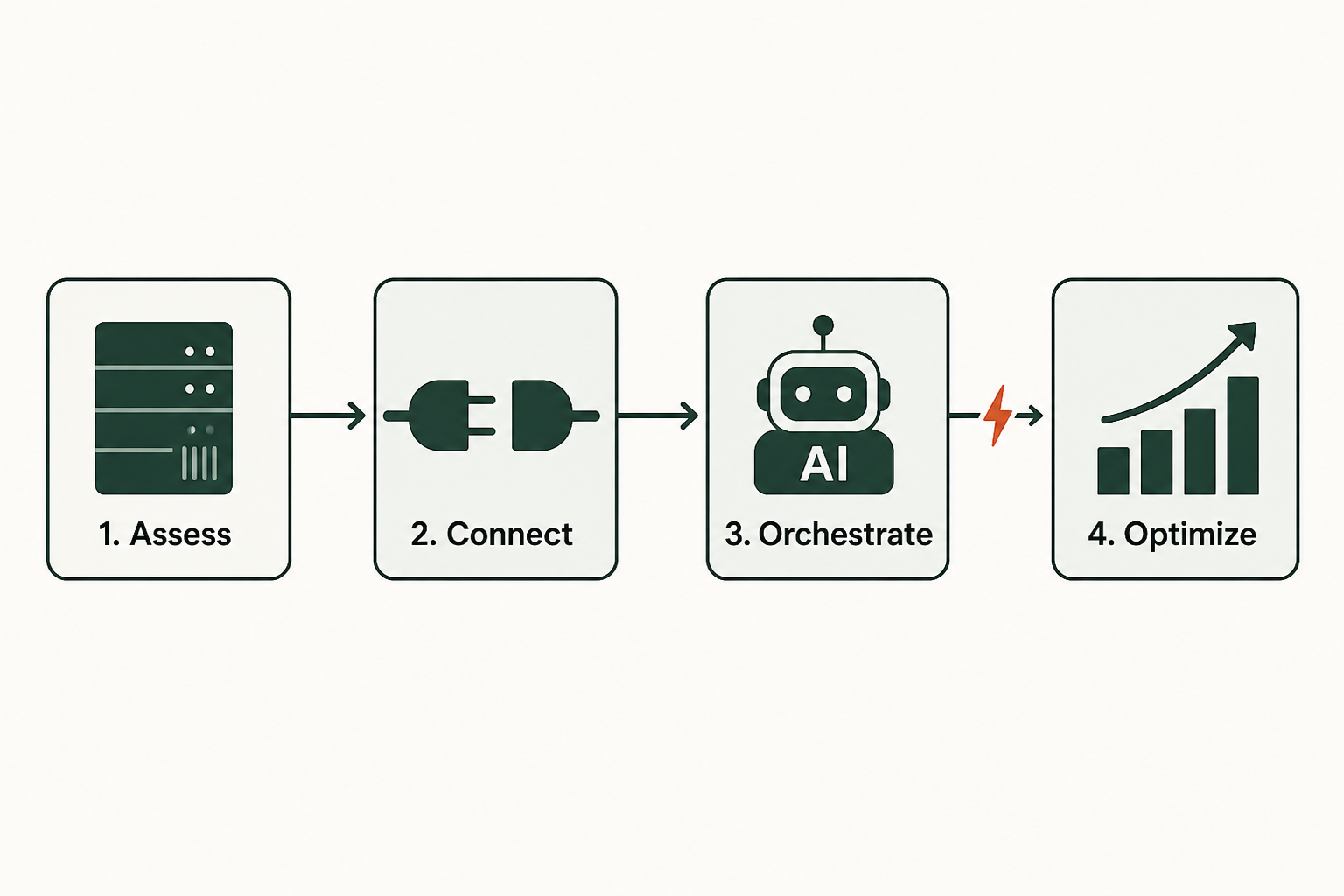
What the verdict is for agentic AI governance: 4.3/5
Score: 4.3 / 5. Upware addresses a real gap in enterprise AI: the execution layer between an agent's recommendation and a system-changing action. It is a disciplined product for controlled agent operations, not a universal AI platform.
A useful agent becomes a liability when it can change a record or trigger a workflow, then touch a system nobody can explain afterward. Effective agentic AI governance needs more than policy documents and dashboards. It needs a controlled runtime path that enforces rules and verifies actions while leaving an auditable record for agent-to-system interactions.
That is the right lens for this review: agents are the brain, the Agentic Harness is the hands. Upware is strongest where an enterprise already has useful AI agents or copilots, but cannot let them act broadly because approvals and policy checks, plus state tracking and recovery, still sit outside the execution path.
The market context supports that problem statement. Gartner places agentic AI at the Peak of Inflated Expectations, and its CIO and technology executive survey found that only 17% of organizations have deployed AI agents, while more than 60% expect to do so within two years, according to its 2026 agentic AI adoption analysis. That gap explains the product's value: enterprises are moving from pilots to governed execution, and pilots break when action control stays informal.
Overall scorecard
| Dimension | Score | Assessment |
|---|---|---|
| Governance fit | 4.6 / 5 | Strong fit for bounded, auditable agent actions across enterprise systems. |
| Execution control | 4.5 / 5 | Designed around deterministic workflows with policy enforcement and verification, plus recovery. |
| Enterprise readiness | 4.3 / 5 | Best suited to regulated or complex environments with consequential workflows. |
| Pricing clarity | 3.4 / 5 | Public dollar pricing is not listed, so procurement needs a direct quote. |
| Time to value | 4.6 / 5 | The stated deployment claim is deployment in days with zero engineering resources. |
The verdict is favorable, with one condition: the buyer must want operational governance for agent actions, not a broad model governance suite or a general agent-building workbench.
What is the Agentic Harness?
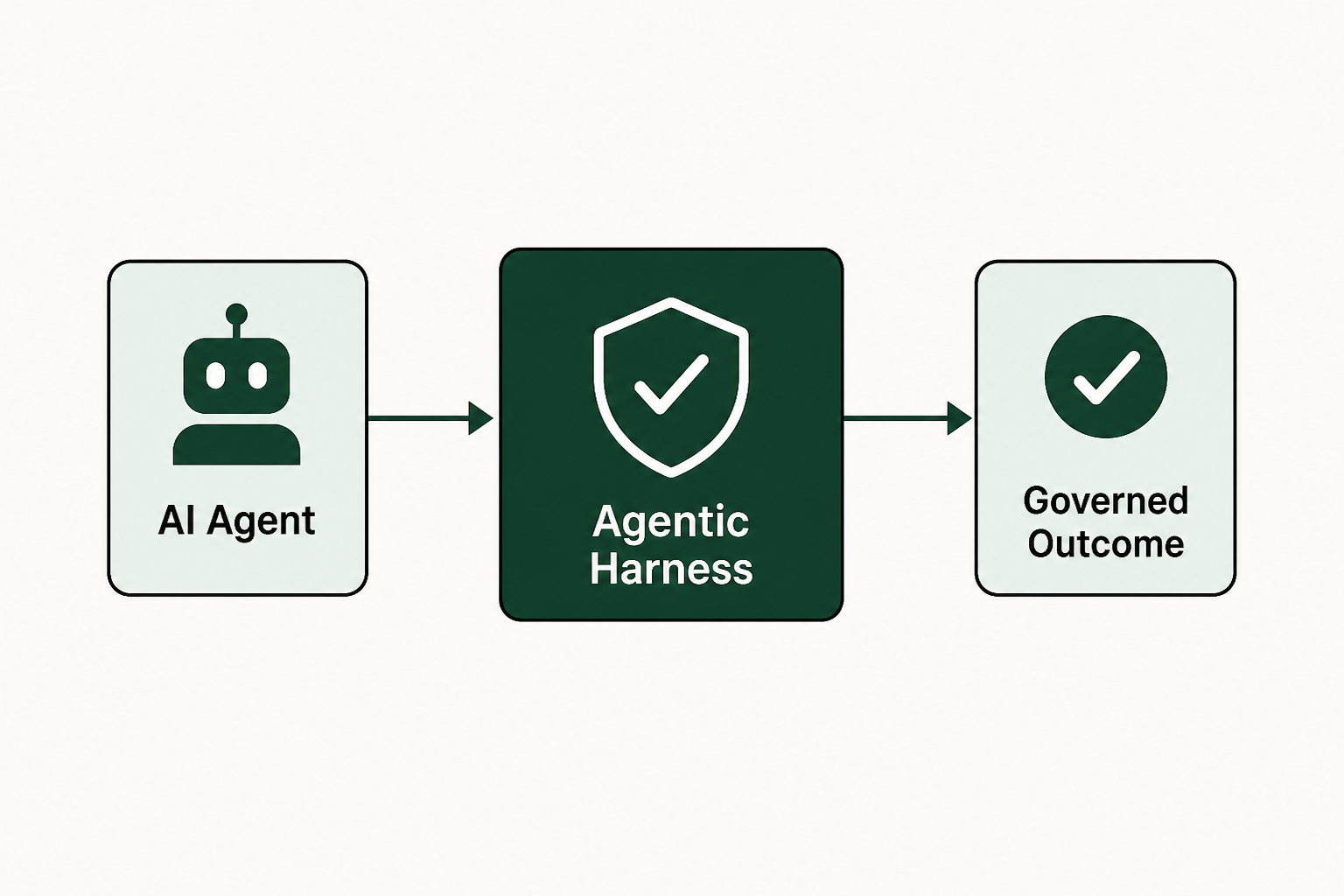
The score only makes sense once the core concept is clear. An Agentic Harness is the operating layer that sits between an AI agent and the enterprise systems it wants to change. In plain English, the agent decides what should happen, but the Agentic Harness controls whether and how that action is carried out.
That distinction matters because older AI governance frameworks were not written for agents that call tools and handle credentials while they interact with external services and change system state. The Cloud Security Alliance notes that the NIST AI Risk Management Framework 1.0 was introduced in January 2023, before agentic architectures became a mainstream deployment pattern, while NIST's NCCoE concept paper on software and AI agent identity and authorization, released in February 2026, addressed core deployment issues in agent identity and authorization. Runtime control is the operational layer that older governance models tend to under-specify.
Upware's category is easier to understand beside a standard AI agent governance guide: governance defines what should be allowed, while governed execution makes permitted work happen in a controlled way. The platform's Agentic Harness exists for that second job.
Conversational agent platforms and agent engineering frameworks do well at helping teams build and orchestrate agents. What they often leave unresolved is the controlled execution path between an agent's intention and a system-level change. Upware centers on the governed execution layer between agents and enterprise systems, where policy and verification, along with state and auditability, decide whether work proceeds.
 What is the Agentic Harness?
Core capabilities: the governed execution layer in action
With that framing in place, the product is best read as an execution layer, not a chatbot wrapper. Its value sits in the path between agent reasoning and operational change, especially when a task reaches across legacy or no-API systems as well as internal portals and regulated workflows.
Policy enforcement & deterministic workflows
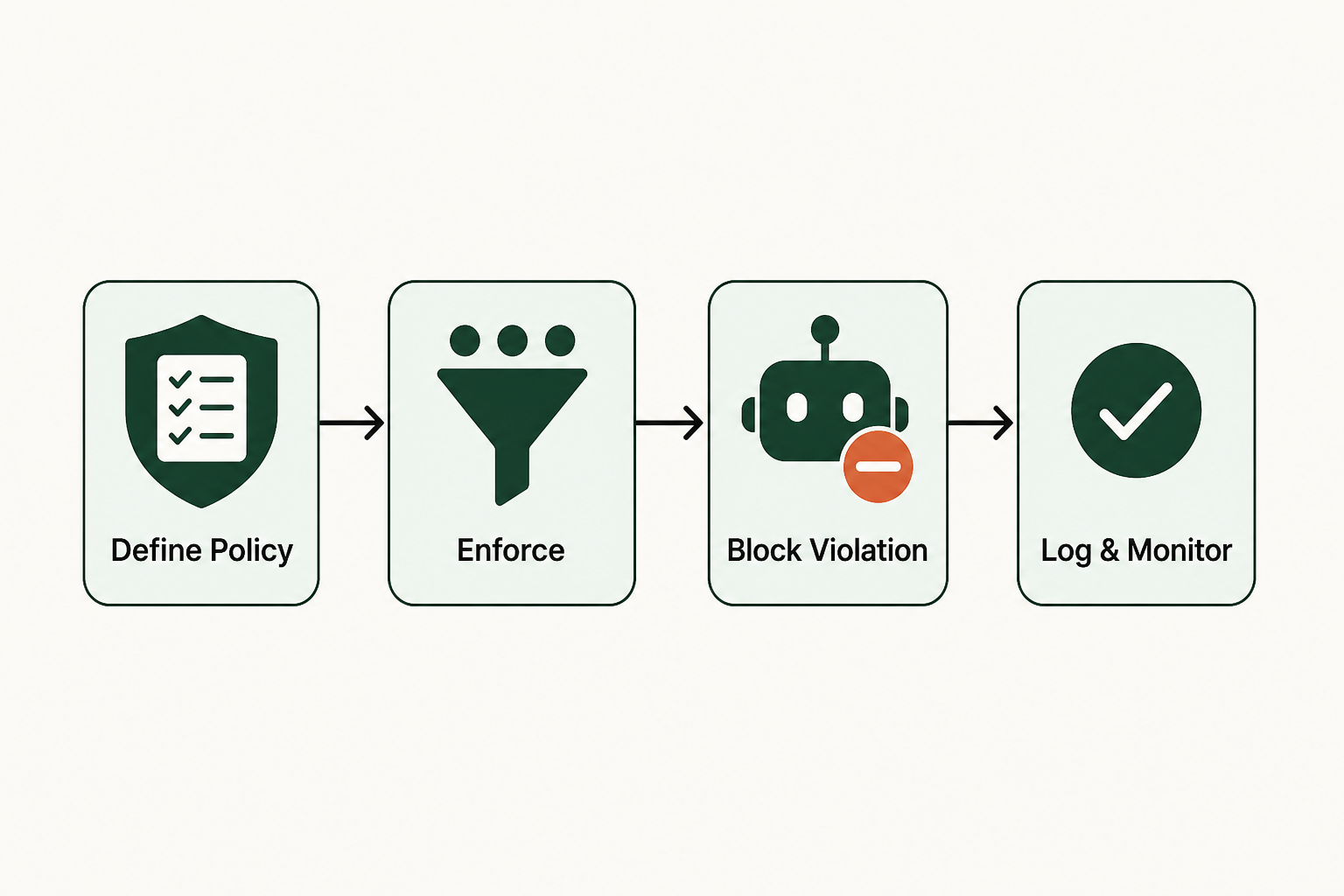
Policy enforcement is the first test. A prompt can tell an agent what not to do, but governed execution needs the action path itself to reject work that violates policy. That is why deterministic workflows matter: they turn high-risk actions into bounded steps with known inputs and checkpoints, with approvals and allowed outcomes.
The broader research direction supports this design. In the Aegis architecture, policy-violating actions are operationally non-executable and logged; specified breach conditions can trigger shutdown, creating auditable proof artifacts. Upware applies the same operational principle to enterprise work: do not leave a consequential action as a model preference if it can be enforced in the runtime path.
For a CIO or CAIO, that changes the approval conversation. The question moves from "Do we trust the agent?" to "Can the execution layer enforce what the agent is allowed to do?" That is a more durable control model.
Action verification & state management
Verification is the second test. An agent can produce a plausible plan, but enterprise systems often contain messy state. That can mean half-updated records and delayed confirmations, or it can mean stale screens, failed API calls, and legacy interfaces that do not report success clearly. The governed execution layer has to check whether reality matches the planned action before continuing.
The controlled trial performance data for Aegis reported median proof verification latency of 238 ms, median publication overhead of approximately 9.4 ms, and higher alignment retention than a baseline condition across matched tasks. That is not a benchmark for Upware, but it is useful external evidence that proof-oriented runtime controls can be measured and evaluated rather than treated as abstract policy language.
Upware's fit is strongest when the enterprise cares about those runtime facts. Did the agent call the right system? Was the action allowed? Was the expected state reached? If not, what recovery path triggered? Those are operational questions, and they belong inside governed execution.
For enterprises formalizing this record, the related discipline of building an AI agent audit trail becomes part of production readiness rather than a compliance afterthought.
Auditability and recovery
Auditability is the third test, and it is where many pilots struggle. Logging token usage and latency may help engineering teams tune a system, but it does not prove what an agent saw and decided, plus the calls, verification steps, and changes that followed. A useful audit record has to follow the decision chain through the execution path.
The Aegis paper's "Genesis Lock" concept, which ties hardware identity to a signed policy layer and a founding authority public key inside a trust root, shows how formal runtime controls can be bound to proof artifacts. Enterprise buyers do not need that exact architecture to see the point: for agentic ai governance, policy must be tied to execution evidence.
That is where Upware's governed execution layer is most persuasive. It treats audit and recovery as part of how work runs, rather than as a report generated after a failure. When an action cannot be verified, the system should pause or recover, with escalation according to policy. That is the difference between observability and control.
Pricing
Once the operating model is clear, cost becomes the harder question. Public dollar pricing is not listed, so this review cannot give a per-seat or per-agent price, a per-action rate, or an annual contract figure. That lack of list pricing is a weakness for buyers who need an early budget number before a vendor conversation, but it is also common for enterprise software sold around system scope and workflow risk, compliance needs, and deployment complexity.
The available vendor claims are operational rather than sticker-price based: deployment in days and zero engineering resources, alongside up to 80% lower token costs and 100% predictability in runtime. Those numbers matter because agentic AI programs often spend money on engineering work to connect systems and model usage during repeated reasoning. Control work added after a pilot fails review is another common cost.
| Pricing item | What is available |
|---|---|
| Public monthly price | Not published |
| Public per-seat price | Not published |
| Public per-action price | Not published |
| Deployment effort signal | Deployment in days |
| Engineering requirement signal | 0 engineering resources |
| Cost discipline signal | Up to 80% lower token costs |
| Runtime predictability signal | 100% predictability in runtime |
A buyer should treat pricing diligence as part of the evaluation, not a final procurement step. The practical questions are:
- For workflows in scope, pricing should be evaluated against the number and risk level of agent actions, not only the number of users.
- For systems that need controlled access, legacy systems and no-API systems can change deployment scope materially.
- For required approvals, human review and compliance evidence can shape the implementation plan, as can recovery handling.
- For a credible cost baseline, the "up to 80% lower token costs" claim needs comparison against the buyer's current agent design and model routing, plus retry behavior.
The pricing verdict is mixed. Upware has strong cost-disciplined operating claims, but the lack of public dollar pricing means serious buyers need a scoped quote before they can compare total cost.
Pros and cons
Those pricing limits do not erase the product's appeal, but they do sharpen the trade-off. Upware makes the most sense when an enterprise needs predictable agent execution across consequential workflows. It makes far less sense when the buyer wants a simple self-serve tool or a broad governance checklist.
Pros
- The Agentic Harness is built around policy-bound execution and verification. It also covers state management and recovery, plus audit, which is the right operating model for high-consequence actions. The stated deployment claim is deployment in days with zero engineering resources, which directly addresses the integration bottleneck that stalls many AI-agent pilots.
- The claim of up to 80% lower token costs gives procurement and AI leadership a concrete efficiency metric to test during evaluation.
- The 100% predictability in runtime claim is strong, and it fits the product's emphasis on deterministic workflows rather than open-ended model behavior.
Cons
- Without public dollar figures, teams need a scoped conversation before they can compare contract cost.
- Buyers looking for broad AI inventory, model lifecycle controls, or ethics program management need to separate those needs from agent execution governance.
- A small team automating simple internal tasks is unlikely to need this level of control, audit, and recovery design.
- Runtime predictability and cost reduction should be tested against the buyer's own systems and workflows, as should deployment effort.
 Pros and cons
Who should use it, and who should skip it
The ideal buyer follows directly from those trade-offs. Upware fits a CIO, CAIO, Head of AI, enterprise architect, or security leader accountable for moving agents from recommendations into live system actions. The organization usually has 1,000 or more employees and complex enterprise systems, with a security or compliance review that asks how an agent is authorized, constrained, audited, and recovered.
The OWASP GenAI LLM Top 10 2026 was released on August 3, and OWASP's agentic AI security and governance work emphasizes inventorying deployed and planned agents, including tool and data access as well as authorization patterns and external interactions, as part of agentic AI security and governance. That is the environment where this kind of platform makes sense: the organization already knows that untracked agent access is not acceptable.
Use it if the agent touches regulated or mission-critical workflows, especially hard-to-integrate ones, where control and audit matter. Skip it if the work is low-risk, if the team only needs a prototype, or if the main problem is model development governance rather than operational execution.
The next step is practical, not philosophical. Pick one consequential workflow; define the permitted actions and map the systems involved; then test whether governed execution can make the agent safe enough to operate.
Implement agentic AI governance. Start your secure future now.
Ready to enhance your enterprise's agentic AI governance?
Discover Upware's capabilities, or connect with our team for a personalized walkthrough.
Frequently asked questions
What is the main benefit of using an Agentic Harness like this?
The main benefit is controlled execution. An Agentic Harness lets an enterprise separate agent reasoning from system-changing work, so actions can run through deterministic workflows, policy checks, verification, recovery, and audit. That matters when an agent is allowed to act inside enterprise systems rather than only recommend what a human should do next.
How is this different from other AI governance or agent-building tools?
Most AI governance programs define rules and document risks while tracking systems. Agent-building tools help teams create agents and connect them to tasks. This product category focuses on the execution layer between the agent and the systems being changed, so governance is enforced while work runs. That is the difference between policy documentation and governed execution.
How long does it take to deploy and see results?
The stated deployment claim is deployment in days. That should not be read as no setup or no planning, because a serious enterprise still needs workflow scoping and policy definition, plus approval paths. The useful benchmark is that the platform is positioned to avoid a long custom engineering build, with a stated requirement of zero engineering resources.
Is this solution suitable for any size of company?
No. It is aimed at midsize-to-large enterprises, especially those with regulated or mission-critical systems, including legacy or no-API systems where agents need controlled access. A small business running low-risk internal automation is unlikely to need this level of audit and deterministic workflows, plus recovery control.