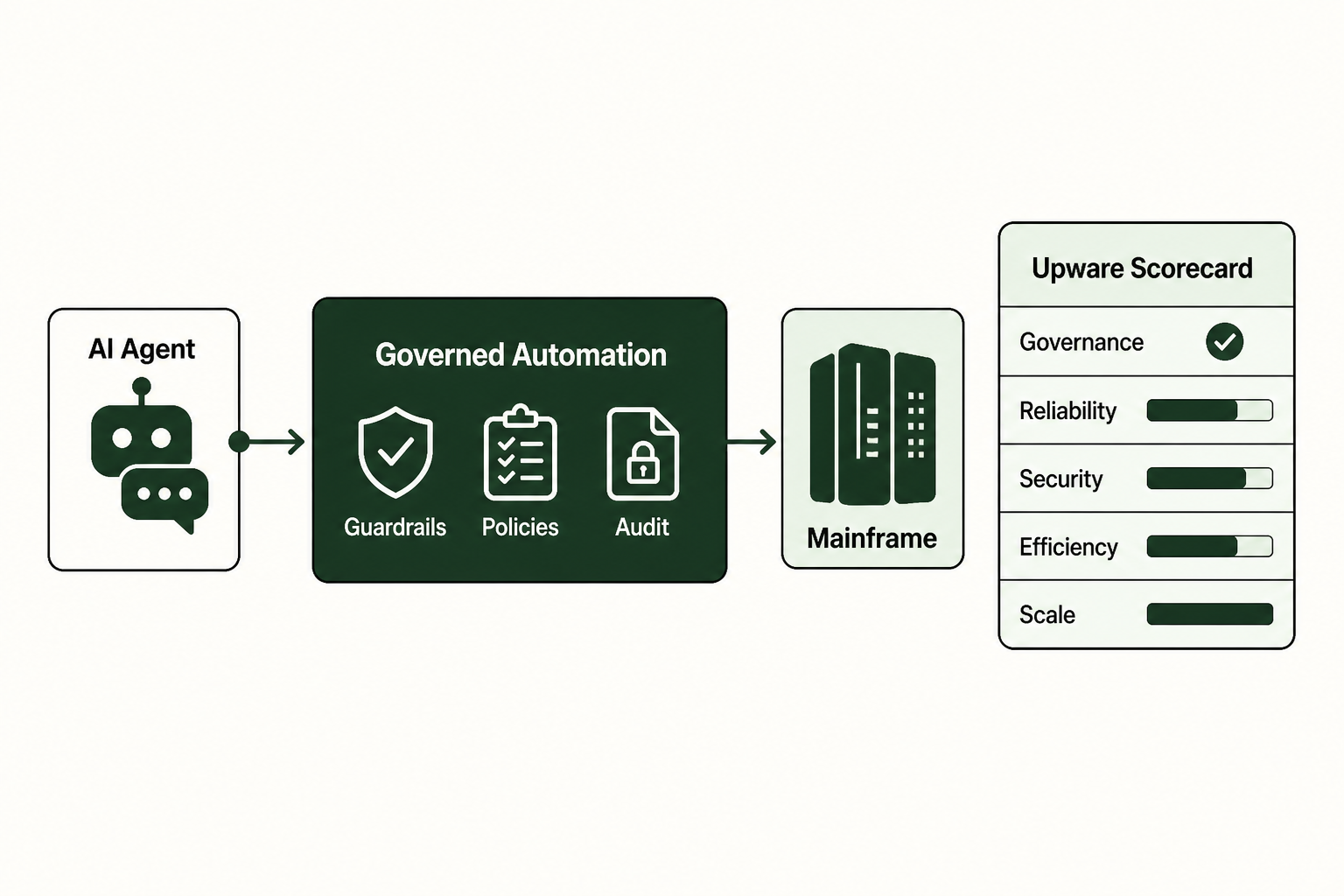
Verdict: 4.3 / 5. If an agent can update a customer record, trigger a refund, change a policy field, or email a regulated report, prompt instructions are too weak to carry the control burden. An effective AI governance policy for agentic actions defines the rules, owners, approvals, and audit evidence required for secure, compliant operation. Upware earns its score because it treats agents as the brain and the Agentic Harness as the hands, putting governed execution between model decisions and enterprise systems. AI agents exhibit non-deterministic, path-dependent behavior that cannot be fully governed at design time, according to a paper published in 2026.
Upware review scorecard: agentic AI governance
Getting an agent to recommend a next step is the easy part. The harder operational question is whether the enterprise can prove what the agent saw, what it called, why it acted, and whether the resulting system change stayed inside policy. That distinction matters because AI agents produce non-deterministic, path-dependent behavior, which is a poor fit for high-consequence enterprise changes unless a controlled execution layer sits underneath the agent. This behavior is described in a 2026 paper.
Overall score: 4.3 / 5
| Evaluation dimension | Score | Review view |
|---|---|---|
| Governance and control | 4.8 / 5 | Strong fit for policy-bound actions where the agent should not directly change systems. |
| Auditability and compliance | 4.5 / 5 | Strong emphasis on traceable execution, approvals, and evidence. |
| Enterprise system fit | 4.3 / 5 | Most relevant where agents must act across enterprise systems, legacy systems, or no-API systems. |
| Pricing clarity | 3.5 / 5 | Cost discipline is a strength, but public tier detail is limited. |
| Ease of adoption | 4.4 / 5 | Deployment in days (verified claim) and 0 engineering resources are meaningful claims for teams stuck between pilots and production. |
Governance and control: 4.8 / 5
The governance score is high because the product does not ask enterprises to give an open-ended agent direct write access and hope the prompt holds. Its premise is tighter: deterministic workflows carry the action, while the agent supplies intent and context, with judgment constrained by policy boundaries. That maps well to the concern large enterprises keep raising. In a 2026 KPMG survey cited in the agent governance literature, 75% of large-enterprise leaders named security, compliance, and auditability as the most critical requirements for agent deployment.
Auditability and compliance: 4.5 / 5
The audit score is slightly lower than governance because buyers still need to test the quality of evidence against their own control environment. The direction is right, though. Runtime predictability, verification checkpoints, and a record of agent-to-system actions are the controls an AI governance policy needs when agents move from advice into execution.
Upware pricing
After the scorecard, pricing becomes the next practical constraint. The available pricing picture is clear in one respect and incomplete in another: the verified pricing-related claim is up to 80% lower token costs (verified claim), while public per-seat rates, tier names, minimum commitments, and usage bands are not stated in the available product evidence. That makes the buying motion look more like enterprise quoting than self-serve software checkout.
| Pricing item | Verified detail | What it means for evaluation |
|---|---|---|
| Token cost impact | Up to 80% lower token costs | The platform's cost argument centers on controlled execution and reduced agent back-and-forth rather than only cheaper model calls. |
| Deployment cost | 0 engineering resources | The claim is strongest for teams that cannot assign platform engineers to every agent-to-system connection. |
| Time to deployment | Deployment in days | Useful for pilots blocked by governance review, but buyers should still account for policy definition, approvals, and testing. |
| Tier detail | Not publicly specified in the verified evidence | Procurement should ask for pricing by workflow, system coverage, volume, support, and audit retention. |
For a bottom-funnel buyer, the sharper pricing question is not whether the tool is cheap. It is what cost the organization accepts when agents act without a governed execution path. Token cost matters, but it is only one line item. The larger exposure comes from slow reviews, duplicate engineering work, manual exceptions, incident reconstruction, and pilots that stall before production because nobody can approve the operating model.
A practical pricing review should ask for four concrete items:
- Workflow scope, including how many agentic actions and enterprise systems are covered.
- Audit retention, including how long execution records are stored and how they can be exported.
- Approval routing, including whether high-consequence actions can require human review.
- Cost model, including how the up to 80% lower token costs claim is calculated for the buyer's own workflows.
Pros and cons
Once cost is framed around execution risk, the benefits and limits become easier to judge. Upware is strongest where an enterprise already has agent prototypes, a known governance gap, and production workflows that cannot rely on prompt instructions alone.
 Pros and cons
Pros
- Governed execution by design, because agent actions are mediated through deterministic workflows instead of being left to a model's runtime choices.
- Runtime predictability, with a verified claim of 100% predictability in runtime for the execution path.
- Lower engineering dependency, with a verified claim of 0 engineering resources, which is valuable when every agent pilot otherwise needs a custom integration project. Faster production path, with a verified claim of deployment in days, assuming target workflows are defined and policies and approvals are already set. Cost discipline, supported by the verified claim of up to 80% lower token costs.
Cons
- Limited public pricing detail, so serious evaluation requires a quote and a workflow-specific cost model.
- Best fit is enterprise-scale, not small teams looking for a lightweight agent builder.
- Policy work still matters, because governed execution cannot replace executive ownership, risk classification, approval rules, or incident handling.
- Not broad model governance, since the product is aimed at agent-to-system execution rather than every aspect of AI lifecycle management.
Core feature: the Agentic Harness and governed execution layer
The pros and cons point to the same underlying design choice: Upware is focused on the moment when an agent's recommendation becomes a system action. The Agentic Harness is the controlled operating layer between an AI agent and the systems it wants to change. In plain English, the agent decides what should happen, but the execution layer decides the allowed path. It also checks whether verification is needed and records audit evidence.
That is the useful distinction for AI agent governance. Agent governance should not stop at model review or prompt policy, and monitoring dashboards are not enough either. It needs a mechanism that turns an intended action into a bounded, recoverable process. Governed execution gives that mechanism a place to live: the workflow, rather than the model, controls how enterprise systems are changed.
deterministic workflows as a control plane
Deterministic workflows are the control plane for consequential actions. Instead of allowing an agent to improvise every step at runtime, a governed path defines allowed actions, required inputs, approval points, verification checks, and failure handling. The verified runtime claim is 100% predictability in runtime, which does not mean every AI judgment is risk-free. It means the execution path can be made predictable once the action enters the controlled workflow.
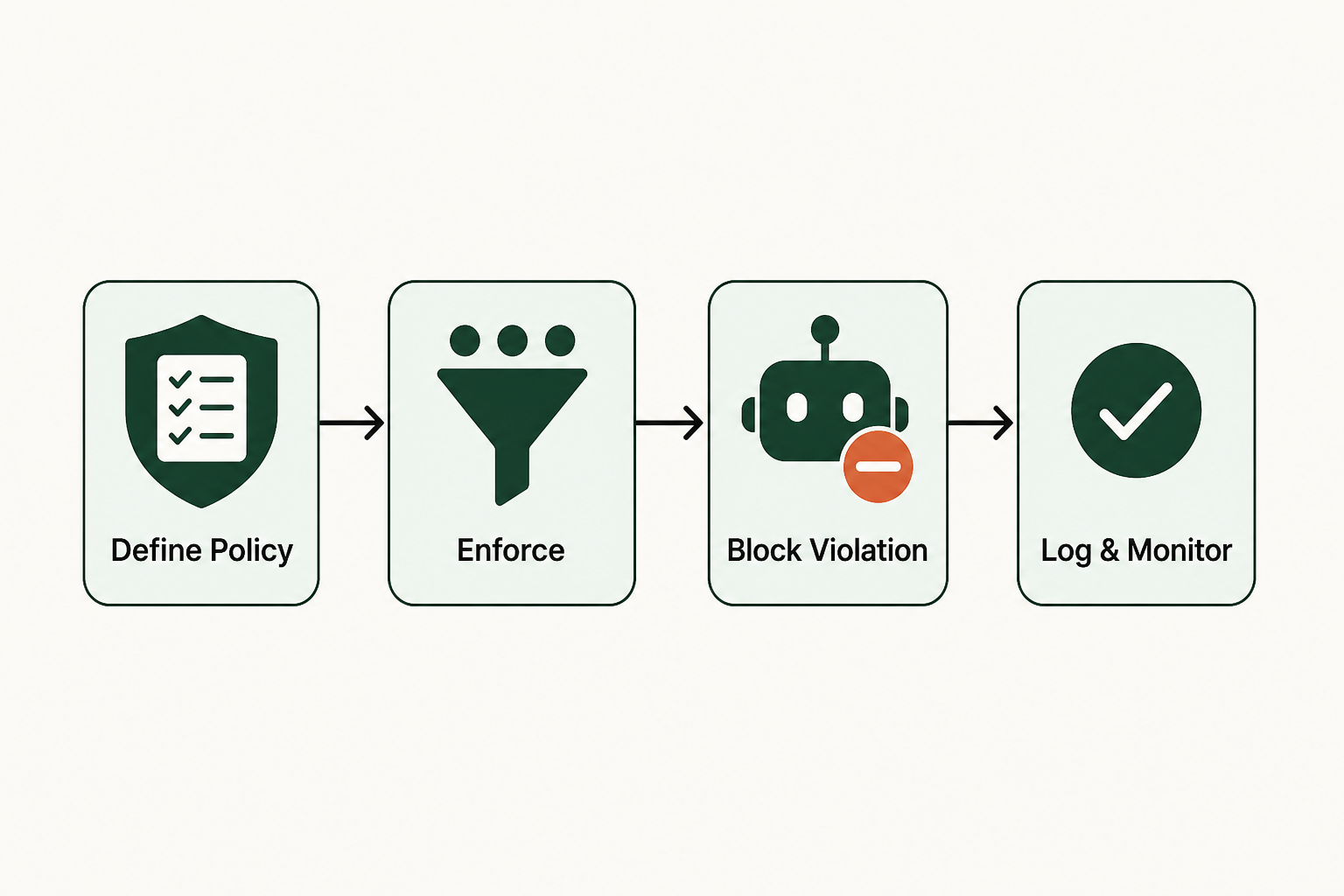
The governance problem for agents is fundamentally different from ordinary software control because agents make autonomous decisions at runtime, each with compliance implications. An agent can make a chain of autonomous choices, each with its own compliance implications, while interacting with tools and databases as well as external services. A practical AI governance policy therefore needs to separate judgment from execution: the model can propose or select a permitted action, but deterministic workflows carry out the change in a controlled way.
Bridging agents and enterprise systems
Conversational agent platforms and agent engineering frameworks are good at building and orchestrating agents. They help teams define agent behavior and connect tools, then use those connections to experiment with task automation. What they leave unresolved is the governed execution layer between agents and enterprise systems, especially when the target environment includes legacy systems, no-API systems, approval-heavy processes, or regulated write actions. Upware centers on that governed execution layer instead, using the Agentic Harness to mediate agent-to-system work through policy enforcement, verification, state management, and recovery.
That approach does not make the agent less useful. It makes the action more governable. The governed execution works because the Agentic Harness gives the enterprise a consistent place to apply policy, preserve context, and control system changes without rebuilding every backend workflow.
That control is especially relevant where older AI risk categories do not fully cover the operating reality. Agentic systems introduce system-level risks such as unintended actions, prompt injection attacks, privilege escalation, multi-agent communication manipulation, and rapid harm propagation at a speed human reviewers cannot monitor action by action. An execution layer gives the policy somewhere to operate.
Auditability and compliance controls
With the control mechanism established, auditability becomes the next test. For enterprise buyers, auditability is not a dashboard count of tokens and latency or a count of successful calls. It is the ability to reconstruct a consequential action: what instruction was given, what data was used, what systems were touched, what policy checks ran, who approved an exception, and how the workflow recovered if the real-world state differed from the plan.
NIST activity around agent identity and authorization, specifically the NCCoE concept paper released in February 2026, points to the same pressure point: agents need concrete authorization models, not vague trust in a tool account. That is why an AI governance policy for agentic actions should define identity, authority, scope, escalation, and revocation at the action level, then require execution records that an auditor can actually read.
The product's fit is strongest when auditability is tied to workflow evidence. A useful AI agent audit trail should connect the decision chain to the execution chain, because a model transcript without system state is thin evidence, and a system log without agent reasoning is incomplete. The Agentic Harness approach is valuable because it links the brain's intent to the hands' controlled action.
External policy examples show why this level of specificity matters. The University of Southern California's generative AI policy, last revised on September 1, 2026, sets requirements for approved AI tool use and calls out institutional data handling as a major risk, including limits on using data to train or improve third-party models unless expressly authorized through an approved agreement and review process. That kind of rule cannot live only in a policy PDF. It has to be enforced where data and actions meet.
For compliance teams, the strongest review criteria are concrete:
- Action evidence, showing what the agent attempted and what the system actually changed.
- Policy enforcement, proving which rule allowed, blocked, or escalated the action.
- Human approval, capturing who reviewed high-consequence steps and when.
- Failure recovery, recording how the workflow handled missing data, conflicting state, or rejected actions.
Who is Upware for (and who should skip it)
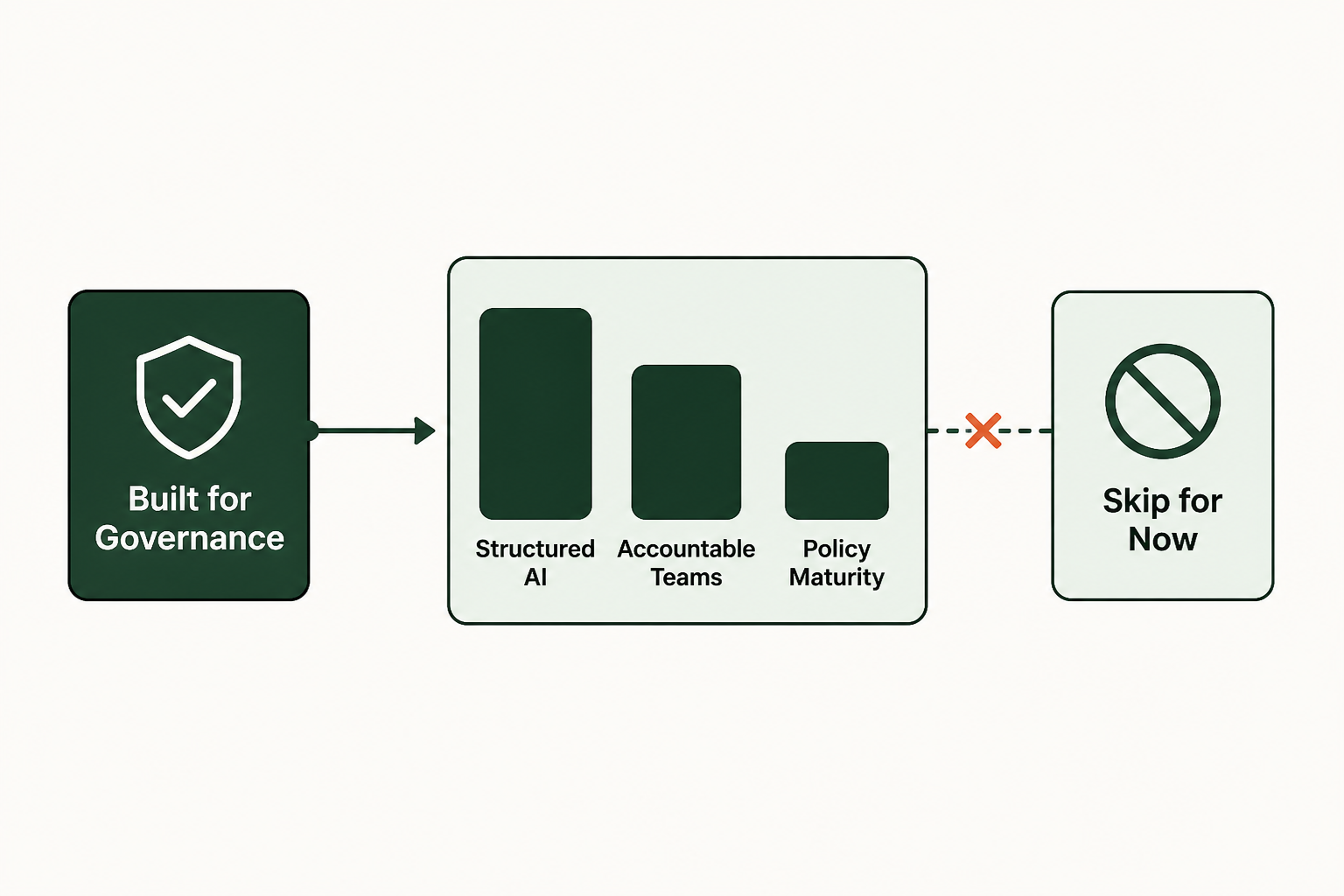
With the control and audit case in view, fit comes down to operating risk. Upware is for CIOs, CAIOs, Heads of AI, enterprise architects, and security leaders who already believe agents can help but cannot approve broader deployment until action control and auditability are solved, along with failure handling. It is especially relevant in regulated or complex-system environments where a useful agent still needs bounded access to enterprise systems.
The platform is a strong fit if the organization has moved past experimentation and into production questions:
- Agents need to write to systems, not merely answer questions or summarize documents.
- Security and compliance teams require proof, not only monitoring metrics.
- Legacy systems or no-API systems are in scope, making normal integration work slow or brittle.
- Human approval must stay in the loop, but only for high-consequence actions rather than every routine step.
- Pilots are stalled, because business owners cannot agree on permitted actions and escalation rules, or on recovery paths.
Teams should skip it if they are looking for a general chatbot builder, a broad AI ethics program, or legal advice on AI regulation. It is also the wrong first purchase for a small company with simple SaaS workflows and no meaningful agent execution risk. The value appears when agents need governed execution across real enterprise systems, where the cost of an unexplained action is higher than the cost of adding a controlled execution layer.
 Who is Upware for (and who should skip it)
The honest trade-off is simple: an Agentic Harness adds structure, and structure requires policy decisions before scale. For enterprises trying to move agents from recommendations to controlled action, that constraint is the point.
Implement robust AI governance now. Contact us.
Ready to implement your AI governance policy?
Discover solutions that fit your team's needs for secure and compliant AI.
Frequently asked questions
What is the main benefit of using an Agentic Harness?
The main benefit is predictable execution for agentic actions. The Agentic Harness places governed execution between the agent and enterprise systems, so the model does not directly improvise every consequential step. That gives teams a clearer way to enforce policy, verify actions, and produce audit evidence while still letting agents help with complex work.
How do I get started with implementing an AI governance policy using Upware?
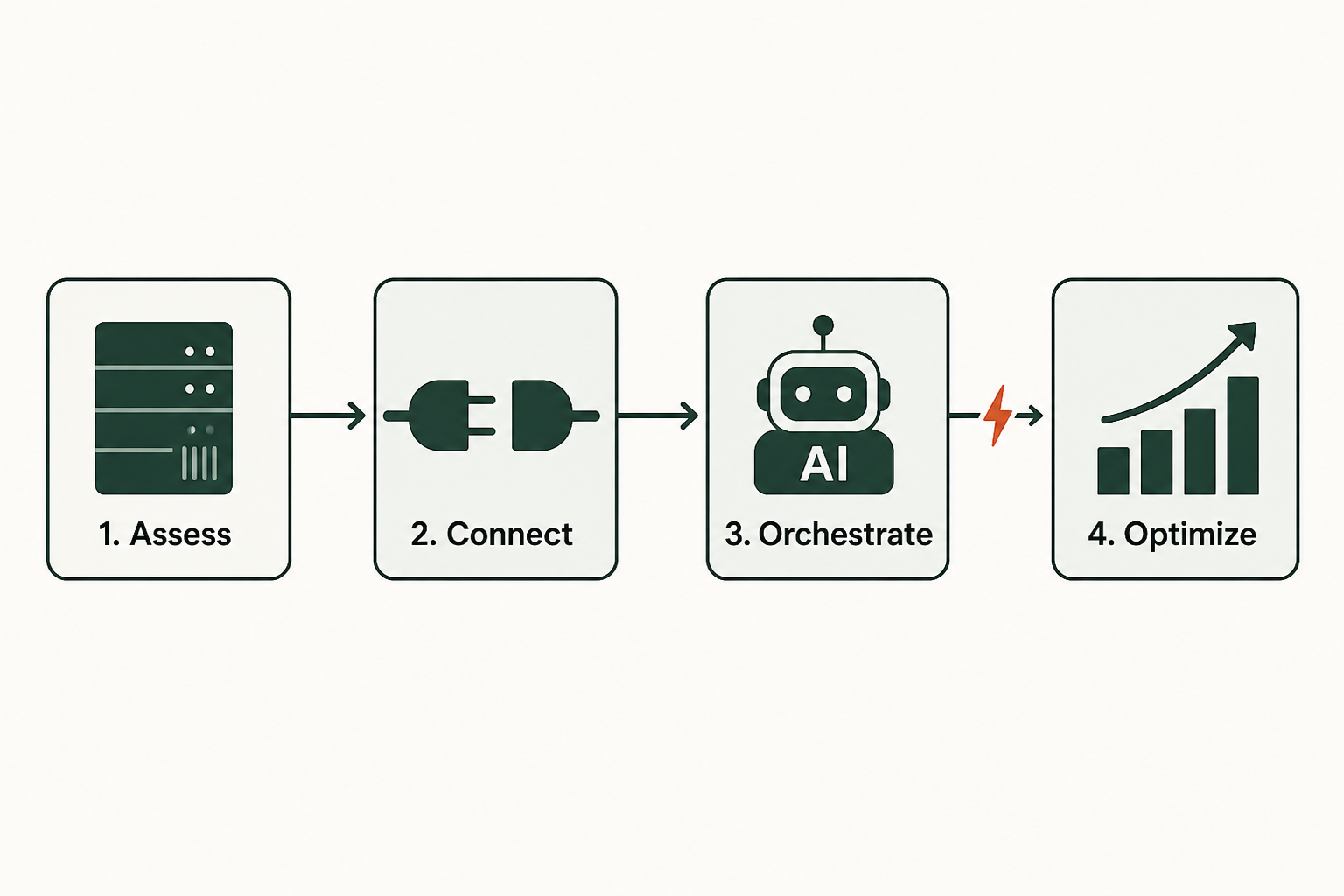
Start by choosing one high-value workflow where an agent needs to take bounded action, then define the permitted actions, required approvals, system access, failure rules, and audit evidence. Upware is most useful once those decisions are ready to be encoded into governed execution. The verified deployment claim is deployment in days, but the policy choices still need executive and control-owner agreement.
How long does it take to see results from governed execution?
The verified deployment claim is deployment in days, so teams can often see operational results faster than they would with a custom engineering build. The timeline depends on workflow complexity, system access, approval design, and audit requirements. A narrow, well-defined action should move faster than a cross-department process with many exception paths.
What are the most common mistakes to avoid when deploying agentic AI?
The biggest mistake is treating agent behavior like ordinary software behavior. Agents make runtime decisions that can create compliance implications across a chain of actions, so prompts and model logs are not enough. Teams should avoid broad tool access, unclear authorization, missing approval rules, weak audit trails, and unmanaged write actions in enterprise systems.